
Originally published on https://sayerji.substack.com
Why BIOSTEM is grown inside twelve colors and deliberate sound — and why beauty is a production standard, not a garnish
Story at a glance
No production environment is silent or dark. Every botanical on Earth grows inside a field of vibration and light — almost always an accidental one. Ours is composed.
Plants demonstrably read their environments: photoreceptors decide germination and growth architecture, and specific vibrations trigger defense chemistry — and even unlock pollen.
BIOSTEM pairs plant meristem cells — undifferentiated, maximally responsive tissue — with living Chaga mycelium, cultivated start to finish under twelve colors spanning light’s full octave and harmonically related sound.
Whether water carries more than chemistry out of that field is an open question. We say so plainly — and we grow as if it does.
What the field does to the molecules is measurable, and we are measuring it: composed-field batches versus standard cultivation, read by full-spectrum metabolomics.
Beauty, in energetic terms, is coherence: high signal, low noise, tended by human intention.
Something happens every time I describe how BIOSTEM is grown. I watched it happen over and over at SproutsCon. I explain that we cultivate young plant stem cells together with Chaga mushroom mycelium under all twelve colors of the visible spectrum, bathed in deliberate sound throughout the entire growth cycle — and people begin to smile. Not politely. Involuntarily. Something in them recognizes the idea before the intellect has finished evaluating it.

I want to explain what I believe they are recognizing. And I want to do it the way this industry too rarely does: by telling you exactly which parts are settled science, which parts are measurement in progress, and which parts are conviction I hold with open hands. You deserve to know which is which. Most labels never tell you.
The environment is never neutral
Begin with a fact that sounds mystical and is actually mundane: there is no such thing as a silent production environment.
Walk into any facility where supplements are made and simply listen. The sixty-cycle hum of mains electricity. Compressors kicking on and off. Motors, mixers, grinders, HVAC, the flicker-buzz of fluorescent ballasts, steel striking steel. Every one of those is a vibration, and vibration acts on matter.
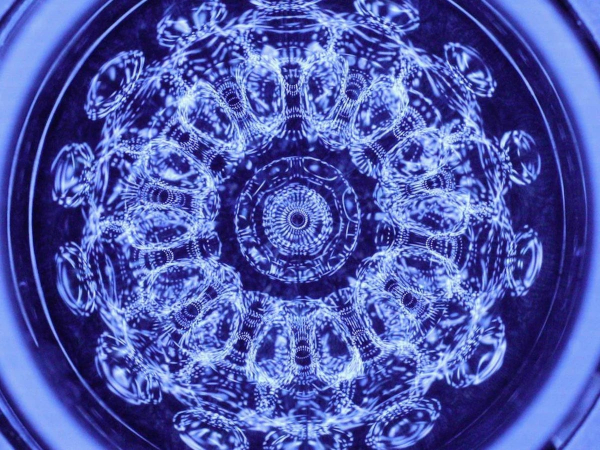
This is not a metaphor. In 1787, Ernst Chladni drew a violin bow across a metal plate dusted with sand and watched sound organize the grains into geometry. The Swiss physician Hans Jenny spent decades photographing what frequencies do to liquids, pastes, and powders, and gave the field its name: cymatics. Today, John Stuart Reid’s CymaScope renders tones as figures on the surface of water — and every tone draws a different figure. While sound is sounding, matter is being shaped.
So the question was never whether the botanicals in your supplement spent their entire becoming inside a field of vibration and light. They did. Every living thing does. The only question is: did anyone compose it?
Almost everywhere in this industry, the honest answer is no. The field is an accident — the arbitrary, dissonant, unchosen frequency-scape of industrial production, played continuously over living matter through every hour of its formation. Not out of malice. Out of deafness. No one was listening, so no one thought to ask what the machinery was saying.
We decided to listen. And then we decided to compose.
Plants are instruments
If “the field shapes the plant” sounds like poetry, consider how much of it is already sitting in the peer-reviewed literature, waiting to be read as a single sentence.
Plants read color — literally, as an instruction set. Phytochrome receptors measure the ratio of red to far-red light, and on that measurement a seed decides whether to germinate at all: whether to be born. Cryptochromes read blue light and direct the architecture of growth. A plant is a spectral instrument before it is anything else.
Plants read vibration. When Heidi Appel and Rex Cocroft played Arabidopsis the recorded vibration of a caterpillar chewing — vibration alone, no caterpillar within miles — the plants mounted chemical defenses against an enemy that wasn’t there. And if that still sounds exotic, walk into any commercial tomato greenhouse. Tomato and blueberry flowers hold their pollen locked inside the anthers and release it only when vibrated at the frequencies of a bumblebee’s buzz; growers keep electric pollination wands, or rent hives of bumblebees, for exactly this purpose. A specific frequency is, quite literally, the key that opens the flower. That is not fringe botany. That is Tuesday, in greenhouses on every continent.

The fungal kingdom has its own signal life. Andrew Adamatzky has recorded trains of electrical spikes propagating through mycelium with a structure he compares to language. Fritz-Albert Popp spent a career measuring the ultraweak light that living cells emit — biophotons — a real, replicated phenomenon whose meaning biology has not finished deciding. Light and sound are not decoration in nature. They are inputs.
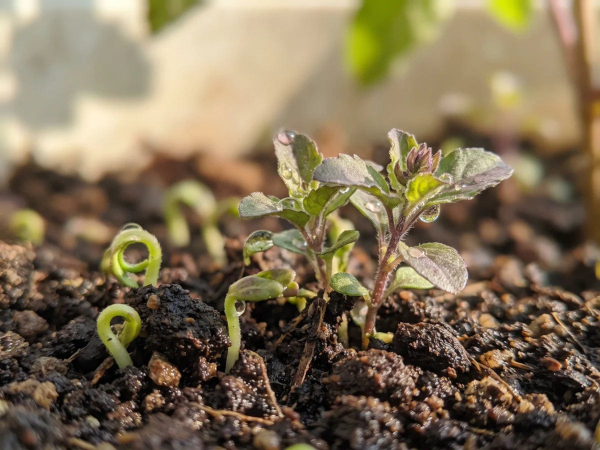
And at the center of BIOSTEM sit the cells most exquisitely tuned to input: meristematic cells, the undifferentiated tissue at a plant’s growing tip. They have not yet decided what to become. They are pure potential, listening for what to become. We pair them with Chaga in its living mycelial form, whose dense biomelanin is one of nature’s great broadband receivers of light and radiation — the same pigment family found in fungi flourishing inside Chernobyl’s ruined reactor rooms, thriving amid radiation that forbids almost everything else.
The question of what such a system hears during its formation is not mysticism. It is agronomy.
The open question of water
Here is the objection I respect most, because it takes the premise seriously: “Fine — but the finished product is dehydrated. Whatever the water experienced during cultivation is gone by the time it reaches the capsule.”
Half of that is simply wrong, and the other half deserves my candor.
The wrong half first: “dried” botanicals are never actually dry. Beneath the residual free moisture lies bound water — the structured hydration layers that cling to every protein, every polysaccharide, every mineral surface in the material. Food science has quantified this for generations under the term water activity: there is a monolayer of water so intimately married to biological molecules that ordinary drying cannot remove it. The medium, at least, never leaves the capsule.
Now the candor. Does that water carry anything beyond its chemistry — a pattern, a record of the field it formed inside? I do not know. No one does. The most precise measurements physics can make say that liquid water forgets its instantaneous structure in less than a trillionth of a second; water bound to biological surfaces holds its order longer, but “longer than a trillionth of a second” is not a shelf life, and I will not pretend to you that it is. The healing traditions of every continent said water receives, holds, and returns pattern. Our instruments, so far, cannot find it. Perhaps the traditions were speaking in metaphor. Perhaps the instruments are asking the wrong question. I hold the question with open hands.
What I can tell you is this: we cannot yet measure what, if anything, the water remembers — and we grow as if it remembers everything. Not because I can prove that wager to you, but because its cost is only a more beautiful factory, while the cost of the industry’s default wager — that the field means nothing — is a medicine formed, hour after hour, by noise nobody chose.

The field and the form
Now the deeper inversion, the one the new biology has been circling for a decade. The conventional model treats a plant as a bag of chemistries and treats its energetic life — its light responses, its electrical signaling, its vibratory sensitivity — as incidental exhaust. Read the evidence the other way around, and the picture becomes: the field organizes; the chemistry executes.
This is no longer a mystic’s claim. In Michael Levin’s laboratory at Tufts, flatworms regenerate with two heads — their genes untouched — because the bioelectric voltage pattern across their tissue was rewritten: the same genome, instructed by a different field, builds a different animal. Tadpoles grow functioning eyes far from their heads when the electrical state of ordinary cells is tuned to say eye here. I cite this for the principle, not as proof of my practice — Levin studies animal bioelectricity, not grow rooms. But the principle now stands in biology’s most careful journals: pattern instructs matter.
The chemistries remain essential. Let me be unambiguous about that: the ginsenosides, the beta-glucans, the melanins, the polyphenols are the vocabulary of the plant, and we obsess over them, milligram by milligram. But vocabulary is not the sentence. The molecules are arranged and expressed within the organizing conditions of the living system. Chemistry is essential — and secondary.
Beauty is coherence
So why beauty, specifically? Why does it matter that the field is composed with the intention of beauty, rather than merely composed?
Because beauty, translated into energetic terms, is coherence: the orderly, harmonic relation of parts to a whole. High signal, low noise.
Why twelve colors? Because light itself answers. From the deepest visible red to the farthest violet, the frequency of light almost exactly doubles — the entire visible spectrum is a single octave, the one octave our biology was built to receive. Divide that octave into twelve equal steps and you have done for color precisely what the chromatic scale did for sound. Twelve colors is not a light show. It is the full keyboard, where the industrial grow-bulb plays one cheap syllable.

The sound is chosen the same way: frequencies in harmonic relationship with one another, rather than the enharmonic collision of motors and mains hum. And it is delivered with intention, because the human beings tending a living process are not outside the field — they are part of it. Every wisdom tradition knew this. The farmer’s song was never entertainment.
We are not sprinkling aesthetics onto production. We are refusing to let the message be noise.
This is what I have meant, all these years, by sacred technology, and beauty as ontology not a merely subjectively held belief or a vibe — a process: defined, repeatable, and novel enough to be the subject of an issued United States patent. Let me be exact about what a patent certifies: that the process is real, new, and specified — not that it heals. Efficacy belongs to measurement, not to lawyers. Which brings me to the promise I most want to make you.
What formed it?
A composed field should leave fingerprints where anyone can read them: in the molecules. Controlled-environment agriculture already knows that light writes chemistry — ultraviolet raises a plant’s phenolic defenses, blue light deepens its anthocyanins — and growers tune spectra to tune compounds as a matter of routine. So we have committed to the experiment this essay owes you: the same genetics, on the same substrate, grown under two skies — our composed field and a standard industrial environment — with both batches read by untargeted metabolomics alongside the marker panel we already track milligram by milligram. If the field is real, it will be legible in the fingerprint. And the question this industry never thought to ask — what formed it? — will have a measured answer: the environment is in the molecules.
I choose my favorite word for all of this deliberately: the process re-minds. The finished formula carries the chemistry of its becoming — and, if the old traditions are right, something more, held in the water that never leaves, with mycelium serving as it always has: the great mediator between kingdoms, translating the intelligence of one into a form the other can receive.
By molecule count, roughly ninety-nine of every hundred molecules in you are water. Whether the water in your medicine says anything to the water in you, I cannot yet prove — and I will not pretend to. That the question is worth growing toward, I have no doubt at all. What I can promise you is on the certificate of analysis. What I believe is in this essay. I will never confuse the two for you.
The industrial age taught us to ask one question of our nutrition: what’s in it? The regenerative age adds the question that was always upstream: what formed it? What field did it grow inside? What did it hear while it was becoming?
BIOSTEM is our answer. Every batch is grown inside a field we composed on purpose — color, sound, and beauty as production standards, listed nowhere on the label and present through every hour of its becoming.
Because you become what you are exposed to.
So does your medicine.
To your health and regeneration, Sayer Ji
Explore our Biostem-based formulations below…
† These statements have not been evaluated by the Food and Drug Administration. This product is not intended to diagnose, treat, cure, or prevent any disease.
No hay comentarios:
Publicar un comentario