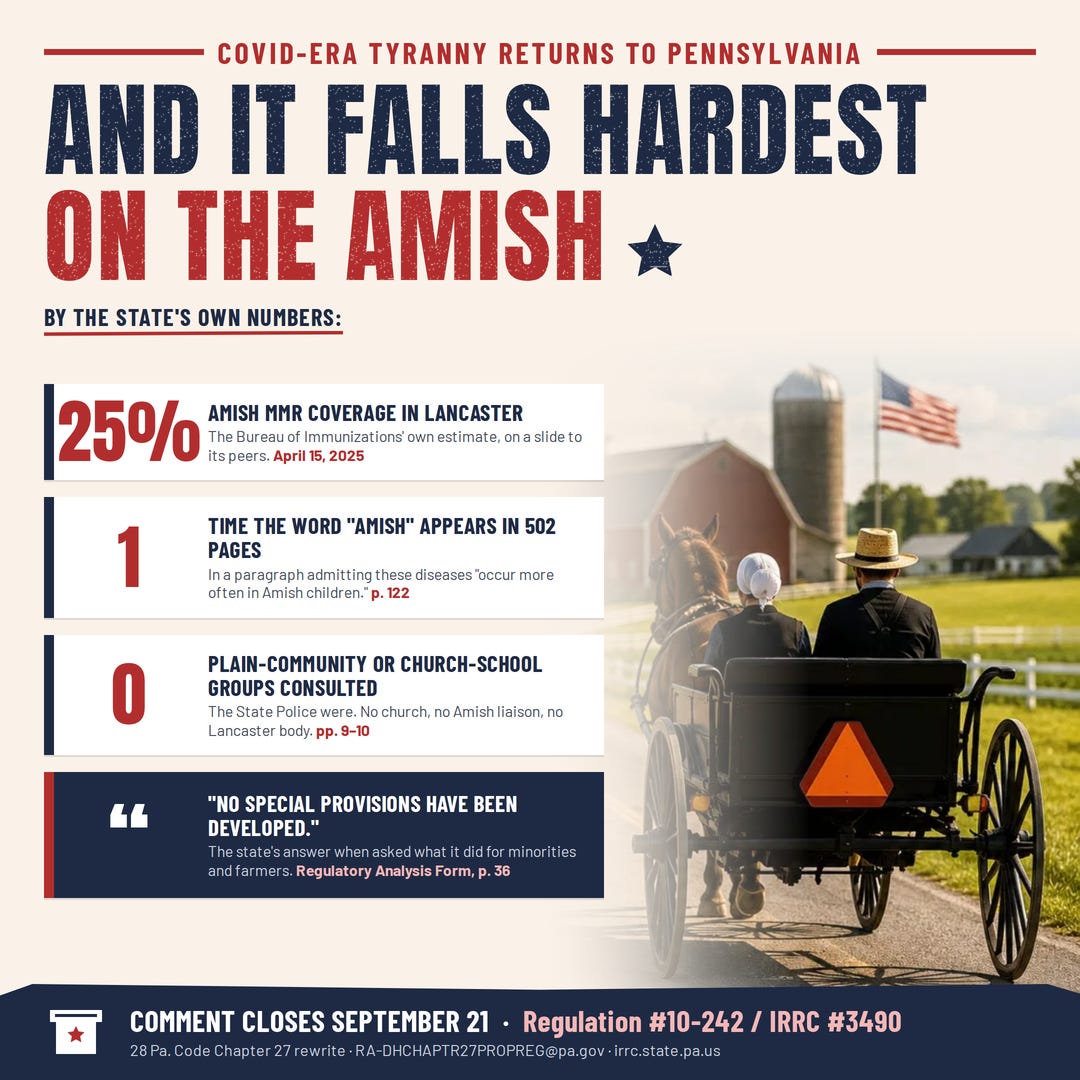
The Department of Health lost the school-mask case in 2021. Its 502-page rewrite writes the power back in — and the community with the fewest ways to resist is the one the text reaches first. By the state’s own estimate, their MMR rate is 25 percent. Comment closes September 21.

The power a court took away in 2021 is being written back in
In December 2021, the Pennsylvania Supreme Court told the Department of Health it could not mask every schoolchild in the state. The regulation the Department relied on limited “any other disease control measure” to the surveillance of disease. The Court then added a line that the Department has now quoted back in its own filing: “[o]f course, the Department has the power to promulgate a different regulation, or to amend this one, to. . . strip the ‘any other disease control measure’ catch-all of its limiting language.” (Corman v. Beam, quoted at p. 3 of the filing.)
The Department did exactly that, and says so on page 3 of the regulatory analysis it filed on June 4:
“The foregoing decision influenced the Department’s proposed amendments to § 27.60(a), which propose to add ‘prevention, containment or mitigation’ as justifications for the implementation of all disease control measures available to the Department under the Disease Prevention and Control Law.”
Then the preamble explains what the new words are for: “measures to restrict access or unprotected access to the affected location,” and less restrictive measures “such as use of a disinfectant, cleaning or social distancing” (p. 250).
Social distancing. In a disease rule filed in June 2026. That is the COVID era coming back through the front door — the regulatory-review process, not an emergency order. I laid out the nine things every Pennsylvanian should know about that rule here.
This piece is about who is standing in the doorway.
The state told its peers exactly who this reaches — a year before it filed
On April 15, 2025, the Director of Pennsylvania’s Bureau of Immunizations, Tom McCleaf, briefed the Association of Immunization Managers on the “Plain Community Population.” His slides are public. Three of them matter here.
The first gives the number. “Among the Amish population, the MMR vaccination rate in Lancaster County was estimated to be around just 25% overall.”
The second lists “Past and planned events.” “Horse and buggy clinics.” “Mud sales.” “School visits,” with a note beneath it: “It is important to have a human face to the state health department.”
The third sits under “Misconceptions and lessons in progress.” “The impact of the COVID pandemic is still being learned. We are building back to be allowed to do certain things with them, but impacts may be lasting.” And on the next slide, under “Relating to other populations”: “Making noteworthy impacts will take time, perhaps even over generations.”
Read those together. The state’s own immunization director says the COVID years cost the Department access to the Plain community, that it is “building back to be allowed” in, that its horizon is generational, and that one in four Amish children in Lancaster County has an MMR record.
Keep that number. Now read what the same Department filed fourteen months later.
It admitted the disparity on page 122 — and wrote nothing for it on page 36
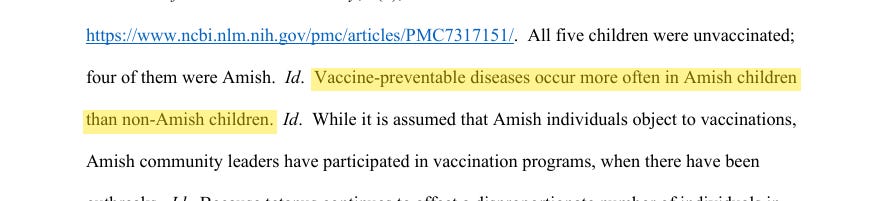
The word “Amish” appears once in 502 pages. It is in a tetanus paragraph on page 122 that credits “Amish community leaders” with participating “in vaccination programs, when there have been outbreaks,” and states, in the Department’s own words: “Vaccine-preventable diseases occur more often in Amish children than non-Amish children.”
On page 36 of the same filing, the Regulatory Analysis Form asks Question 25: “List any special provisions which have been developed to meet the particular needs of affected groups or persons including, but not limited to, minorities, the elderly, small businesses, and farmers.”
The answer, in full:
“No special provisions have been developed as this proposed rulemaking applies to all health care practitioners, health care facilities, clinical laboratories, schools, colleges, universities, childcare group settings, veterinarians, and the general public in this Commonwealth.”
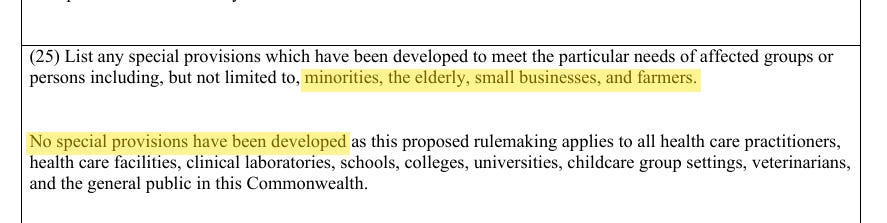
So the Department documented that a religious minority carries a disproportionate share of the diseases this rule governs, and then wrote a rule with nothing in it for them. That is not an inference. It is two sentences from the same filing.
The State Police were consulted. The Amish were not.
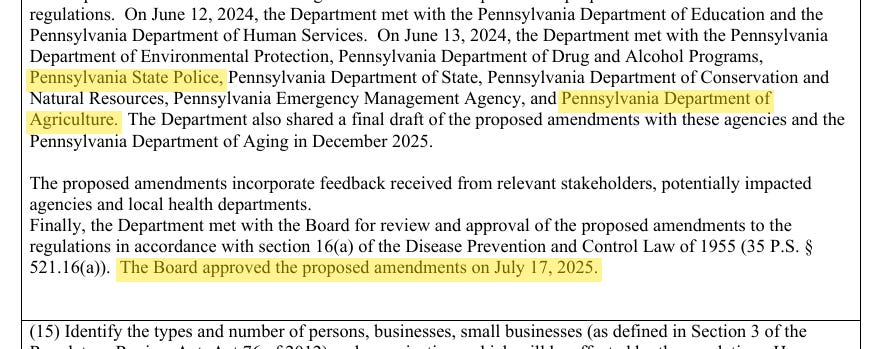
Question 14 of the same form asks the Department to “list the specific persons and/or groups who were involved” in drafting. The answer runs a page (pp. 9–10): the Children’s Hospital of Philadelphia, the Pennsylvania Medical Society, the Hospital and Healthsystem Association, eleven local health departments, the PA Association of School Administrators, a dozen hospitals and health systems. Then the seven sister agencies the Department met on June 13, 2024, and later sent its December 2025 “final draft”: the Department of Environmental Protection, the Department of Drug and Alcohol Programs, the Department of State, the Department of Conservation and Natural Resources, PEMA, the Department of Agriculture — and the Pennsylvania State Police.
Here is who is not on the list. Any nonpublic or religious-school body. Any Plain-community representative. Penn Medicine Lancaster General, which runs the Amish outreach the state cites in its own case studies. Any Lancaster County entity at all — the county has no health department, so it was not at the May 10, 2024 meeting of local health departments either.
Agriculture belongs at a disease-rule meeting; the package touches animal disease, and its presence is unremarkable. The State Police is the unusual chair at the table. A disease rule that defines “school” to include church schools for the first time was drafted with the State Police in the room, and no church.
The rule adds church schools by definition — then forgets to count them
One more line from the form. Question 15 asks how many entities are affected. The Department counts “All 500 school districts … more than 160 brick-and-mortar charter schools and 14 cyber charter schools … and the approximately 199,000 individuals employed by public and private schools” (p. 13). It never counts a nonpublic school as an entity — not one of the church schools its own definition adds. The compliance burden on the category the rule newly names was never estimated because the category was never counted.
That is the paperwork. Now the rule itself.
Ten places the rewrite reaches Amish life
The regulation is facially neutral. It never names the Amish as a target, and I am not claiming it does. What follows is where neutral text lands on a community that holds church in barns, buries its dead from the family home, sells milk from the family dairy, schools its children in one room until eighth grade, does not use the internet, and will not sue. Every item carries the page.
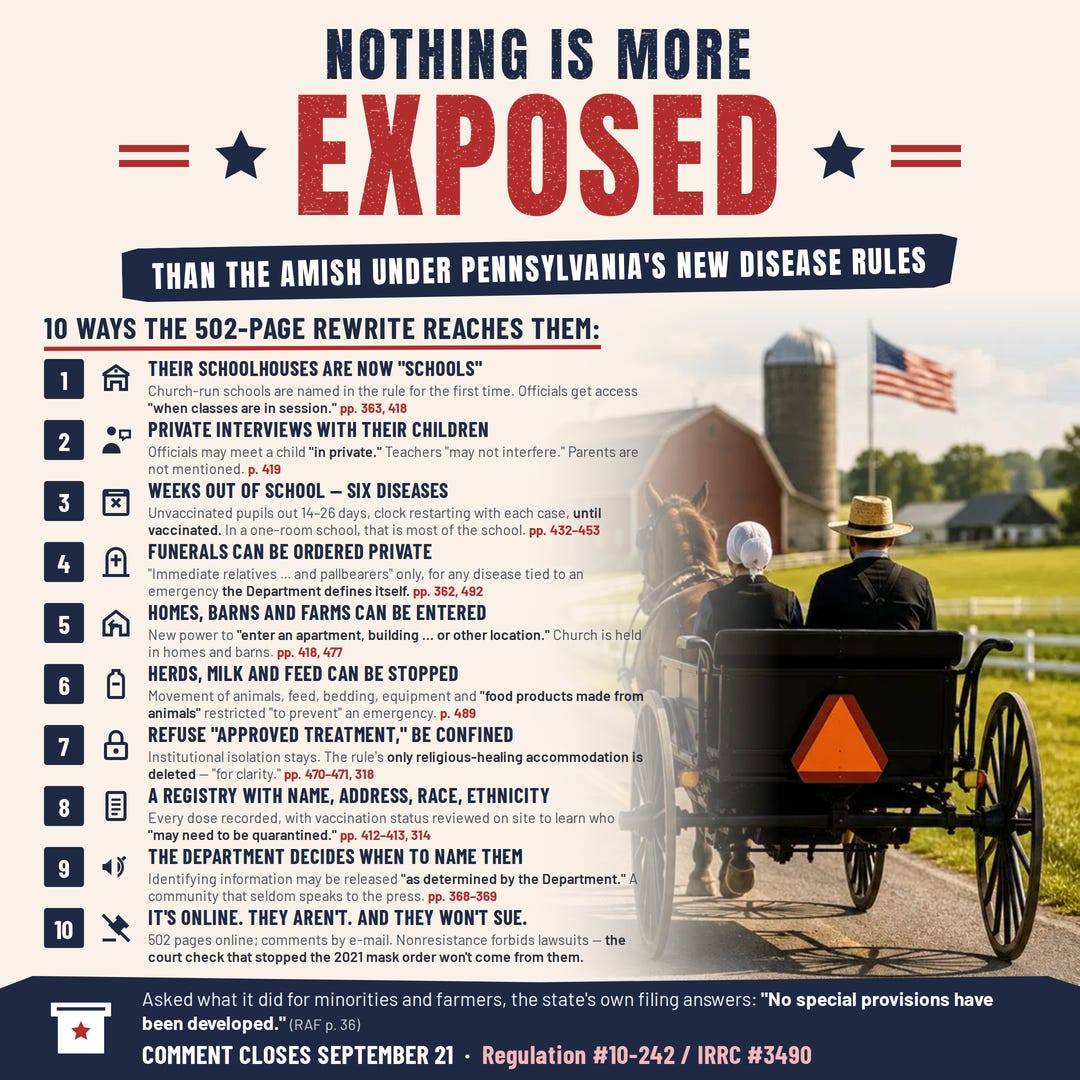
1. Their one-room schools are now “schools” under the rule
Chapter 27 has never defined “school.” The rewrite does (p. 363), and the definition’s third clause reads: “This includes any school operated by a bona fide church or other religious body.” Every school-directed power in the package now expressly reaches a one-room parochial school run by a board of fathers and taught by an unmarried Amish woman with an eighth-grade education.
Then the new § 27.60c(a) (p. 418): a school “shall provide the Department or local health authority with reasonable and timely access to a person for the purpose of contact tracing or partner services, including access when classes are in session.”
Hold that next to the April 2025 slide — “School visits … It is important to have a human face to the state health department.” The slide describes a visit the school could decline. The rule describes one it must permit. The slide is dated April 15, 2025; the Board approved the rule on July 17, 2025. The two are documented to converge in time and purpose. Nothing in the record shows they were planned together, and I am not saying they were.

2. Officials can question their children alone — parents aren’t in the rule
§ 27.60c(b) (p. 419): a person, “including an employee or official of a school, shall permit the Department or local health authority to meet and speak with a student or other person in private, and may not interfere with the student or other person’s ability to exercise their right to give consent under 35 P.S. § 10103.” That is the 1970 minors’ consent statute. Parents are not mentioned. “Interfere” is not defined. The Department’s stated reason for writing the section: “there has been confusion in the past regarding whether the existing provisions of the regulations specifically apply to schools” (p. 255). What confusion, where, it does not say.
In a community organized around parental authority, the person the rule forbids from “interfering” is a nineteen-year-old neighbor with no counsel to call.
3. One case can empty a schoolhouse for weeks — until the needle
Today’s rule lets the Department exclude “presumed susceptible” pupils during a measles outbreak, for 14 days. The rewrite scraps it (pp. 483–484) and rebuilds the power for diphtheria, measles, mumps, pertussis, rubella and varicella (pp. 432–453). Measles, at p. 436: the Department “may, in the course of conducting disease control measures under Subchapter C, exclude a person susceptible for measles … until the person provides proof that they are not susceptible, receives a vaccine for measles, or when no cases of measles have occurred in the specific school … for 21 days.” Mumps is 26 days (p. 439). The clock restarts with every case.
Now put the state’s own number on it. At a 25 percent MMR rate, one case in a 30-pupil Amish school sends roughly twenty-two children home. With rolling cases across a church district, and six or seven children to a family, the exclusion has no end date except the needle — or a serology test, which the rewrite now accepts (p. 467) and which a cash-pay family buys per child. Lancaster, the state’s own outreach partners note, “has the highest rate of uninsured persons in PA” (AIM case study). Amish education ends at eighth grade in one room. There is no online school, no homeschool co-op, no district to send a laptop.
How many children, how many days, what it costs: the Department “is not able to estimate” (pp. 18–31).
One more thing about this power: read as written, it does not work. The susceptibility definitions say “born before December 31, 1956” where the rule they replace says “after” (pp. 437, 484). If the Department fixes that at final-form, the corrected text — the one that actually excludes children — will never go out for comment.
4. A self-declared “emergency” can close a funeral
Chapter 27 has never defined “public health emergency.” Now it does (p. 362): an event that “affects or has the potential to seriously affect the health, safety or welfare of a significant number of persons … and whose scale, timing or unpredictability threatens to overwhelm routine medical or public health capabilities.” A declaration by the Governor or HHS is “included” — one way in, not the door.
Then § 27.204 (p. 492): a funeral “with the body” of anyone who died of a listed disease “or other known or suspected communicable disease associated with a public health emergency … shall be private when so ordered,” and private means “only the immediate relatives of the deceased, the officiating person and the necessary number of pallbearers.” Today that order is limited to diseases that require isolation or quarantine.
An Amish viewing is held in the family home over one to three days. The service is held in a home, a shop, or a barn. When Lancaster County buried the Nickel Mines schoolgirls in 2006, funeral director Philip W. Furman expected 300 to 500 people at each (CBS News, Oct. 4, 2006). That is the ritual the order dismantles — on the strength of an “emergency” the Department may define for itself.
5. Homes and barns can be entered, and the old threshold is gone
The old investigation rule required a case “judged by the Department or local health authority to be a potential threat to the public health” (§ 27.152, p. 477). It is bracketed for deletion. Its replacement, § 27.60a(a) (p. 418): the Department “may investigate any case, outbreak, public health emergency, and unusual occurrences of diseases, infections and conditions.” Full stop. Then (b): it “may enter an apartment, building, health care facility, school, college or university, or other location as necessary to conduct its investigation.” The old rule barred obstructing an official “who seeks to enter a house”; the affirmative power to enter is new.
A new definition does quiet work here. “Unusual occurrence” (p. 365) now includes “a common disease or condition in an uncommon segment of the population.” That is a textbook description of measles in the Plain community — and it is a standalone trigger for investigation, entry, and thirty-minute telephone reporting (§ 27.3(b), p. 366).

Church meets in homes and barns on a rotating schedule. Contact-tracing one case means every household that sat in the same barn on Sunday. And the Shapiro executive branch’s most recent entry onto a Lancaster Amish farm with authority in hand — the January 4, 2024 Department of Agriculture search of Amos Miller’s Upper Leacock Township farm — came with two State Police vehicles (WITF). The rule does not mention that history. The community remembers it.
6. Herds, feed and milk can be stopped — before any emergency exists
This one is not in my earlier piece. I missed it, and it may be the most Amish-specific provision in the package.
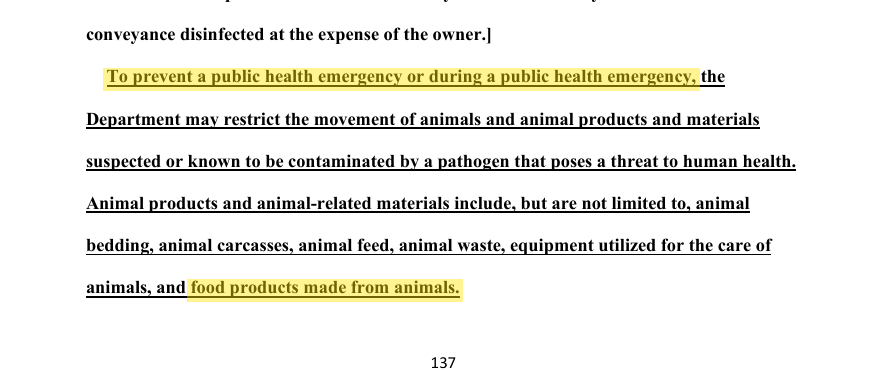
Old § 27.191 was an importation rule: in a declared emergency, the Department could require a permit to bring animals or animal products into the Commonwealth. The rewrite deletes it and writes this (p. 489):
“To prevent a public health emergency or during a public health emergency, the Department may restrict the movement of animals and animal products and materials suspected or known to be contaminated by a pathogen that poses a threat to human health. Animal products and animal-related materials include, but are not limited to, animal bedding, animal carcasses, animal feed, animal waste, equipment utilized for the care of animals, and food products made from animals.”
“[F]ood products made from animals” is milk, cheese, eggs and meat. “Suspected” is the standard. “To prevent” an emergency is the trigger — before one exists. There is no notice, no hearing, no appeal in the text, and the preamble (pp. 332–333) confirms the point of the amendment is to extend the power “to not only include during a public health emergency, but to prevent one as well.”
This is a raw-milk and dairy-herd power, written in the county where every publicly documented armed raw-milk raid of the past two decades has targeted a Plain farmer, filed by the executive branch that put State Police cruisers in Amos Miller’s driveway, and drafted with the Department of Agriculture consulted and no farmer.
One clause the Department left standing may limit it. § 27.35(b) (p. 412), unchanged: “This chapter applies only to animals having or suspected of having one of the diseases, infections or conditions listed in subsection (a)” — nine named diseases, plus anything reportable as an “unusual occurrence.” Whether that bounds § 27.191 is a question the Department should be made to answer in writing.
7. Refuse “approved” treatment and be confined — and the one religious clause is gone
§ 27.87(a), unchanged for decades (p. 470): a person with a communicable disease who “refuses to submit to treatment approved by the Department” shall be “isolated in an appropriate institution designated by the Department … for safekeeping and treatment until the disease has been rendered noncommunicable.” § 27.87(c), also decades old, said approved treatment “may include treatment by an accredited practitioner of a well recognized church or religious denomination which relies on prayer or spiritual means alone for healing.” The rewrite deletes it (p. 471), and explains: “In practice, the Department relies on evidence-based treatments and would only approve of a church, religious or spiritual treatment to the extent that it is evidence-based” (p. 318).
To be precise: that clause was written for denominations that rely on prayer alone. The Amish use hospitals, the Clinic for Special Children, chiropractors and herbalists alongside home care; they were never squarely inside it. What the deletion does is remove the rule’s only religious-healing accommodation while keeping the confinement power — with “treatment approved by the Department” undefined, no decider named, and no hearing anywhere in 502 pages. A large, cash-pay, hospital-wary family nursing a sick child at home is the fact pattern that sentence was written for.
8. A registry that maps them — and a stated reason
§ 27.36 (pp. 412–413) makes the vaccine registry mandatory: every dose, with name, date of birth, gender, address, race, ethnicity, manufacturer and lot number. A patient may decline “in writing”; nothing requires anyone to tell a parent that. § 27.77(a)(4) (p. 466): “The Department may review the immunization status of a child at the caregiver’s location and may provide the caregiver with on-site immunization education.” The preamble says why: vaccination status “is an indicator as to which children are susceptible and may need to be quarantined in cases of illness or disease” (p. 314).
The state’s own outreach documents describe “in-home horse and buggy immunization services” (AIM case study). A dose registry cross-referenced with school and birth records is the address list for them. And § 27.4a (p. 367) adds a second feed: every emergency-department visit, within 24 hours, with race, ethnicity, diagnosis codes and “patient’s home zip code.” Bird-in-Hand is 17505. Intercourse is 17534. Ronks is 17572. In Lancaster County, a zip code is an ethnicity.
9. The Department decides when to name them
§ 27.5a(1.1) (pp. 368–369): identifying information may be disclosed “when disclosure is necessary to inform the public of the risk of a communicable disease, as determined by the Department.” No standard. No appeal. In a settlement of about 44,000 people (Young Center for Anabaptist and Pietist Studies, Elizabethtown College) living in identifiable villages, “identifying” can mean a church district, a schoolhouse, a market stand — against people who seldom speak to the press, run no rebuttals, and will not sue for defamation.
10. It’s online. They aren’t. And they won’t sue.
The 502 pages live on the IRRC website. The Pennsylvania Bulletin is online. The Department’s newborn-screening list is kept “on its website” (p. 404). Comments run by e-mail and web form. The Department’s own April 2025 slide lists “Communications; Phone policies” under lessons still being learned. A rulemaking whose only path to the affected community is paper carried in by someone else is a rulemaking that community will not see.
And then the check that is not coming. In 2021 the mask order fell because legislators, led by Senate President Pro Tempore Jake Corman, and non-Amish parents sued. In Wisconsin v. Yoder — the 1972 case that protects Amish schooling — the Amish fathers did not sue anyone; Wisconsin prosecuted them, and by conviction they would not even defend themselves. Their defense was argued by attorney William B. Ball and paid for through the National Committee for Amish Religious Freedom, an interfaith group of outsiders that a Lutheran minister, William Lindholm, had formed in 1967 for exactly that reason. In Lindholm’s words: “Since the Amish will not defend themselves, believing literally in the Bible — ‘turn the other cheek,’ it says — their defense was paid for by public donations.”
A power is only as limited as the people willing to test it. The community most exposed to this rewrite is, by conviction, the one that will not.
Three more that didn’t fit on the graphic
The burial rule
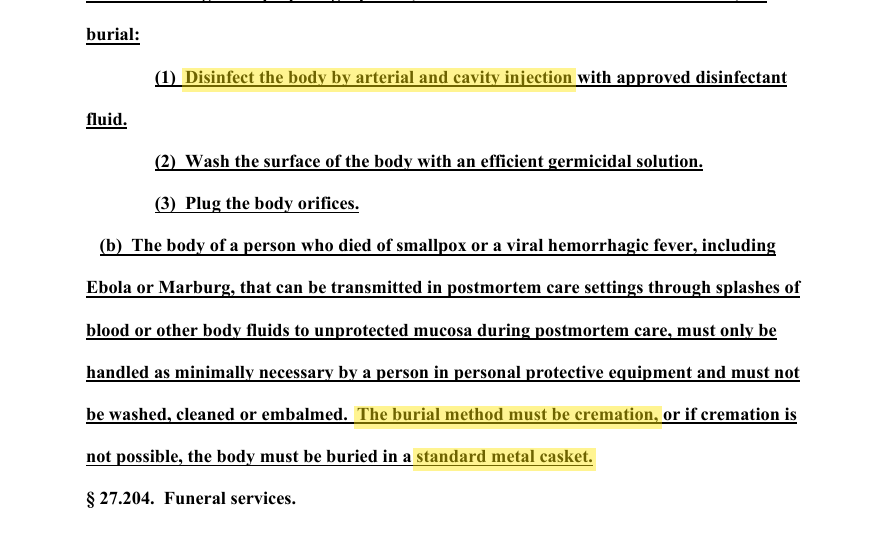
§ 27.203 (p. 491) is rewritten to say that “an undertaker or person acting as such,” preparing for burial a person who died of a communicable disease, shall “disinfect the body by arterial and cavity injection with approved disinfectant fluid,” wash it, and plug the orifices. Arterial and cavity injection is embalming. The old rule reached “other known or suspected communicable diseases” too, so the scope is not new — but the rewrite restates it as a flat rule and adds no religious clause, though the same package keeps one for newborn eye drops (§ 27.98(b), p. 474). Lancaster Old Order families generally use an English mortician. The most conservative affiliations in the state prepare their dead themselves. “[P]erson acting as such” is the family.
A new subsection (b) adds, for smallpox and viral hemorrhagic fevers, that “the burial method must be cremation, or if cremation is not possible, the body must be buried in a standard metal casket.” The triggers are exotic. A state mandating cremation with no religious accommodation is the pattern in miniature.
The food-handler household
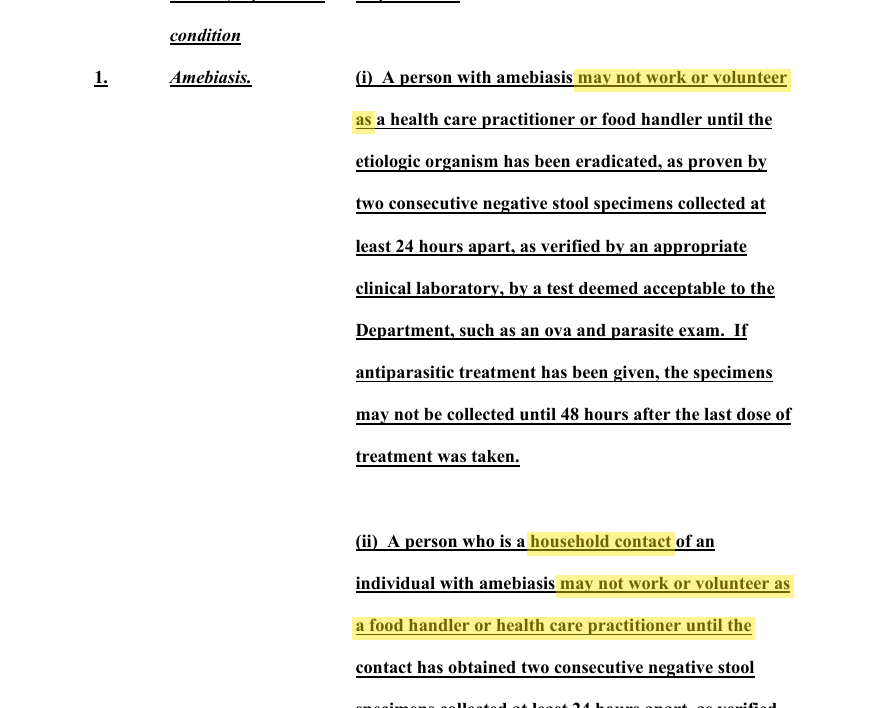
“Food handler” is newly defined (p. 357) as anyone who “as part of their occupation or volunteer work, may have direct contact with food or a food-contact surface … including … those volunteering at food service places or events.” Farm stands, market stands, church meals, benefit auctions. Then § 27.71a(b) (p. 453): “A person who supervises food handlers … shall adhere to” exclusions for cases “and for close contacts of such persons” — for example, STEC (p. 455): no work “until the etiologic organism has been eradicated, as proven by two consecutive negative stool specimens … verified by an appropriate clinical laboratory.”
Household-contact exclusions existed before (old § 27.157, p. 482). What is new is the volunteer-inclusive definition, the reach to “close contacts,” and the duty on the supervisor. One child’s shiga-toxin E. coli — the pathogen named in the 2024 Miller warrant — bars the household from the family food business until each member clears two cash-pay lab tests, with the father as the “person who supervises.”
The birth-defects registry
§ 27.37 (pp. 413–414) creates a mandatory registry with twelve categories, including “chromosomal abnormalities” and “abnormal findings on neonatal screening,” reported within 180 work days for live births and fetuses past 19 weeks. The Plain community, because of founder-effect recessive disorders, is the most genetically distinctive population in the state; its clinics are licensed facilities and will report. The annex lists no data fields, no opt-out, and no confidentiality provision specific to this registry. The effective date is a blank, to be filled by a notice in the Pennsylvania Bulletin.
What this piece does not claim
It does not claim the rule targets the Amish. The text is neutral on its face. The claim is narrower and fully cited: the Department documented the disparity (p. 122), consulted no one from the community (pp. 9–10), never counted its schools (p. 13), and developed no special provisions (p. 36).
It does not claim the outreach program and the regulation were planned together. They converge — April 2025 slides, July 2025 Board vote, “school visits” on one and school access on the other. Convergence is documented. Coordination is not, and I will not assert it.
It does not claim every power here is new. Confinement for refusing treatment (§ 27.87(a)) and measles exclusion (old § 27.160) are old. The six-disease expansion, the church-school definition, § 27.60c, the entry power, the self-defined emergency and its reach into funerals and farms, the mandatory registry, the disclosure exception and the deleted accommodation are new. I have tried to say which is which every time.
It concedes what cuts the other way. “Health care practitioner” (p. 358) means licensed only, so the prenatal-testing and newborn duties do not reach the lay midwives who attend many Plain home births — and the old rule’s “physicians and midwives” language at § 27.98 is gone (p. 474). The child-care exemption is widened to “a strong moral or ethical conviction similar to a religious belief” (p. 464). A positive antibody test now counts as immunity (p. 467). The symptom-exclusion rule (§ 27.72) does not newly burden Amish schools, which never had nurses and already needed a physician’s clearance. And the Department’s own preamble credits “Amish community leaders” with cooperating in past outbreaks (p. 122) — which makes access-by-right less necessary, not more.
It does not relitigate the two deaths. The coroner’s findings, the “measles-associated” label, and the timing of the August 25 announcement are documented in earlier pieces. This piece stands without them.
Why “COVID era” is the right name
Strip the adjectives and look at the mechanism. A court said the Department lacked a power. The Department did not ask the legislature for it. It rewrote its own regulation, told the review commission the court’s decision “influenced” the change, and described the restored power in the vocabulary of 2020: “restrict access,” “social distancing.” No sunset. No legislative vote. No hearing right anywhere in 502 pages.
What is different from 2021 is the room it lands in. In 2021 the power was tested against suburban school districts with lawyers and parents who sue. In 2026 it lands first on a community with a 25 percent MMR rate, one-room church schools, home funerals, family dairies, no internet, and a religious commitment never to go to court — a community the Department’s own director said it was “building back to be allowed” to reach, on a horizon of “generations.”
That is not a Shapiro problem or a Pennsylvania problem. It is what administrative government does when nobody in the room speaks for the people outside it. And in this case, nobody did.
What you can do before September 21
Comments close September 21. E-mail the Department at RA-DHCHAPTR27PROPREG@pa.gov with “Regulation #10-242 / IRRC #3490” in the subject line, or file with the Independent Regulatory Review Commission. Paper works too: IRRC, 555 Walnut Street, Suite 804, Harrisburg, PA 17101. Sign your name. Cite a page. One specific point in your own words is one file on an analyst’s desk; a thousand copies of a form letter is one file. Pick yours:
Consultation. Which nonpublic or religious-school body, and which Plain-community representative, was consulted before “school” was defined to include church-operated schools (p. 363)? The form (pp. 9–10) lists none. Will the Department convene one before final-form?
Counting. Why does the affected-entity count (p. 13) include 500 districts and 174 charter schools and no nonpublic school, when the definition adds every church school in the Commonwealth?
Special provisions. Reconcile p. 122 with p. 36. What accommodation for the Plain community was considered and rejected, and why?
Parents. Add parental notice to § 27.60c (p. 419) wherever 35 P.S. § 10103 does not forbid it, and define “interfere” so that a teacher calling a parent is not obstruction.
Farms. State the standard for “suspected … to be contaminated” in § 27.191 (p. 489), name the decider, provide notice and appeal, and say whether § 27.35(b) (p. 412) limits it.
Burial and funerals. Add a religious-objection clause to § 27.203 (p. 491) on the model of § 27.98(b); require an actual declaration, with a basis and an end date, before “public health emergency” (p. 362) can trigger § 27.204.
Notice. Commit to paper notice of any Subchapter C order, and of the final-form text, to communities without internet access — through the school boards and bishops the state’s partners already meet.
And one thing that is not a comment: if you know a school board father or a bishop in Lancaster, Lebanon, Big Valley or anywhere else in Plain Pennsylvania, print this and the nine things and hand them over. The rule will not reach them any other way.
Three questions the Department should answer
Which organizations representing nonpublic schools, religious schools, or the Plain community were consulted in the development of Regulation 10-242, and on what dates?
Does § 27.35(b) limit the Department’s authority under proposed § 27.191, and if not, what standard governs “suspected” contamination?
Will the Department correct “before” to “after” in the susceptibility definitions at pp. 433–445, and if so, will the corrected text be re-noticed for comment?
Dates
September 21 — comment closes.
~October 11 — House Health and Senate HHS committee comment window closes.
October 21 — IRRC comments due.
By September 21, 2028 — final-form due; IRRC votes in public; either committee can move to disapprove.
Every quotation above was checked against the filing at the page cited, and against the Bureau of Immunizations’ April 2025 slides and the AIM Lancaster County case study. Corrections will be published in-line with edit history preserved.
No hay comentarios:
Publicar un comentario