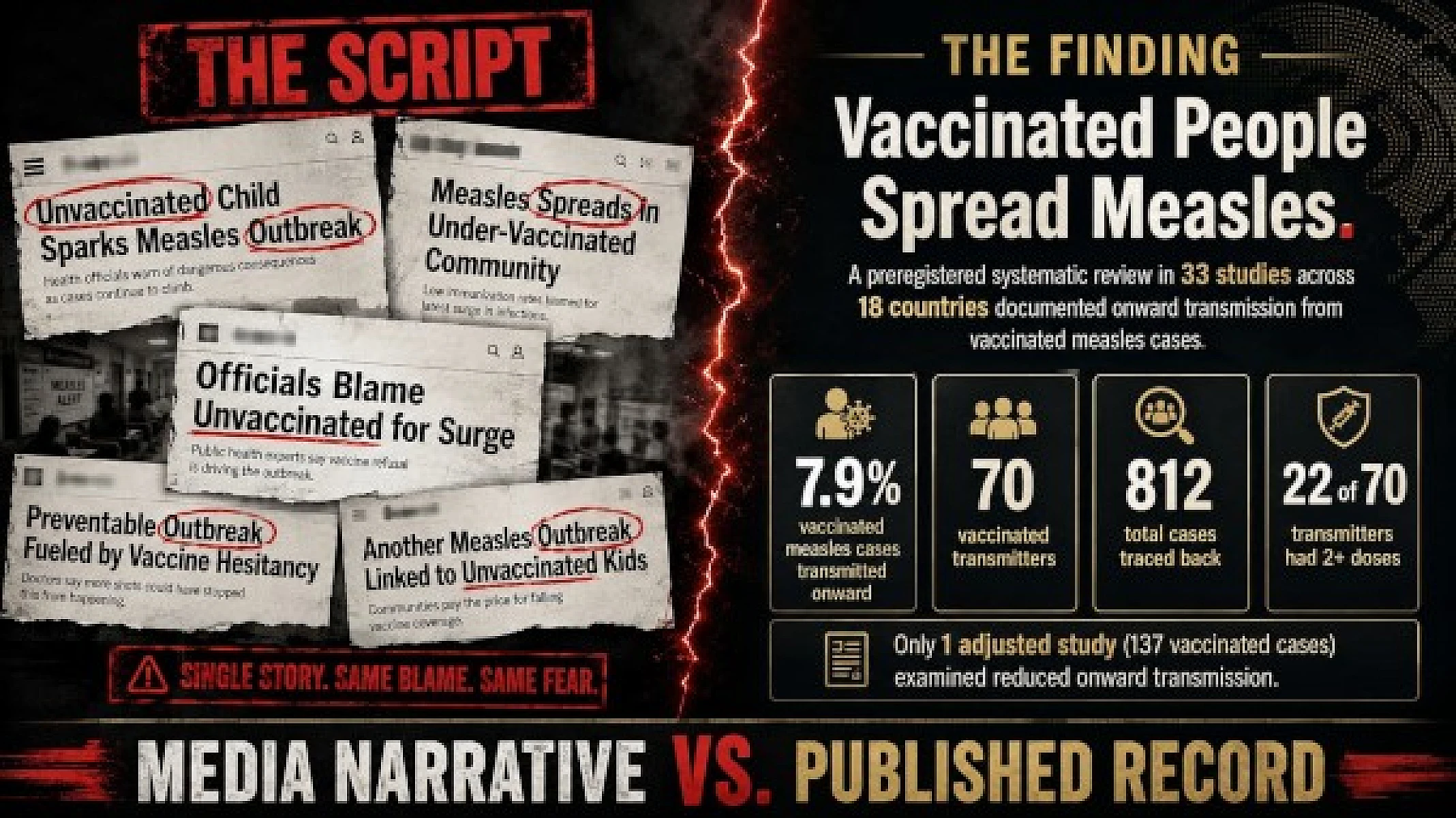
A preregistered systematic review in Expert Review of Vaccines found 70 vaccinated transmitters, 812 downstream cases, and one small study underneath the claim that MMR reduces onward spread.
A new peer-reviewed study by CDC, WHO, and Johns Hopkins leadership found that nearly 8 out of every 100 vaccinated people who catch measles pass it to someone else. Almost a third of them had received two doses. And the world has exactly one study, of 137 people, trying to measure how much the vaccine actually reduces onward spread.
For a generation, the public message about the measles shot has been simple. If you are vaccinated, you cannot spread it. A new study, written by the people who run the global measles elimination program, quietly says otherwise.
View and share the X thread dedicated to this post:
![FireShot-Capture-954---BREAKING_-Vaccinated-People-Spread-Measles.-The-CDC,-the-WHO,-and-J_---[sayerji.substack.com].jpg](https://fls-a0de34a7-7f40-4480-890f-5c01779c21d4.laravel.cloud/6250/FireShot-Capture-954---BREAKING_-Vaccinated-People-Spread-Measles.-The-CDC,-the-WHO,-and-J_---%5Bsayerji.substack.com%5D.jpg)
Who wrote this
Not activists. Not skeptics. The paper is co-authored by the former director of the entire U.S. Immunization Program at the CDC, the CDC’s own measles laboratory chief, the head of Johns Hopkins’ vaccine access center, the recent WHO measles program lead who is now Canada’s Acting Chief Public Health Officer, the man who chairs the WHO commission that certifies whether entire regions have eliminated measles, and PAHO’s top immunization official for the Americas. One author is a paid consultant to Merck, Sanofi, Moderna, Dynavax, and Seqirus. Another runs an institute that discloses funding from vaccine manufacturers.
These are not outsiders raising doubts. The people who spent their careers building the measles elimination framework — at CDC, Johns Hopkins, PAHO, RIVM, and the WHO regional verification commissions — are the people who signed this paper.
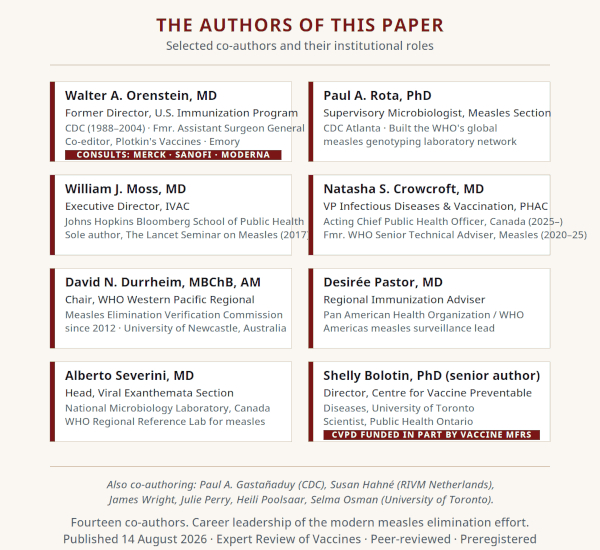
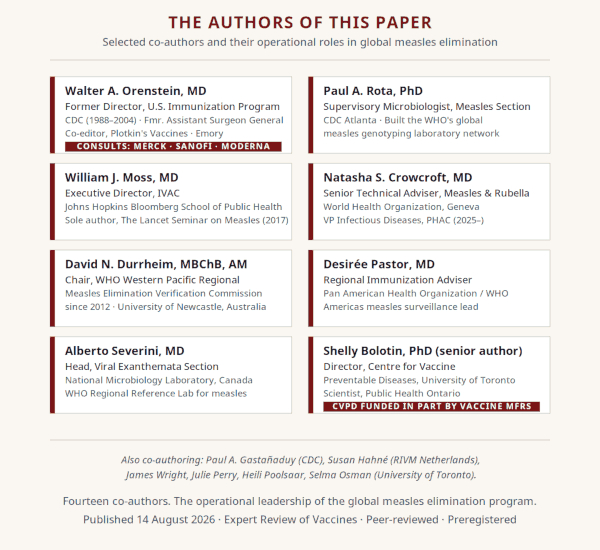
Selected authors and their institutional roles.
The evidence, in detail
Walter Orenstein, MD, ran the U.S. Immunization Program at the CDC for 16 years and was Assistant Surgeon General; he co-edits Plotkin’s Vaccines. Paul Rota, PhD, is the CDC’s Supervisory Microbiologist for the Measles Virus Section and built the WHO’s global measles genotyping laboratory network. William Moss, MD, is Executive Director of the International Vaccine Access Center at Johns Hopkins and sole author of The Lancet‘s 2017 Seminar on measles. Natasha Crowcroft, MD, is the Vice President, Infectious Diseases and Vaccination Programs at the Public Health Agency of Canada and has served as Acting Chief Public Health Officer for Canada since September 2025; she was the WHO’s Senior Technical Adviser for Measles and Rubella in Geneva from 2020 to 2025. in Geneva. David Durrheim has chaired the WHO Western Pacific Regional Measles and Rubella Elimination Verification Commission since 2012. Desirée Pastor, MD, is PAHO’s Regional Immunization Adviser for the Americas.
Orenstein’s disclosure, verbatim: “WO is a consultant with Merck, Sanofi, Moderna, Dynavax, and Seqirus, however receives no funding related to the subject of this manuscript.”
Bolotin’s disclosure, verbatim: “The Center for Vaccine Preventable Diseases (CVPD), of which SB is Director, is supported by various funding sources, including donations from vaccine manufacturers.”
What they found
Across 33 outbreak investigations in 18 countries — investigations selected because they documented transmission events — 70 of 890 vaccinated measles cases (7.9 percent) passed measles on to someone else . This is the rate observed within the investigations selected, not a population estimate. It is what the field’s own leadership finds when it goes looking, and it is the first time the number has been pooled across the modern literature. Those 70 people caused 237 direct next-generation cases, and when the chains were followed forward, 812 total measles cases could be traced back to a vaccinated index case.
Almost a third of the vaccinated spreaders, 22 out of 70, had received two or more doses. Two doses is what the public-health system calls “fully vaccinated.”
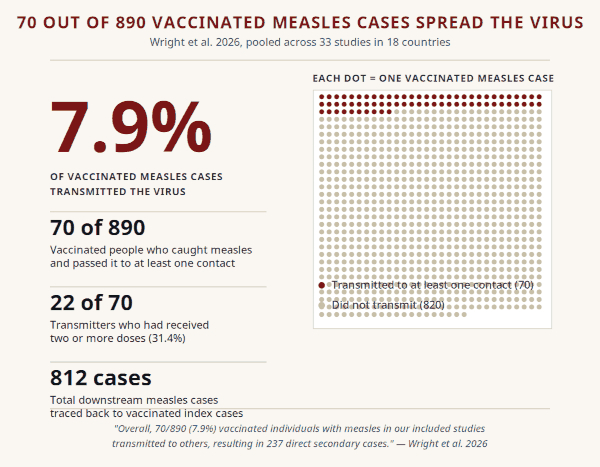
Each dot represents one vaccinated measles case from the pooled review. Red dots are the 70 who transmitted the virus onward.
The evidence, in detail
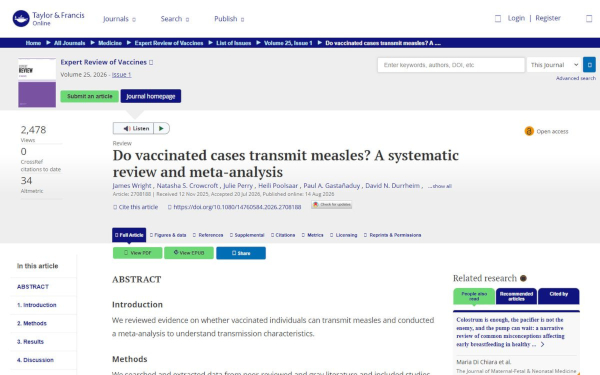
From the paper verbatim: “Overall, 70/890 (7.9%) vaccinated individuals with measles in our included studies transmitted to others, resulting in 237 direct secondary cases (median number of transmissions: 2 (IQR: 1, 4)).” Twenty-two of 70 (31.4%) had received two or more doses. Among transmitters, the median number of secondary cases did not differ significantly between one-dose and two-dose recipients (1 vs 3, p = 0.49) — a comparison of transmission size among those who already transmitted, not of who transmits. Transmission occurred in healthcare facilities, schools, and community settings, sometimes after brief encounters without direct contact. The paper is a preregistered systematic review (protocol INPLASY2025110004), reported to PRISMA standards, applying an NIH quality tool with a minimum inclusion score. Two reviewers screened 5,240 deduplicated peer-reviewed records plus gray literature with perfect inter-rater agreement (Kappa = 1.0).
What the field actually knows about the vaccine and spread
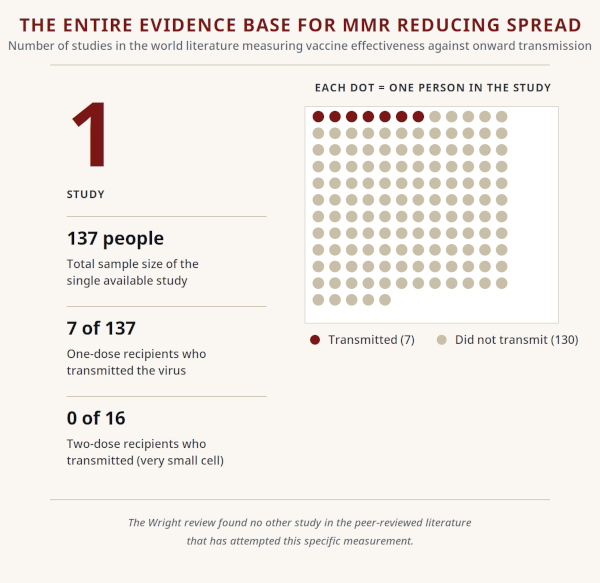
Here is the finding that should stop the conversation. Wright et al. searched 11,911 peer-reviewed records and 22 gray-literature records. Among the studies that met their inclusion criteria, only one had ever attempted to estimate an adjusted vaccine effectiveness against onward transmission from an infected vaccinated person. One study. It looked at 137 people.
That is the entire evidence base, in this preregistered systematic review, for the specific quantitative claim about how much MMR reduces onward transmission from an already-infected vaccinated person. One study. 137 people. Two other papers — Tranter 2024 in the CDC’s Emerging Infectious Diseases and Gastañaduy 2020 in JAMA Pediatrics — quantify related transmission dynamics from different angles; Wright et al. explicitly call the Tranter finding concordant.
The evidence, in detail
The single study is a Dutch outbreak analysis. Of 137 vaccinated cases, 7 out of 137 with one dose transmitted; 0 out of 16 with two doses transmitted. Adjusted vaccine effectiveness against onward transmission: 10% for one dose (95% CI −80 to +62) and 61% for two or more doses (95% CI −203 to +100). Wide confidence intervals because the sample is small, especially the 16-person two-dose cell. The point is not that the shot fails to reduce spread — Wright et al. explicitly state that the paper “found no evidence to contradict the current thinking that vaccinated cases are much less likely to transmit measles to others.” The point is that the evidence base for how much it does reduce spread is a single small study.
Why this explains outbreaks nobody could explain
For more than twenty-five years, measles outbreaks have shown up in communities that public-health authorities themselves reported as 95 percent or more vaccinated.
• Corpus Christi, Texas, 1985: 99 percent of students vaccinated, more than 95 percent immune.
• Montana, 1985: 137 measles cases in a population with a 98.7 percent vaccination rate.
• A Colorado college in 1988: 84 students infected, over 98 percent with documented immunity.
• Cape Town, 1992: 91 percent vaccinated, outbreak attributed by the investigators to primary and secondary vaccine failure.
Fair-read caveat: none of these outbreaks by itself proves the modern vaccine failure phenomenon. Corpus Christi 1985 was concentrated among the 74 seronegative students; none of the 1,732 seropositive students contracted measles. What the historical outbreaks together demonstrate is a repeated pattern — measles cases and transmission occurring in populations that public-health messaging treats as effectively closed — and the Wright meta-analysis now quantifies the mechanism that pattern implied.
These outbreaks were documented in the peer-reviewed record at the time. They have been documented every few years since. I have covered them at length in Measles Vaccine Failures Documented for A Quarter of A Century, and the pattern is stable.
Until now, the standard framing in outbreak communications has been that these were anomalies. Isolated. Fringe. Corner cases. What Wright et al. 2026 quantifies is the mechanism that made those outbreaks not anomalies at all. If 7.9 percent of vaccinated measles cases transmit onward, and 31 percent of those transmitters had received two doses, and the evidence base for how much the shot reduces onward spread from an infected vaccinated person is one study of 137 people — then a highly vaccinated population is not the impermeable barrier the public messaging has treated it as. It never was. The peer-reviewed record has been showing why, in individual outbreak reports, for the entire post-elimination era. This is the first time the field’s operational leadership has put a single number on the underlying phenomenon.
The scope, honestly
The historical outbreaks in 95%+ vaccinated populations are real and repeatedly published. Corpus Christi 1985, Montana 1985, Colorado 1988, Cape Town 1992, and dozens of others sit in the peer-reviewed record. They do not by themselves prove the MMR vaccine fails at the population level — many of those same outbreak reports credit two-dose coverage with rapid containment, and every serious MMR effectiveness estimate against measles infection remains high. What the historical outbreaks establish, and what Wright et al. 2026 now quantifies, is narrower: measles cases occur, and transmit, in populations that public-health messaging treats as effectively closed. The population-level model has been more fragile than the messaging suggested, and vaccinated individuals have been part of that fragility for decades.
What the paper does not answer: the strain question
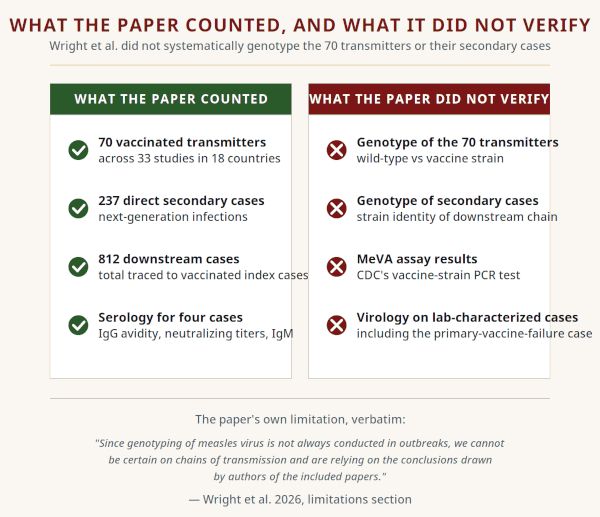
The paper counts vaccinated people who caught something called measles and passed it to someone else. What it does not do, and it says so in its limitations, is confirm which strain of measles those people were actually carrying.
This matters because the MMR vaccine is not an inert biological. It is a live, weakened measles virus. The vaccine itself is shed by recently vaccinated people. It has been documented to cause measles-like illness. And in the peer-reviewed record, vaccine strain has been recovered from patients as long as 100 to 800 days after their shot. What the paper does not do is confirm that the 70 transmitters were carrying wild-type virus. It concedes it “cannot be certain.” The most honest reading is that most of them probably were wild-type breakthroughs, but the door is open, and it is open by the paper’s own admission.
The evidence, in detail
The paper’s genotyping caveat, verbatim: “Additionally, since genotyping of measles virus is not always conducted in outbreaks, we cannot be certain on chains of transmission and are relying on the conclusions drawn by authors of the included papers.” The words vaccine strain, genotype A, attenuated, and MeVA appear zero times in the paper. The CDC’s MeVA rRT-PCR assay exists specifically to distinguish vaccine strain from wild-type. Two of this paper’s own co-authors, Rota and Severini, run WHO reference laboratories that perform this discrimination routinely.
What the peer-reviewed record actually shows about MMR and shedding
The vaccine-strain question the Wright paper does not answer is not a new question. It is a live literature. Here is what that literature actually reports, in both directions, from primary sources.
Vaccine-strain RNA persistence is real, and lasts longer than most people think.A 2019 Australian study by McMahon and colleagues in Viruses detected sequence-confirmed vaccine-strain measles RNA in respiratory specimens of 11 children between 101 and 784 days after their MMR shot. The authors did not establish that the persistent RNA represented viable virus and explicitly called for further work to determine that. Not 14 days. Not 29 days. Detectable RNA persisting more than two years post-vaccination.The finding was verified against PubMed and appears in my Master Citations archive, available upon request.
Replicating vaccine virus, not just RNA fragments, has been recovered. A 2024 study by Watkins and colleagues in the Journal of Infectious Diseases, using both healthy children and macaques, cultured live replicating attenuated measles virus from the lungs of 2 of 8 macaques 7 to 21 days after subcutaneous MMR. This is not detection of leftover RNA. It is live, replicating vaccine virus in the respiratory tract of a vaccinated animal.
Vaccine-associated measles illness in the recently vaccinated is documented. A 2018 case in the Canadian Medical Association Journal described a healthy 40-year-old woman who developed a full measles-like illness that was clinically indistinguishable from wild-type measles, with vaccine-strain genotype A confirmed by Canada’s National Microbiology Laboratory. A 2013 Eurosurveillance report described a child who developed the same, five weeks post-MMR, genotype A confirmed. A 2025 case in the CDC’s Emerging Infectious Diseases described an immunocompromised child. A separate 2025 case documented a vaccine-strain infection with a novel mutation that evaded the CDC’s own MeVA assay, initially producing a false-negative result and treated clinically as wild-type until whole-genome sequencing revealed the truth.
One case report has ever suggested person-to-person vaccine-strain transmission. A 1989 Lancet letter by Millson reported brother-to-sister measles-like illness after MMR immunization. That case was clinical only. No laboratory confirmation. No genotyping. It sits in the record as a suggestion, not as evidence that meets the strain-discrimination bar the field itself set.
The formal systematic review, however, remains what it is. In 2016, Greenwood and colleagues reviewed 773 articles specifically searching for genotypically confirmed vaccine-strain transmission from a vaccinated person to a susceptible contact. Their finding was clear: no confirmed case in the peer-reviewed literature.
The honest state of the record is that vaccine-strain shedding is documented, prolonged in some cases, and capable of causing clinically indistinguishable measles-like illness in the vaccinated person. Person-to-person transmission of that shed virus has been suggested in one uncontrolled case report from 1989 and has never been genotypically confirmed. That gap is not proof of impossibility. It is what a research program that has not yet asked the question in the right way, at scale, looks like.
There is a further problem underneath this one, and it is not academic. In real outbreak investigations, distinguishing vaccine-associated measles from wild-type measles in a recently vaccinated person requires genotyping. Standard RT-PCR does not do it. The Minnesota outbreak of 2017 produced 63 wild-type genotype B3 cases and 34 vaccine-associated genotype A rash illnesses side-by-side in the same population.
The original Minnesota investigators described the vaccine-associated rash illnesses as non-contagious; my point is not that they transmitted but that the diagnostic problem — routine PCR cannot distinguish the two — created 34 cases that would have been counted as measles without genotyping.
The Okinawa outbreak of 2018 produced 99 wild-type and 14 vaccine-associated cases in the same surveillance stream. In the CDC’s own 2024 MMWR, of 17 measles-positive commercial syndromic PCR panels, all 14 patients with available vaccination data had received MMR — most within three weeks. Without confirmatory strain testing, public-health investigations can and do confuse the two. I walked through this at length in The Measles Certainty Gap, and the practical implication for the Wright paper is direct: when the paper’s own limitations concede that genotyping is not always conducted, it is conceding the exact diagnostic problem the modern peer-reviewed record has been describing for a decade.
The scope, honestly
Two things are true at the same time. First, MMR is not a shot that never sheds and never causes measles-like illness — that framing does not survive contact with the peer-reviewed record. McMahon 2019, Watkins 2024, and the multiple vaccine-associated measles case reports all establish that. Second, no genotypically confirmed case of vaccine-strain human-to-human transmission has ever been published, and the Greenwood 2016 systematic review is the standing evidence on that specific question.
Where this leaves the Wright paper: its 70 transmitters were probably wild-type breakthroughs, and both the paper’s authors and this article take that as the likeliest reading. But the paper does not close the door, because the paper did not systematically genotype. Two of its own co-authors run the laboratories that could close it. Until they publish that follow-up, the door stays where the paper left it.
The evidence, in detail
McMahon J, Mackay IM, Lambert SB. Measles Vaccine Virus RNA in Children More Than 100 Days after Vaccination. Viruses 2019. Detected vaccine-strain RNA in respiratory specimens of 11 children 100 to 800 days post-MCV. PMC6836000
Watkins TA, Green AB, Amat JAR, et al. Detection of Live Attenuated Measles Virus in the Respiratory Tract Following Subcutaneous MMR Vaccination. Cultured replicating LAMV from the lungs of 2 of 8 macaques 7 to 21 days post-MMR, with no evidence of transmission to unvaccinated animals. PMC11998556
Vaccine-associated measles in a healthy 40-year-old woman. CMAJ 2018;190(35):E1046–E1048. “Vaccination with the measles–mumps–rubella vaccine is safe, but can very rarely be associated with clinically significant illness that is indistinguishable from wild-type measles.” PMC6148643
Case of vaccine-associated measles five weeks post-immunisation. Eurosurveillance 2013;18(49):20649. Vaccine-strain genotype A confirmed by National Microbiology Laboratory, Canada. Eurosurveillance
Measles vaccine virus mutation following vaccination. Case report describing a novel C407T mutation in the MeVA probe-binding region that evaded CDC’s vaccine-strain assay and initially produced a false-negative result. PMC12579314
Vaccine-Associated Measles in an Immunocompromised Host. 2-year-old immunosuppressed child, 18 days post-MMRV. PMC12169434
Millson DS. Brother-to-sister transmission of measles after measles, mumps, and rubella immunisation. Lancet 1989;1(8632):271. The one case report suggesting vaccine-strain human-to-human transmission — clinical presentation only, no laboratory confirmation. PubMed 2563426
Greenwood KP, Hafiz R, Ware RS, Lambert SB. A systematic review of human-to-human transmission of measles vaccine virus. Vaccine 2016;34(23):2531–2536. “No evidence of human-to-human transmission of the measles vaccine virus has been reported amongst the thousands of clinical samples genotyped during outbreaks or endemic transmission and individual case studies worldwide.” PubMed 27083423
Why most vaccinated cases get missed
Vaccinated people who catch measles usually don’t look like textbook measles patients. Their symptoms are milder. They often don’t have the full picture of fever, rash, cough, runny nose, and red eyes that doctors are trained to look for. In this paper, only about 1 in 3 vaccinated transmitters met the World Health Organization’s clinical definition of measles at all. Only 1 in 20 had the full classical presentation.
The authors interpret this as good news. Milder cases probably spread less virus. That is a fair reading. It also means most vaccinated cases will not trigger the isolation, contact tracing, or laboratory testing that would find them in the first place. The 70 transmitters the paper found are, by the authors’ own admission, likely an undercount.
The evidence, in detail
Among 19 transmitters with detailed symptom data, 7 of 19 (36.8%) met the WHO clinical case definition, and 1 of 19 (5.3%) had all five classical symptoms. The paper offers both caveats, in different directions: “our finding of 70 vaccinated transmitters is likely an underestimate, since not all outbreak investigations record measles vaccination history” and “this potential misclassification may mean that the true number of vaccinated cases included in our study is lower than 70.” The authors also state: “vaccinated cases, and particularly those experiencing secondary vaccine failure, often experience milder measles symptoms, a lower viral load, and shorter durations of both symptoms and viral shedding compared to unvaccinated cases, which may explain why they are less likely to transmit measles virus to others.”
The record now shows 70 vaccinated transmitters, 812 traceable downstream cases, and a headline effectiveness estimate resting on 137 people.
What this is not
This paper does not say the measles shot is worthless. It does not say vaccinated people spread measles as often as unvaccinated people. On both counts, the paper explicitly says the opposite. Vaccinated people are still less likely to catch measles, and when they do catch it, they are still less likely to spread it than unvaccinated people are.
What the paper does say is narrower and harder to spin. Vaccinated people spread measles. Two-dose vaccinated people spread measles. Nearly a third of the spreaders they found were fully vaccinated. The evidence for how much the shot reduces spread rests on one study of 137 people. Most vaccinated cases probably never get counted. And the strain identity of the 70 documented transmitters — wild-type or vaccine-strain — is a question the paper does not attempt to answer.
The evidence, in detail
The paper’s boundary sentence, verbatim: “Our study did not directly compare the extent of measles virus transmission from vaccinated cases to that from unvaccinated individuals, [and] we found no evidence to contradict the current thinking that vaccinated cases are much less likely to transmit measles to others.” The strongest counter to a lay reading is Gastañaduy et al., JAMA Pediatrics 2020, which analyzed 2,218 U.S. measles cases from 2001 to 2017 and found effective reproduction numbers of 0.76 unvaccinated, 0.17 one-dose, and 0.27 two-or-more-dose, with 19 of 23 possible superspreading events involving unvaccinated index cases. Gastañaduy is a co-author on the Wright paper as well. The two findings are compatible: vaccinated cases transmit at lower per-case rates than unvaccinated cases and vaccinated cases still transmit at rates the field can now quantify.
What this means for the outbreak stories you keep reading
Every “unvaccinated child sparked the outbreak” story of the last several years rested on an unstated premise: that a fully vaccinated person could not have been the index case, could not have carried the chain forward, could not have been responsible for downstream cases. That premise has never been true. The peer-reviewed literature has documented individual vaccinated transmitters for over a decade. This is the first time the field’s operational leadership has put a number on it.
The number is 7.9 percent. The dose that fails is often the second one. The evidence base for how much the vaccine reduces onward spread would fit in a village of 137 people. And the strain question — is it wild-type or is it vaccine-derived — is one the field has the tools to answer, and has not yet used them at scale on the population it needs to.
That is what the CDC’s measles laboratory chief, the field’s most senior American immunization-program veteran, and the co-editor of the field’s own textbook signed their names to in August 2026. Read the paper. Then read every outbreak headline of the last two years back against it.
![FireShot-Capture-954---BREAKING_-Vaccinated-People-Spread-Measles.-The-CDC,-the-WHO,-and-J_---[sayerji.substack.com].jpg](https://fls-a0de34a7-7f40-4480-890f-5c01779c21d4.laravel.cloud/6257/FireShot-Capture-954---BREAKING_-Vaccinated-People-Spread-Measles.-The-CDC,-the-WHO,-and-J_---%5Bsayerji.substack.com%5D.jpg)
Correction and update — September 4, 2026
Two corrections to the piece, and one to the X thread, prompted by an exchange with Dr. Vincent Iannelli.
Chart label. The chart originally labeled the 820 non-red dots as vaccinated cases that “did not transmit.” Wright et al. document 70 transmitters and state that number is likely an underestimate; the paper does not establish that the remaining 820 transmitted to no one. The correct label is “no transmission documented,” and the chart has been updated. Note the direction: 7.9% is a floor, not a fixed value.
Second-dose framing. The line “the dose that fails is often the second one” is unsupported by the data and has been removed. The 22-of-70 figure is the two-dose share of transmitters, not the frequency of second-dose failure.
A quotation in the X thread. Twice on X I put a paraphrase inside quotation marks, writing that the authors recommend contact tracers “must not rule out vaccinated cases.” That is not their language. Their conclusion is that such transmissions “must be considered in public health investigations.” Nobody raised this; I caught it reviewing my own thread. The correction is posted on X and I am repeating it here because the readerships overlap.
Dr. Iannelli did not contest any of the reported figures — 70/890, 22/70, 237 direct secondary cases, 812 traceable downstream cases — because they are the paper’s own numbers. On whether contact tracers should treat vaccinated cases as possible sources, he wrote: “Everything must be considered.”
A companion piece on what the paper’s own symptom breakdown (7 of 19 transmitters meeting the WHO clinical case definition; 1 of 19 with the full classical presentation) implies for how outbreak case counts are constructed runs today.
No hay comentarios:
Publicar un comentario