Originally published on https://sayerji.substack.com
How the same institutional network that helped New York end religious exemption entirely — and fine three one-room Amish schools $118,000 — is now running what its own director called a “multi-generational” persuasion campaign against America’s largest Plain community
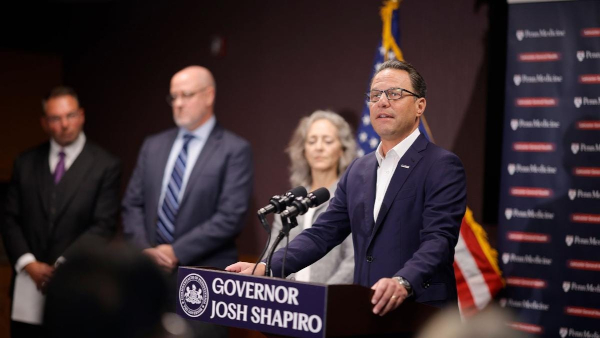
On Tuesday, August 25, 2026, Pennsylvania Governor Josh Shapiro stood inside Penn Medicine Lancaster General Health’s Women and Babies Hospital, flanked by the hospital’s CEO, and announced two “measles-associated deaths” — the first in Pennsylvania in 35 years.
If we trust official state reports, zero of the 393 measles patients confirmed in Pennsylvania in 2026 had been fully vaccinated, and both people who died were unvaccinated. This is on the record, in the same LancasterOnline article that first broke the coroner’s contradiction. The vaccine’s disputed efficacy is not what this piece is about.
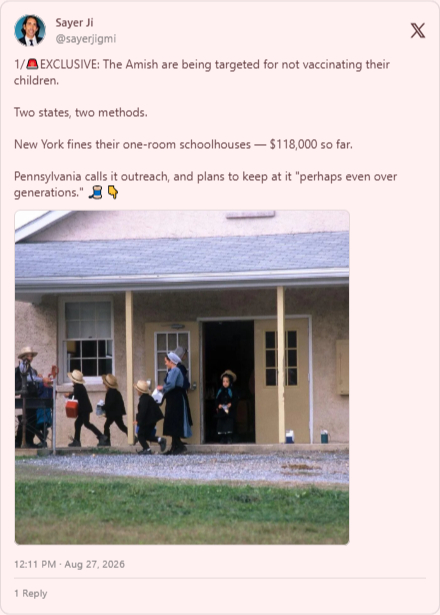
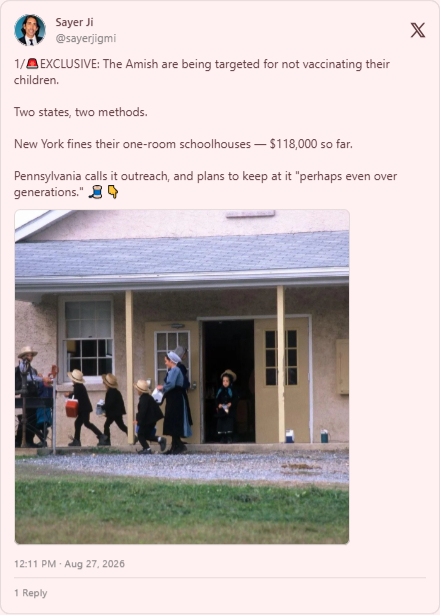
This piece is about whether the response Pennsylvania is designing for the Amish — a multi-generational persuasion campaign described in the state’s own briefing documents, backed in New York by $118,000 in fines against three one-room Amish schools and a possible mass exodus of 25,000 Amish residents — is the appropriate constitutional response to a religious minority in a country founded on religious liberty.
That question does not depend on the vaccine. It depends on the coercion. And the coercion is now on the record.
The Lancaster County Coroner told the local paper his office had handled “no measles deaths”. The one death that was folded into the state’s Aug 25 announcement and reached the coroner’s office was an infant who died of a laceration of the spleen; measles antibodies were merely present in postmortem testing. The second announced death remains unexplained in the coroner’s records — the state has not clarified whether it was ever a coroner case. Republican County Commissioner Josh Parsons called for transparency and got attacked in return, publicly, by his fellow commissioner Alice Yoder — who spent 30+ years as an executive at that same hospital running its Amish vaccination outreach, and who did not mention her background from the podium.
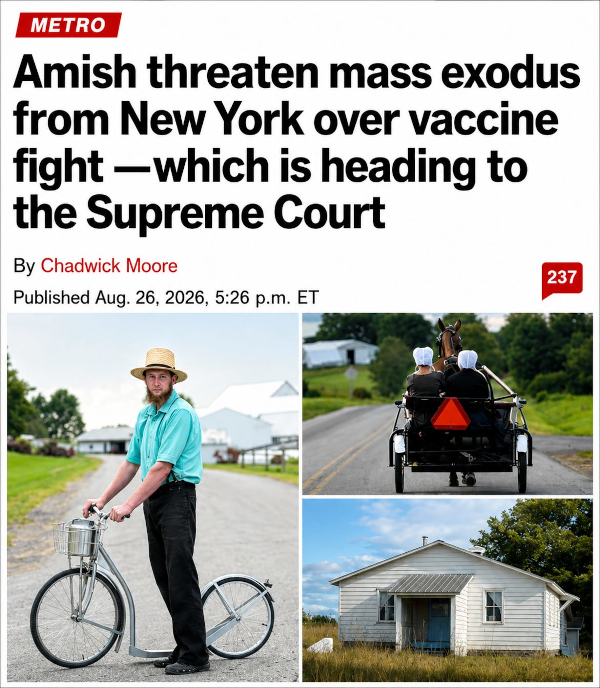
Meanwhile, 200 miles north, three one-room Amish schools in upstate New York are staring down the $118,000 in state fines, their attorneys are preparing a second petition to the U.S. Supreme Court for September, and roughly 25,000 Amish are discussing whether to leave New York for Pennsylvania.
These are two moments of the same institutional story.
This is a full investigation into what that story actually is — carried out inside a state whose own executive order boasts that it manufactures “more than one-half of all vaccines administered in the United States.”
Every claim below links to a primary source that has been fetched, read, and verified.
Two tiers of the same policy: what’s happening in Pennsylvania and New York right now
There is a real distinction that matters. Pennsylvania in 2026 is running an access-and-persuasion program — voluntary clinics, in-home visits, and materials designed to increase MMR uptake among Amish and Old Order Mennonite families. New York in 2026 is enforcing a coercive statutory regime — the state legislature repealed religious exemption in 2019, and the state health department is fining three one-room Amish schools $118,000 for enrolling unvaccinated Amish children.
These are two different legal instruments. They are being applied to the same religious minority at the same time. Whether they add up to “coordination” in a strong conspiratorial sense or “convergent evolution of technique among peer state health departments” is a judgment call. What is documented, and what should ground the discussion, is that in April 2025 the director of Pennsylvania’s Bureau of Immunizations shared a stage at a national conference with the New York City official who ran the 2019 Haredi coercion program — presenting “Outreach in the Plain Community” and “Past Efforts and Current Initiatives in NYC’s Haredi Population” as adjacent sessions under a single umbrella titled “Responding to Measles Outbreaks in High Priority Populations.”
That is not a conspiracy. It is a documented institutional network. And it is where every religious minority whose vaccination rate the state deems inadequate is going to be discussed, tactically, in years to come.
Here is what each tier looks like right now, on the ground:
Pennsylvania — access-and-persuasion:
· 91 pop-up MMR clinics across the state since April 2026, with 40 more planned
· 4,100+ MMR doses administered at those clinics
· 35,000+ Pennsylvanians received MMR in July 2026 alone — 10,000 more than a typical month
· 1,000+ providers briefed in the two weeks before the Aug 25 announcement
· Six school-based Vaccines for Children (VFC) sites in Lancaster County
· Buggy clinics, mud sales, Amish schoolhouse visits, in-home immunization services — all in the state’s own documented tactical repertoire
· No fines, no mandatory-vaccination orders, no exclusion orders — voluntary tier
New York State — coercive statutory regime:
· Religious exemption to school vaccination requirements repealed statewide, June 13, 2019
· $52,000 fine against Dygert Road School (near Canajoharie)
· $46,000 fine against Pleasant View School / Twin Mountain School (Heuvelton)
· $20,000 fine against Shady Lane School (Clymer)
· $118,000 total on three one-room Amish schools
· $2,000 civil penalty per violation; the state treats each day each unvaccinated student attends as a separate violation
· Second Circuit reaffirmed against the Amish in June 2026 after a Supreme Court remand
· Second petition to the Supreme Court being filed in September 2026
· Amish attorney Aaron Siri told the New York Post the schools could only pay “if the state seized their land to settle the debts”
· Roughly 25,000 New York Amish — the fifth-largest Amish population in the country — are discussing relocation to Pennsylvania
The tools differ. The target does not.
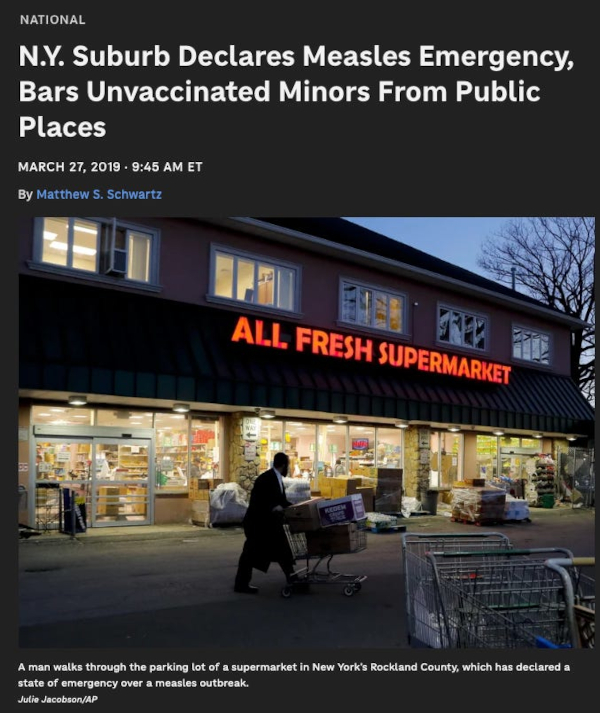
There is a historical precedent worth naming, because the reviewers of this piece will: In 2019, Rockland County, New York — where a measles outbreak concentrated in Orthodox Jewish neighborhoods — issued an emergency order banning unvaccinated minors from public places, including houses of worship, with misdemeanor exposure for parents. New York City then imposed mandatory MMR within 48 hours in four Brooklyn ZIP codes, with $1,000 fines. NYC issued 57 summonses; two schools were closed. The National Association of Counties then published Rockland’s action as a model for other counties to follow. That is the coercive template. Pennsylvania has not deployed it. New York has, in its non-emergency-order form, kept it deployed for six years. The Amish plaintiffs are asking the Supreme Court to end it. New York is defending it.
What “targeting” looks like when the state describes it in its own words
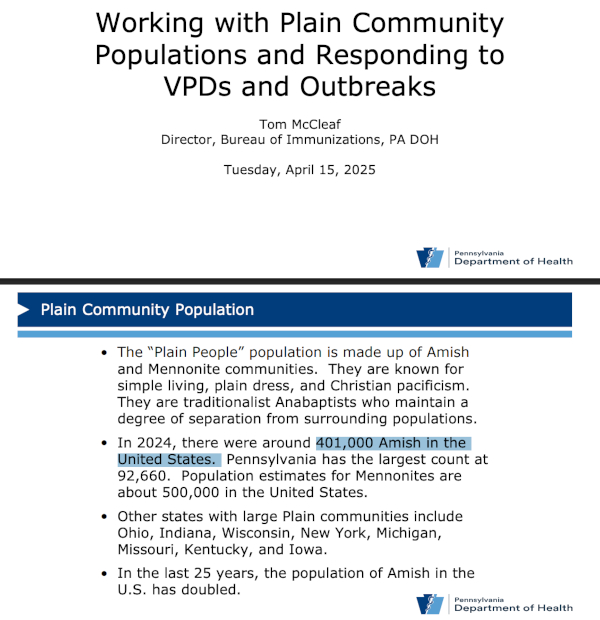
The single most important document in this story is a slide deck presented April 15, 2025 to the Association of Immunization Managers — a national body representing state and territorial immunization program directors. The presenter: Tom McCleaf, Director of the Pennsylvania Bureau of Immunizations. The section title: “Outreach in the Plain Community.” The umbrella title of the session: “Responding to Measles Outbreaks in High Priority Populations.”
That phrase — “high priority population” — is the state’s operational vocabulary for describing the Amish and Old Order Mennonite communities. Not my characterization. The state’s own.
Here is what the deck says, every phrase verbatim from the fetched PDF:
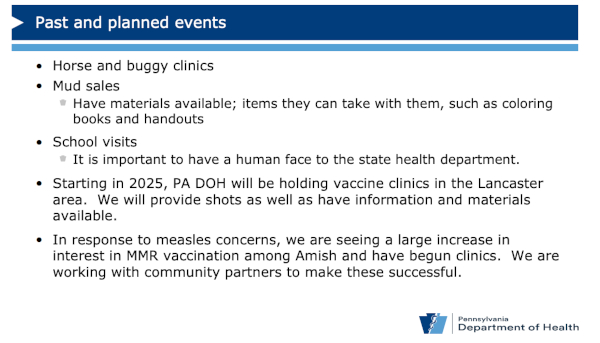
Tactics:
· “Horse and buggy clinics”
· “Mud sales — Have materials available; items they can take with them, such as coloring books and handouts”
· “School visits — It is important to have a human face to the state health department”
· “Place free materials at stores that they frequent and in farmer’s markets”
· “Starting in 2025, PA DOH will be holding vaccine clinics in the Lancaster area”
Persuasion doctrine:
· “Trust is the easiest thing lost, and the hardest thing gained”
· “Building connections with key stakeholders and trusted messengers is key”
· “Don’t be pushy and accept small wins”
· “Focus on staying healthy and fit, preventing diseases, with vaccines as just an aspect of that”
· “Making noteworthy impacts will take time, perhaps even over generations”
Reasonable people can disagree about what those last two lines mean. A charitable reading is standard health-communication practice: meet people where they are, don’t lead with the ask, take a long view. A less charitable reading is that the state has published its own strategy for changing a religious minority’s practices across biological generations by embedding vaccination inside a broader wellness framing.
You should decide for yourself. But the phrases are on the record, from the state, at a national conference. The words “over generations” mean what they mean.
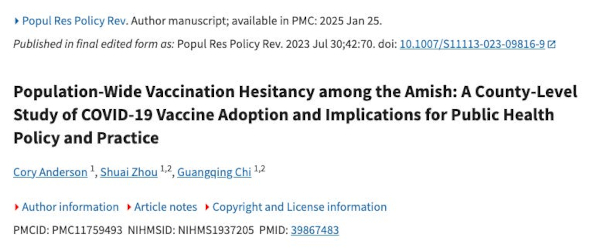
The Amish community itself has named the specific harm it fears from exactly this kind of program. From peer-reviewed research documenting what the 2014 Ohio outbreak taught the community (Anderson, Zhou & Chi 2023, Population Research and Policy Review):
“the public shame of being singled out as a people for causing a public health crisis”
That is what “high priority population” means to the people so designated.
The “learning laboratory”
The Association of Immunization Managers’ companion case study on the Pennsylvania program is titled “Pennsylvania: Immunization Rate Improvement Activities for Special Populations in Lancaster County.”
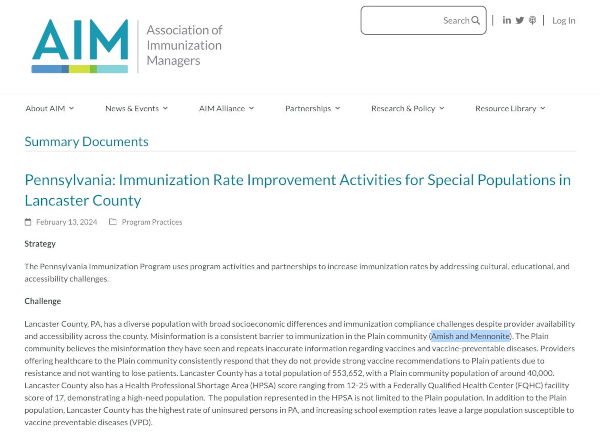
The line that should have led every news story: “The Pennsylvania Department of Health (PDH) utilized Lancaster County as a learning laboratory for immunization improvement activities.”
The program formally began July 1, 2022. It coordinates:
· Six school-based Vaccines for Children (VFC) sites
· The Lancaster County Immunization Coalition
· The Health Improvement in Plain Population (HIPP) Task Force — an entity the state names as a partner but whose governing documents, membership, and funding are not on the public record
· Farm Safety Days
· Penn State University Hospital pediatric residency
· Two research studies with Millersville University and Elizabethtown College
And here is a sentence that deserves close reading, from the case study itself: “In-home immunization services provided the desired privacy and led to additional families receiving vaccinations.”
The program identified in-home delivery as effective because it provided “desired privacy” — which the reader can construe generously (respect for individual family decisions) or critically (removal of community visibility from the choice). The state’s own document does not say which. It says only that in-home delivery worked because it was private. The interpretation belongs to the reader.
I raise it because the Amish are a communal religious society whose vaccination decisions, per peer-reviewed research, are typically made at the household level with input from neighbors and family — and because a program that increases uptake specifically by delivering vaccination out of that view is worth naming, whatever one’s inference.
Alice Yoder: what the record shows
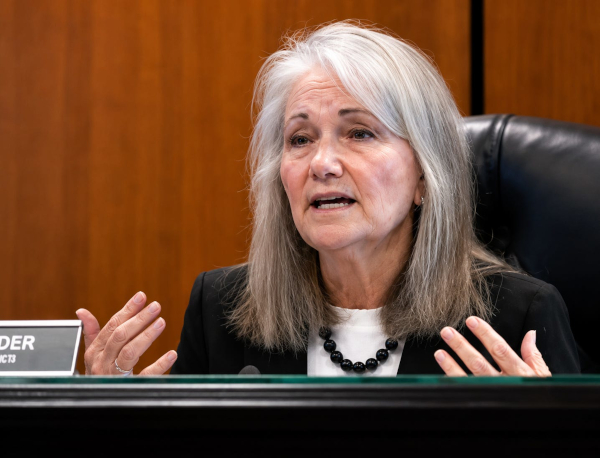
Alice Yoder is a sitting Lancaster County Commissioner. Her official conduct in that role is legitimately newsworthy, and her employment history is a matter of public record. What follows is what is documented. I offer no legal or ethical conclusion the record does not itself support.
· 1988 — Joins Penn Medicine Lancaster General Health, per her LinkedIn profile. (Her county biography describes her as having developed the LGH Wellness Center starting in 1992. Both may be correct — an employee can join a hospital before founding a specific program inside it. The 1988 date is her own.)
· 1991 — LGH launches ChildProtect, a free vaccination program for Amish children, after Amish bishops asked for help during a rubella outbreak. Since then LGH has “immunized 70,000 children, 46 percent from the Amish community”
· 2015 — Yoder, as LGH Director of Community Health, tells the American Hospital Association: “We saw the herd immunity aspect as a community benefit,” and “The Amish were coming more and more in contact with the English population”
· 2021 — Yoder is the on-record voice in national coverage of Amish COVID vaccine outreach — quoted in WESA, Business Insider, and the Associated Press
· November 2023 — Elected Lancaster County Commissioner as the only Democrat in an otherwise Republican body
· January 2024 — Sworn in
· State positions she still holds — Governor’s Advisory Board of Health; Vice-Chair of the PA Health Improvement Steering Committee (county bio)
· August 25, 2026 — Yoder is the sole county elected official at Governor Shapiro’s press conference announcing the two “measles-associated deaths” — held inside Penn Medicine LGH’s Women and Babies Hospital, alongside the LGH CEO and an LGH department chair (Governor’s release)
· August 26, 2026 — When Parsons asked her questions at the Board of Commissioners meeting the next morning as the person who had stood at that podium, she “did not have any answers,” per Parsons’s contemporaneous X post. Yoder then posted on social media that Parsons was “intentionally sowing misinformation and doubt in a trusted public health agency”
That is the record. Yoder did not mention at the Aug 25 event that she spent decades running the Amish vaccination program at the hospital hosting the event, that she was the AP’s on-record source in 2021 explaining Amish vaccine hesitancy to the American public, or that she holds sitting state health-board appointments that influence this response.
Her Statement of Financial Interests — required annually under 65 Pa.C.S. §1104 — is not published online. Whether she still receives compensation, pension, or retiree benefits from Penn Medicine LGH is answerable only through that filing, which is obtainable by records request from the PA State Ethics Commission. Someone should file the request. Whatever it shows will be the record.
Until then: what is on the record is that a county commissioner appeared at her former hospital to defend a contested state announcement, and did not tell the audience she had spent three decades running that hospital’s Amish vaccination program. Readers can draw whatever inference they think that supports.
The money the Governor doesn’t talk about
Governor Shapiro’s Executive Order 2025-02 — signed October 1, 2025 at Children’s Hospital of Philadelphia — contains a recital that no national outlet has quoted in its coverage of the August 25 death announcement:
“Pennsylvania is home to companies and institutions that are national leaders in vaccine research, development, and manufacturing, and the Commonwealth manufactures more than one-half of all vaccines administered in the United States.”
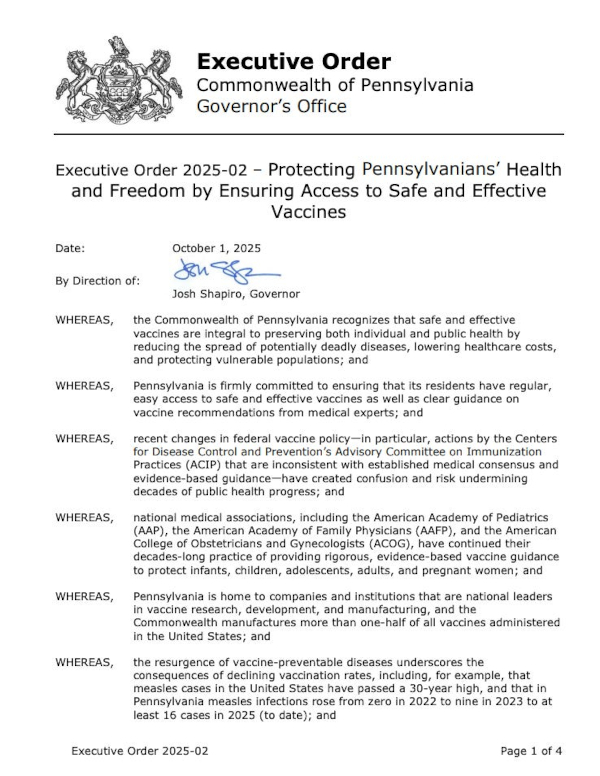
Directive 1 of that same order commands the Department of Health to build a state Vaccines for Children backstop that “shall include measures to capitalize on Pennsylvania’s national leadership in vaccine research, development, and manufacturing.”
That is not the language of a neutral public health measure. That is the language of an industrial policy commitment written into a childhood vaccine program.
Under Shapiro’s tenure, the state has awarded pharmaceutical manufacturers a subsidy stream at scale unmatched in the nation:
· GSK — $800 million investment, $21 million state subsidy — Marietta, Lancaster County; October 2024. From this plant “one in four Americans are administered a vaccine.”
· Eli Lilly — $3.5 billion investment, $100 million state subsidy — Fogelsville, Lehigh County; January 2026
· Sanofi Pasteur — $10.6 million RISE PA grant — Swiftwater, Monroe County; June 2026. This plant makes ~42% of U.S. flu vaccine doses.
· Merck — $2.9 billion expansion — West Point, Montgomery County; August 2026. This is where MMR (M-M-R II) is manufactured.
Now note the geography: Penn Medicine LGH’s free ChildProtect immunization clinic operates at 1159 River Road, Marietta. GSK’s state-subsidized vaccine plant is at 325 North Bridge Street, Marietta. Same small Lancaster County borough. Pennsylvania is delivering federally-funded MMR doses to Amish children in the same town where a pharmaceutical manufacturer builds vaccines with $21 million of state subsidy.
And the federal money nobody discusses: In FY2023 alone, the CDC awarded Pennsylvania $146,180,461 in Vaccines for Children “Vaccine Purchases” — federal dollars flowing directly to manufacturers. Nothing in that line item names the Amish. But it is the single largest documented public-to-manufacturer transfer in the state’s vaccine ecosystem, and every dose administered by a state health worker in an Amish home has been purchased through it.
I want to be honest about what I did not find: I searched hard for evidence that pharmaceutical manufacturers write checks earmarked for Amish outreach. I did not find it. The money flow to the coalition infrastructure that runs the buggy clinics is federal — CDC to PA DOH to the Pennsylvania Immunization Coalition to local coalitions and LGH’s community-benefit budget. The AIM coalition case study says so explicitly: “The majority of the funding comes from the CDC.”
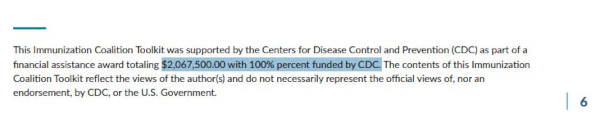
But the pharma money exists upstream — as state subsidies to manufacturers, as an endowed Merck chair at Penn and CHOP, as $2 million per year in GSK “COiMMUNITY” grants that in 2025 included the Association of Immunization Managers (the same body that hosted McCleaf’s April 2025 targeting presentation), and as an executive order that hardwires state vaccine purchasing to in-state manufacturing.
The pharma link is structural. It is upstream. And it is enormous. It doesn’t have to write a check to a buggy clinic to shape what the buggy clinic does.
What the Amish themselves have said
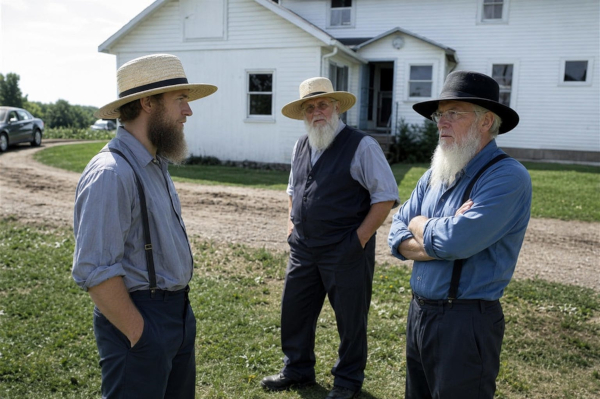
For every day of coverage of the August 25 announcement, and for every day of the New York fines litigation, this has been the most obvious hole in the story: nobody has asked the Amish.
They have, in fact, answered.
Amish father Joseph Miller, lead plaintiff in the New York school-fines case, submitted this written statement to the U.S. Supreme Court on July 31, 2025:
“Our forefathers came to America for freedom of religion in concerns of living a God fearing life + bringing up our children in a way, to hope through salvation, an everlasting life in eternity. To do this we need to put our full trust in the Almighty God. Proverbs 3:5[.]”
“Yes our Almighty God wants us to fully put our faith + trust in Him. Which is in conflict to put our trust in vaccines.”
“We are also commanded to not be conformed to this world. Romans 12:1-2.”
“Also since some of the vaccines are based on fetal or aborted cell lines, we believe it would be an abomination to our Creator to inject such into our bodies.”
Ezra Wengerd, the Amish elder elected by his community to represent all New York Amish schools in dealings with the state:
“The Amish will choose prison time or a martyr’s death before going against their convictions.”
“[Our] utmost desire [is] to live a quiet peaceful, undisturbed life and obey those in authority over us. But once those laws are in conflict with what the [B]ible teaches then we are commanded to obey God rather than man. Acts 5:29.”
These are not the words of a community weaponized by anti-vax activists. They are the words of a community with a 350-year theology of separation applying its ancient principles to a specific modern intervention.
And here is what New York State did in response. New York State Senator James Skoufis, on the record, justifying the 2019 repeal of religious exemption:
“The matter of fact is the religious exemption in New York State is made up. It’s fake. Because there is no religion that objects to vaccines. Not Islam, not Catholicism, not Judaism.” (SCOTUS petition, quoting the legislative record)
Assemblyman Jeffrey Dinowitz, on the same record:
“There’s nothing, nothing in the Jewish religion, the Christian religion, in the Muslim religion … that suggests that you can’t get vaccinated …. It is just utter garbage.”
Dinowitz then compared parents invoking religious exemptions to those who “tried [Galileo] as a heretic.”
That is the legislative animus the Amish plaintiffs are asking the Supreme Court to strike down. The Court vacated the Second Circuit’s ruling upholding the mandate on December 8, 2025 and sent the case back for reconsideration in light of Mahmoud v. Taylor. On remand, the Second Circuit reaffirmed against the Amish. The plaintiffs are refiling in September.
The community that isn’t monolithic
The most under-reported single fact in the entire national coverage is this: there is no Amish central authority to speak on this issue. The Plain community is not a bloc.
The most careful primary-voice quantitative study — Scott, Wenger, Stoltzfus et al. (2021), surveying 391 Amish families in northeast Ohio — found that a minister or bishop was named as most influential in vaccine decisions by only 4.3% of refusing families, and zero vaccinating families. Vaccination decisions are made at the household level, informed by the local church district of about 30 families, led by an unpaid bishop with no formal training.
Braxton Mitchell, a University of Maryland geneticist and longtime Amish community collaborator, put it to STAT in June 2026:
“I can say in Lancaster, many do, many don’t. There’s no directive from the church bishops about this issue, so families just choose what they want.”
Mitchell also pointed out something no national outlet has picked up:
“My impression in at least the Lancaster community is that it was not a religious issue at all per se, that a lot of it was skepticism against the government.”
Donald Kraybill, the Elizabethtown College Amish scholar, told the AP the plainest version of it:
“They’re not getting that from the media. … They’re getting it from their English neighbors.”
So when Pennsylvania’s Bureau of Immunizations director stands at a national conference and outlines a multi-generational campaign to change Amish vaccination behavior, the state is targeting a community that isn’t actually running a coordinated resistance campaign to begin with. There is no “Amish anti-vax movement” to counter. There are households, each making its own decisions, informed by neighbors, tradition, natural remedies, biblical teaching, and the same skepticism of institutions that a majority of non-Amish Americans have expressed in poll after poll since 2021.
The 2014 Ohio outbreak — the closest analogue to the current Pennsylvania situation — resulted in 8,000 Amish getting vaccinated voluntarily out of a settlement of 32,630. The community responded when it decided the risk warranted it. Ervin Kauffman told NPR in the middle of it: “I guess there was no scare to us before… I guess we were too relaxed.”
But that same community — the one that responded voluntarily in 2014 — later named, in peer-reviewed research, the specific harm it feared from being singled out publicly:
“the public shame of being singled out as a people for causing a public health crisis”
That is precisely what the Pennsylvania coverage of August 25 delivered. The Amish were made the explanatory center of a story that the state’s own outbreak data does not center on them. Dr. Pia Fenimore, vice chair of pediatrics at Lancaster General Hospital, said as much in June 2026 (three months before the deaths announcement): “the current outbreak is not centered in Amish households.” By August, Lancaster County held approximately half the state’s confirmed cases — meaningfully concentrated in the Plain community, but not the entirety of the outbreak. The 393 total cases spanned 28 counties, and per the state’s dashboard, adults made up a majority.
What the health outcomes literature actually shows
Autism. Only one population-based prevalence study has directly examined autism among Amish children. Robinson et al., presented at the International Meeting for Autism Research in 2010, conducted door-to-door screening of 1,899 children in Amish communities in Holmes County, Ohio, and Elkhart-LaGrange, Indiana. The researchers confirmed seven cases—approximately 1 in 271 children.
That figure is strikingly lower than the prevalence subsequently reported in the broader American population. Yet the study did not examine vaccination records, was published only as a conference abstract, and did not provide confidence intervals. It therefore cannot, by itself, establish why autism prevalence appeared so much lower in the communities studied.
Several features of Amish life complicate direct comparison with the general population. Amish children move through different medical, educational, and diagnostic systems: families generally do not rely on Medicaid records, children are less likely to enter conventional special-education referral pipelines, schooling often occurs in small community schools through eighth grade, and medical care is frequently paid for directly.
The Amish also descend from a relatively small founder population and possess a distinctive genetic architecture. But genetics alone does not make the finding irrelevant. It makes the population scientifically important—precisely because it offers researchers an unusually well-defined community in which genetic, environmental, dietary, pharmaceutical, educational, and vaccination exposures could be examined together.
Nor are the Amish uniformly unvaccinated. Surveys indicate that approximately 17.7% to 40.7% of Amish families accept some or all recommended vaccines. This means the Robinson study was not comparing a completely unvaccinated population with a vaccinated one. If vaccination exposure contributes to autism risk, combining children with different exposure histories inside the same population would tend to dilute the association rather than manufacture it.
Then-CDC director Dr. Julie Gerberding told journalist Dan Olmsted in 2005, according to his contemporaneous reporting, that a properly designed study of autism in the Amish “could be done and should be done.”
That was 21 years ago.
The obvious follow-up study—one that verifies diagnoses, reconstructs individual vaccination histories, measures major environmental and pharmaceutical exposures, and compares Amish children with carefully matched non-Amish populations—has still never been conducted.
The absence of that research is not evidence that the question has been answered. It is evidence that one of the most consequential and testable questions in American public health remains conspicuously unexamined.
Cancer, diabetes, cardiovascular, allergy. This is where the Amish evidence is genuinely strong — and also where the debate turns on confounders that both sides tend to mishandle.
· Westman et al. (2010), Cancer Causes & Control: 9,992 Ohio Amish adults, 1996–2003. All-cancer rate ratio 0.60 (p<0.0001). Tobacco-related cancer rate ratio 0.37, non-tobacco 0.72. The authors tested for the screening confounder by excluding screen-detectable cancers (prostate, breast, colorectal, cervical) and calculating the SIR on the remaining cancers: male 0.48, female 0.57. Their conclusion in the paper: this supports “a minimal effect of decreased cancer screening on the observed low cancer incidence in the Amish.”
· Katz et al. (2011), Journal of Rural Health — the counter-evidence to include: From the same research group (Westman is a co-author), 134 Amish adults surveyed for cancer screening rates. Amish screening rates were dramatically lower than Ohio Appalachia non-Amish participants: prostate 13.5% vs 63.1%; colorectal (males) 10.3% vs 40.0%; cervical 48.0% vs 84.0%; breast 24.8% vs 53.7%. The authors’ stated conclusion: lower screening rates “may be a contributing factor to the reduced cancer incidence rates reported among this population.”
These two findings together tell a more nuanced story than either paper alone: the Amish do have measurably lower cancer incidence, but they also screen much less. Westman’s stress-test on non-screen-detectable cancers shows the effect persists even when screening is removed as a variable. Katz’s follow-up shows screening is nonetheless a real contributor to the observed gap. Both are correct. The honest picture is that the Amish cancer advantage is likely a combination of tobacco abstention, physical labor, dietary patterns, founder genetics — and lower screening. The advocacy claim that vaccination status explains it is not what these papers show. The fact-check claim that it is only screening is not what they show either.
· BMJ Open Diabetes Research & Care: 5,377 Lancaster County Amish adults vs 2,571 NHANES European-American participants. Diabetes prevalence 3.3% vs 13.2% (ratio 0.34). Hypertension 12.7% vs 37.8% (ratio 0.46). Awareness and treatment were markedly lower in the Amish — meaning the low prevalence is not an artifact of better management.
· Tantoco et al. (2018), Annals of Allergy, Asthma & Immunology — the natural experiment. Amish household allergic disease prevalence 26.4% vs Old Order Mennonite 46.7% (p=0.0008). Both groups are genetically similar Swiss-German Anabaptists. Both are under-vaccinated relative to the general population. What differs is farm exposure and raw-milk consumption. This study, uniquely, holds vaccination roughly constant and varies farm exposure — isolating farm exposure and raw-milk consumption, not vaccination, as the driver of the allergy difference.
That last study matters most methodologically. It is the natural experiment closest to what a rigorous Amish vaccinated-vs-unvaccinated study would look like. And it shows why simple “the Amish are healthier because they don’t vaccinate” framings are wrong: two under-vaccinated Anabaptist populations have very different allergy rates depending on farm exposure. Vaccination alone can’t be the answer.
The honest formulation:
There is one real prevalence measurement of autism among the Amish — roughly 1 in 271, versus CDC’s contemporaneous estimate of about 1 in 100. That gap has never been tested against vaccination status. The Amish are measurably healthier on multiple adult cancer, diabetes, hypertension, and allergy measures — with the AP itself conceding the underlying pattern. The mechanism is unresolved. Lower screening plausibly contributes to the cancer gap. Founder genetics, tobacco abstention, physical labor, farm exposure, and dietary patterns all plausibly contribute across measures. The specific vaccination question has never been rigorously studied, despite being publicly identified in 2005 by a sitting CDC director as one that “could be done and should be done.” That state of affairs — twenty-one years of an obvious, publicly-flagged research question left unanswered — is itself a finding.
What the national media didn’t tell you
I audited more than 30 national and regional stories published August 25–27, 2026 for a specific set of facts a reader would need in order to understand what actually happened.
The Philadelphia Inquirer did break the coroner story on August 26, in follow-up coverage that included the spleen laceration, Parsons’s dispute, the PA DOH definitional caveat, and the terminology fight. Credit where it’s due. LancasterOnline, PennLive, ABC27, FOX43, CBS 21, and one AP state wire item carried by the Lewistown Sentinel all reported these facts. Pennsylvania regional press did its job.
Where the coverage broke down was the wire copy that reached the rest of the country. Mike Stobbe’s AP wire story — the version reproduced verbatim or near-verbatim by 6abc, STAT, dozens of regional papers, and read by most Americans — contained none of it. Not the coroner, not the spleen laceration, not Parsons, not Pennsylvania’s role as vaccine manufacturer, not Yoder’s LGH history. National broadcast outlets were slower than the Inquirer to follow up, and most simply moved on to Shapiro’s fight with RFK Jr. as the frame.
That is a different, narrower claim than “media blackout” — and it is documented and true.
The framing inversion in national coverage. The Amish were made the explanatory center of a story that Pennsylvania’s own outbreak data does not center on them. Adults made up a majority of the 393 confirmed cases, spanning 28 counties. Lancaster County held about half the state’s cases — meaningfully concentrated in the Plain community, but not the entirety. And the case fatality that dominated coverage was one contested infant death whose cause the county coroner did not classify as measles.
The advocacy layer moved in lockstep. Protect Our Care — fiscally sponsored by the Sixteen Thirty Fund, the Arabella Advisors-managed 501(c)(4) with $282 million in 2024 revenue — put out a same-day statement that never mentioned the Amish once, blaming the deaths on Donald Trump and RFK Jr. Nine former CDC directors issued a coordinated warning providing the reasonable-expert backdrop. The Public Health Communications Collaborative — built with UNICEF, First Draft, Yale, and the Public Good Projects — had pre-emptively published an alert against the “Amish don’t have autism” claim more than a year before the current outbreak, positioning the misinformation-control infrastructure ahead of the story it would ultimately be applied to.
The Amish were both the framing device and the erased subject. The story was about them. Their voices — in the SCOTUS petition, in peer-reviewed research, in local reporting when it existed — were nowhere in the national version of it.
Where this ends
The playbook has one more stage after Pennsylvania’s voluntary tier and New York’s coercive statutory tier. It is the stage where the coordinated pattern becomes an explicit policy: end religious exemption to school vaccination requirements state by state, close the schools that resist, fine the parents into the ground, and let the courts sort out the wreckage.
New York has done it. California has done it. Maine has done it. Connecticut has done it. West Virginia never had one. That’s five states down.
The Supreme Court will decide next term whether that constitutional trajectory continues. If it doesn’t stop it — or if a new state extends the New York model — then the coercive template that was tested on the Orthodox Jewish community in Brooklyn in 2019, and that is being applied to the Amish now, will move down the list. The next religious minority is already visible in the coverage: the fastest-growing group of religious exemption filers are, per multiple KFF polls, not any particular denomination but a rising bloc of previously mainstream families whose skepticism of institutional medicine has crystallized since 2020.
You may be reading this piece because you already agree. Someone in your family may be reading it because they don’t yet. To both of you, the core evidentiary reality is the same — and it is stronger than either side has been willing to state:
· According to official reports, zero of 393 Pennsylvania measles patients in 2026 had been fully vaccinated.
· The state announced “first measles deaths in 35 years” under a classification standard that does not require measles to be the cause of death — and the one death that reached the county coroner was classified by that coroner as a spleen laceration.
· A state health department director stood in front of his national peers and described a multi-generational campaign to change the vaccination practices of a religious minority. Every word of it is on the record. The state’s own briefing calls it “over generations.”
· A former hospital executive who ran that religious minority’s vaccine program for three decades became a county commissioner and defended the contested state announcement at that same hospital without mentioning her background. Her financial-disclosure filings are obtainable and have not yet been obtained.
· Pennsylvania simultaneously subsidizes vaccine manufacturers at unmatched scale, in an executive order that explicitly ties the state’s childhood vaccine purchasing to in-state industry.
· The community itself is not monolithic. There is no Amish central authority. There is no bishop directive against vaccines. There is a 350-year theology of separation applied by individual families, in their own homes, in prayer, in circumstances only they and their God fully understand.
· The peer-reviewed literature shows the Amish are measurably healthier on multiple adult health measures. The mechanism is unresolved. The one study that would settle the vaccination question specifically has been publicly requested by a former CDC director for 21 years and has never been done.
· Three one-room Amish schools face $118,000 in fines. Twenty-five thousand New York Amish are discussing leaving. The Supreme Court will decide in the coming term.
The vaccine’s efficacy does not settle the coercion question. It never has. Religious liberty in a constitutional republic is not conditional on whether the state agrees with the theology. And every institution named in this piece — every hospital, every state health department, every philanthropic wire-service funder, every advocacy nonprofit, every county commissioner who forgot to mention her thirty-year hospital career — is currently arguing that it should be.
The Amish have already told us what they think:
“Once those laws are in conflict with what the [B]ible teaches then we are commanded to obey God rather than man.”
— Ezra Wengerd, Amish elder (SCOTUS petition, July 31, 2025)
That is what a real religious community sounds like when the state comes for it. That is what the First Amendment was written to protect. Everything else is a policy question.
The escalation the state has run before
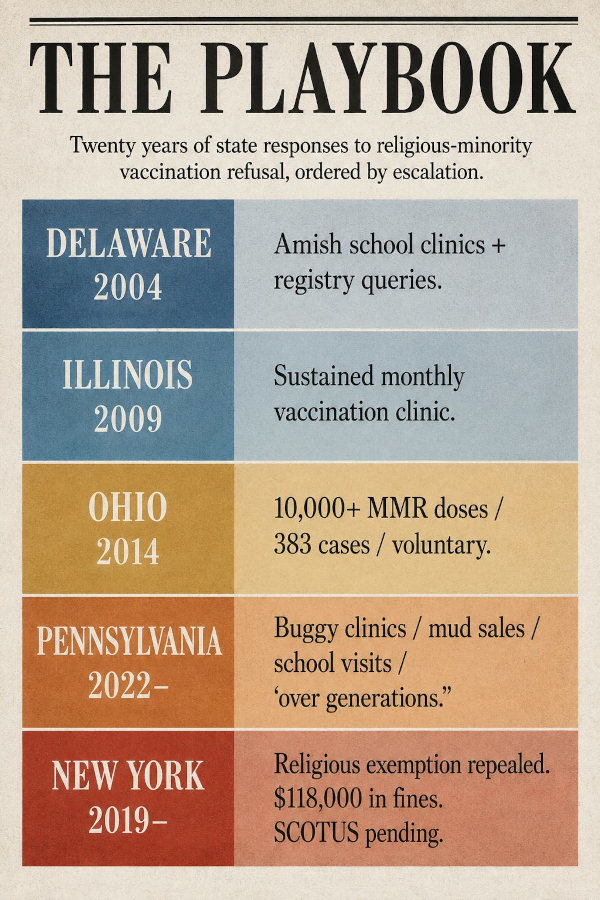
· Delaware 2004–05 (Amish, pertussis) — Special clinics held at Amish schools; state immunization registry queried against individually identified Amish children. Voluntary. MMWR 55(30)
· Illinois 2009–10 (Amish, pertussis) — Sustained monthly vaccination clinic; targeted outreach with Amish leaders. Voluntary. ASPR TRACIE
· Ohio 2014 (Amish, measles) — 383 cases, 89% unvaccinated; 10,000+ MMR doses administered in a settlement of 32,630 (only 1% of the settlement infected before containment). Voluntary campaign, community responded. NEJM
· Pennsylvania 2022–present (Amish/Plain, measles) — Six school-based VFC sites, buggy clinics, mud sales, Amish schoolhouse visits, in-home FQHC immunizations, 91 pop-up clinics, 4,100+ MMR doses since April 2026. Voluntary. State’s own director described the program as intended to work “over generations.” AIM case study; McCleaf deck
· Rockland County, NY 2019 (Orthodox Jewish, measles) — 30-day emergency ban on unvaccinated minors from public places including houses of worship; misdemeanor/fine/jail exposure for parents. Coercive. NPR
· New York City 2019 (Haredi, measles) — Mandatory MMR within 48 hours in four Brooklyn ZIP codes; $1,000 fines; 57 summonses; school closures. Coercive. Network for Public Health Law
· New York State 2019–present (Amish, all vaccines) — Religious exemption to school vaccine requirements repealed statewide. Three one-room Amish schools fined $118,000 combined for enrolling unvaccinated Amish children. Coercive. Supreme Court petition pending September 2026. NY Post
These are two different legal tiers. Delaware through Pennsylvania are access-and-persuasion. Rockland through New York State are coercive. I do not claim they are one coordinated program. I claim they are peer state health departments sharing tactics at national conferences, applied to religious minorities the departments have designated “high priority populations,” in an escalating pattern that has moved from voluntary outreach in 2004 to $118,000 school fines in 2026. Reasonable people can differ on what to call it. But it is on the record.
If you would like to help this reporting spread, please share it. If you have direct information about the HIPP Task Force, Alice Yoder’s financial disclosures, or any Amish family who has been contacted for in-home vaccination, my contact information is at sayerji.substack.com. Every source is protected.
No hay comentarios:
Publicar un comentario