Busca en Nuestros Archivos

Busca en Nuestro Blog

Translate / Traducir

Mostrando entradas con la etiqueta Black Sea. Mostrar todas las entradas

22 septiembre, 2019

#US and #Israel’s Role in #Prolonging #SyrianConflict

Latest Astana Peace Process Summit Highlights U.S. and Israel’s Role in Prolonging Syrian Conflict
By Sarah Abed
The focus of this particular summit was on restoring peace and stability in Syria by forming a committee to draft a new Syrian constitution, as well as defeating terrorist factions in Idlib. Read more...

Will the US Use Greece to Block Russia in the Black Sea?
By Paul Antonopoulos
The Trump administration last week made its first major step to create a Greek-centric NATO corridor following United States Ambassador to Greece, Geoffrey R. Pyatt, announcement that his country intends to acquire the strategic port of Alexandroupoli. Read more...

Turkey’s “Refugee City” Proposal for Syria Amounts to Demographic Engineering
By Andrew Korybko
Turkish President Erdogan’s recently announced proposal to build a “refugee city” in Northern Syria amounts to demographic engineering intended to stop the creation of a “Kurdish Corridor” there and also prevent the region from fully reintegrating into Damascus’ fold after the war. Read more...
20 marzo, 2014

Russia Extends its Control

Crisis in Ukraine: Russia Extends its Control over the Black Sea and Strategic Waterways
By Prof Michel Chossudovsky

The decision of  Crimea to join the Russian Federation has strategic and geopolitical implications.
The union of Crimea with Russia redefines both the geography as well as the geopolitical chessboard in the Black Sea basin.  

It constitutes a major setback for US-NATO, whose longstanding objective has been to integrate Ukraine into NATO with a view to undermining Russia, while extending Western military presence in the Black Sea basin.

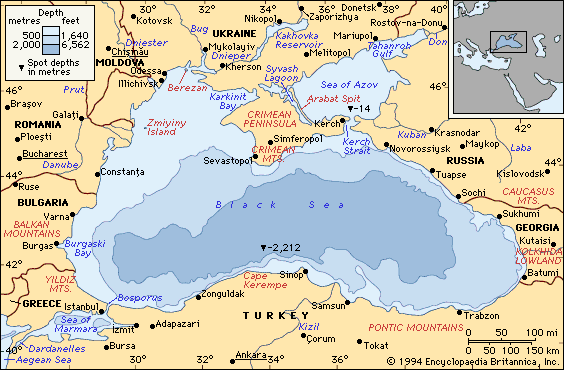
With the March 18, 2014 Treaty signed between Russia and Crimea, the Russian Federation will extend its control over the Black Sea as well over the Sea of Azov, the West coastline of which borders on Eastern Ukraine and the Donesk region. (see map below) 

Under the agreement between Russia and Crimea announced by president Putin, two “constituent regions” of Crimea will join the Russian Federation: the “Republic of Crimea” and the “City of Sevastopol”. Both will have the status of “autonomous regions”.

The status of Sevastopol as an autonomous entity separate from Crimea is related to the location of Russia’s Naval base in Sevastopol.

Since the break-up of the Soviet Union, Russia retained its naval base in Sevastopol under a bilateral agreement with Ukraine. With the signing of the March 18th Treaty, that agreement is null and void. Sevastopol including the Russian naval base become part of an autonomous region within the Russian Federation. The naval base is no within Ukraine under a lease agreement. Moreover, Crimea’s territorial waters now belong to the Russian Federation.

Strategic Waterway: The Kerch Straits
Russia now formally controls a much larger portion of the Black Sea, which includes the entire coastline of the Crimean peninsula. The Eastern part of Crimea –including the Kerch straits– are now under Russia’s jurisdiction control.  On the Eastern side of the Kerch straits is Russia’s Krasnodar region and extending  southwards are the port cities of Novorossiysk and Sochi.

Novorossiysk is also strategic. It is Russia’s largest commercial port on the Black Sea, at the cross-roads of major oil and gas pipelines between the Black Sea and Caspian sea.


Historically, the Kerch straits have played a strategic role. They constitute a gateway from the Black Sea to Russia’s major waterways including the Don and the Volga.