Busca en Nuestros Archivos

Busca en Nuestro Blog

Translate / Traducir

Mostrando entradas con la etiqueta Binoy Kampmark. Mostrar todas las entradas

28 junio, 2015

The #Charleston #Church #Gunman

The Silence of the Law: The Charleston Church Gunman

By Binoy Kampmark
gun flag
Arguments about guns in the United States resemble forays into intense religious debate.  They are doctrinal issues (the “right” to bear arms; the entitlement to protection) that chatter through the various lobbies.  There are purely quibbling legal issues (what regulations are appropriate in terms of controlling access to guns).  There are the broader ethical issues (should people even have guns as a principle to begin with?)

Those left behind in such debates tend to be the silent corpses, littered collateral damage in a rights culture that hyperventilates with each urban massacre.   Fascinatingly, none of these mass killings ever qualifies as a terrorist onslaught, even if inflicted by a person with a dog-breakfast ideology.

A theme that has recently emerged about whether Dylann Roof’s conduct prior to the deeds he is charged

10 junio, 2015

#Nonsense at the #G7Summit: #Russia, #Greece and Convenient #Threats

By Binoy Kampmark

G7 flags

Oh, the misdirected fury of it all. The self-appointed elect, those states at the G7, have decided to have a chat about matters deemed critical for them.  A few interlopers are also present – Nigeria, Tunisia and Liberia, for instance.  Like any club whose rules vary between snooty and arbitrary, there were exclusions.  On this occasion, basic arithmetic dictated that it would be a G7 summit, as opposed to a G8 one – Russia was excluded, largely because, it would seem, the member states needed something to talk about.

The agenda shaped up very quickly. The G7 chat fest did take some time out to consider the environmental side of matters, suggesting that fossil fuels were being given the heave ho.  “We commit to doing our part to achieve a low-carbon global economy in the long-term, including developing and deploying innovative technologies striving for a transformation of the energy sectors by 2050.”[1]

But the members had two states in their sights.  One was the superstar absentee, target of European and US morality and historical ennui: Russia.  As the G7 communique outlined, “We stand ready to take further restrictive measures in order to increase [the] cost on Russia should its actions so require.”  The other was Greece, target of economic opprobrium and whipping boy of Europe’s disastrous financial policies.

It was Moscow who got the biggest serve.  “Does [Vladimir Putin],” US President Barack Obama observed, “continue to wreck his country’s economy and continue Russia’s isolation in pursuit of a wrong-

18 mayo, 2015

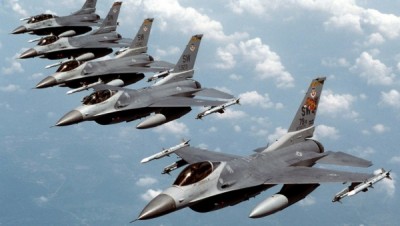
#US #Bombers to #Australia

Washington’s Deployments in the Pacific

us_bombers

The language never reflects the actual conduct.  Deploying weapons to a region in greater numbers is not seen as provocative, even if placing such items in a theatre of operations is bound to get neighbours nervous.  This is particularly the case about the US “rebalance” in the Asia-Pacific.  “The ongoing deliberations,” notes John J. Hamre of the Centre for Strategic and International Studies, “are shaped more by the legacy of the past (for example arguing about where to relocate particular facilities) than by the security imperatives of the next thirty years.”

In the background, China lurks as both threat and opportunity – as long as the appropriate moves are made on its part to accommodate the wishes of Washington and its allies.  Grow and flourish, by all means but do so within neatly demarcated parameters of power interests.  Enemies can be refashioned and rebranded overnight, even if they do tend to hold the credit strings.

This is the backdrop of the remarks made last week by David Shear, the US Defence Department’s Assistant Secretary for Asian and Pacific Security Affairs. Before the US Senate Foreign Relations Committee on Wednesday, Shear explained that Washington would “be placing additional air force assets in

21 abril, 2015

Fearing the Loss of #Hegemony: The Concept of #US Retreat


The Road to Armageddon: The Insane Drive for American Hegemony Threatens Life on Earth

“A hegemon is supposed to solve international crises, not cause them.” – Christopher Layne, The American Conservative, May 1, 2010

Nothing upsets those drunk on imperialist virtue than the fact it might end.  Such romances with power do have a use-by-date, going off like old fruit. Eventually, the crippling contradictions will win through in the end. The days of the US empire are numbered – but then again, they always were.

The recent round of spring meetings at the International Monetary Fund and the World Bank flutter with suggestions that American economic power is being shaded, be it by the republic’s own dysfunction, or the emergence of other powers like China.  “People can’t be too public about these things,” argues Arvind Subramanian, chief economic advisor to the Indian government, “but I would argue this is the single most important issue at these spring meetings.”[1]

This would come as a surprise for some.  The various theorists on international theory, many slumming at The Weekly Standard, form the praetorian guard of arm chair defenders of American virtue and power.  Max

07 octubre, 2014

Air Strikes Against the #IslamicState

The Law of Futility
By Binoy Kampmark
airstrike
War is a dirty, unforgiving business.  It is not rendered clean by remote deployments and orders executed at a distance from seemingly safe areas.  It takes lives, inflicts unspeakable harm, and rarely brings smiles to those who suffer it. But the members of the US-led coalition currently involved in striking Islamic State targets in Syria and Iraq would have you think otherwise.  They give the impression that clean distances are golden, and air strikes will have their intended “degrading” effect.  Therein lies the message about the false salvation of machinery – the technological panacea that rarely does what it is meant to.

The notion that air power would win the day has been something of a fetish for enthusiasts, both of the prophetic and practising sort.  It prophetically concerned H. G. Wells in The War in the Air(1908).  It enraptured Britain’s blood lusting Air Marshal Arthur “Bomber” Harris during World War II, who believed in characteristically delusional fashion that his death sowing fleets won the war in exclusive fashion.  Curtis “Demon” Le May fronted as the US equivalent, instrumental behind the striking of sixty-four Japanese cities between March and August 1945 that killed around 330,000 people.  The doctrinal holy water, however, came from the font of the US Strategic Bombing Survey.

10 septiembre, 2014

The Scotland Drive for Independence

Decapitating the Union, Seceding from the United Kingdom
By Binoy Kampmark 

Scottish independence globalresearch.ca
It is a union that has lasted 307 years.  On September 18, Scotland goes to the polls to see whether it will secede from the United Kingdom.   The polls are getting closer, and shocks have been felt with the suggestion that the Yes vote may well get across the line.

There is much going for the Yes group.  Britain suffers the curse of centrism.  London is everything, and sees itself as everything.  The great, rebarbative weapon of the south, Margaret Thatcher, destroyed the industrial, and consequently, Tory base. (In thanks, the north sports only one conservative member.) University education is free for the Scots, a feature that seems positively alien in public school mad England.  While the state is still seen as an instrument of social responsibility, down south, it is an evil in need of winding back.

The nationalists claim that Scots will be richer to the tune of £1,000 a year if they leave.  This figure is not necessarily reliable – like all such projections, they are subject to debt obligations, productivity and the natural resource issue.  North Sea oil is certainly touted as the great patch up, but it can only ever be temporary.

For all of this, the leader of the Scottish National Party (SNP), Alex Salmond, might finish strongly, even if he won’t get the vote he wants.  Salmond caught Alistair Darling, leader of the Better Together group, napping in their second television debate.  No nonchalance there. Just a roar for the independence cause.  In the last leg of this campaign, the pro-union campaigners are starting to sweat at the social media barrage and street canvassing on the part of the Yes campaigners.

28 agosto, 2014

NSA: Over 850 Billion Records

“Obese Intelligence”: The NSA Search Engine. “Over 850 Billion Records about Phone Calls, Emails, Cellphone Locations, and Internet Chats”
By Binoy Kampmark
nsa
The Intercept was already getting the intelligence community excited with its revelations that the National Security Agency had decided to mimic inspector Google.  Through creating a search engine in the manner of those pro-transparency pioneers, the intelligence community was turning the tables on the very idea of searchable information.  Why keep it the operating preserve of the public?  The search engine has, as it stands, over 850 billion records about phone calls, emails, cellphone locations, and internet chats.[1]

The revelations have a few implications, the most obvious one confirming the seamless transition between intelligence work on the one hand, and the policing function on the other. The distinction between intelligence communities whose interests are targeting matters foreign to the polity; and those who maintain order within the boundaries of a state in a protective capacity, prove meaningless in this form.  The use of ICREACH makes it clear that the Drug Enforcement Administration and the Federal Bureau of Investigation are regular clients and users of the system.

A 2010[2] memorandum from the Chief of Liaison Support Group at the CIA titled “CIA colleagues enthusiastically welcome NSA training” speaks with praise about those “NSA-ers embedded in CIA’s workspaces”.  Indeed, it speaks very highly of the “information sharing” ethos of the NSA within the Intelligence Community, channelling Google’s operating rationale within more secret spaces. Furthermore, in 2010, the relevant data base provided the NSA “and second Party telephony metadata events to over 1000 analysts across 23 US Intelligence Community agencies.”

Those keen on squirreling information into such a data base are no doubt thrilled by the prospects that it can be made available to the “appropriate” sources.  ICREACH has become one of the largest, if not largest system for the internal processing and sharing of surveillance records within the United States.  It is not, according to The Intercept, connected with the NSA database that stores data on Americans’ phone calls pursuant to s. 215 of the Patriot Act.