Ray McGovern
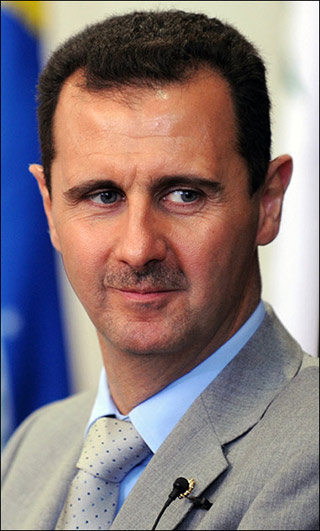 |
| Credit: Fabio Rodrigues Pozzebom via Wikimedia Commons |
Editor Note: Despite the Obama administration’s
supposedly “high confidence” regarding Syrian government guilt over the
Aug. 21 chemical attack near Damascus, a dozen former U.S. military and
intelligence officials are telling President Obama that they are picking
up information that undercuts the Official Story.
MEMORANDUM FOR: The President
FROM: Veteran Intelligence Professionals for Sanity (VIPS)
SUBJECT: Is Syria a Trap?
Precedence: IMMEDIATE
We regret to inform you that some of our former co-workers are
telling us, categorically, that contrary to the claims of your
administration, the most reliable intelligence shows that Bashar
al-Assad was NOT responsible for the chemical incident that killed and
injured Syrian civilians on August 21, and that British intelligence
officials also know this. In writing this brief report, we choose to
assume that you have not been fully informed because your advisers
decided to afford you the opportunity for what is commonly known as
“plausible denial.”
We have been down this road before – with President George W. Bush, to whom we addressed our first VIPS memorandum immediately
after Colin Powell’s Feb. 5, 2003 U.N. speech, in which he peddled
fraudulent “intelligence” to support attacking Iraq. Then, also, we
chose to give President Bush the benefit of the doubt, thinking he was
being misled – or, at the least, very poorly advised.
Secretary of State John Kerry departs for a Sept. 6 trip to Europe
where he plans to meet with officials to discuss the Syrian crisis and
other issues. (State Department photo)
The fraudulent nature of Powell’s speech was a no-brainer. And so,
that very afternoon we strongly urged your predecessor to “widen the
discussion beyond … the circle of those advisers clearly bent on a war
for which we see no compelling reason and from which we believe the
unintended consequences are likely to be catastrophic.” We offer you the
same advice today.
Our sources confirm that a chemical incident of some sort did cause
fatalities and injuries on August 21 in a suburb of Damascus. They
insist, however, that the incident was not the result of an attack by
the Syrian Army using military-grade chemical weapons from its arsenal.
That is the most salient fact, according to CIA officers working on the
Syria issue. They tell us that CIA Director John Brennan is perpetrating
a pre-Iraq-War-type fraud on members of Congress, the media, the public
– and perhaps even you.
We have observed John Brennan closely over recent years and, sadly,
we find what our former colleagues are now telling us easy to
believe. Sadder still, this goes in spades for those of us who have
worked with him personally; we give him zero credence. And that goes, as
well, for his titular boss, Director of National Intelligence James
Clapper, who has admitted he gave “clearly erroneous” sworn testimony to
Congress denying NSA eavesdropping on Americans.
Intelligence Summary or Political Ploy?
That Secretary of State John Kerry would invoke Clapper’s name this
week in Congressional testimony, in an apparent attempt to enhance the
credibility of the four-page “Government Assessment”
strikes us as odd. The more so, since it was, for some unexplained
reason, not Clapper but the White House that released the “assessment.”
This is not a fine point. We know how these things are done. Although
the “Government Assessment” is being sold to the media as an
“intelligence summary,” it is a political, not an intelligence
document. The drafters, massagers, and fixers avoided presenting
essential detail. Moreover, they conceded upfront that, though they
pinned “high confidence” on the assessment, it still fell “short of
confirmation.”
Déjà Fraud: This brings a flashback to the famous Downing
Street Minutes of July 23, 2002, on Iraq, The minutes record the Richard
Dearlove, then head of British intelligence, reporting to Prime
Minister Tony Blair and other senior officials that President Bush had
decided to remove Saddam Hussein through military action that would be
“justified by the conjunction of terrorism and WMD.” Dearlove had gotten
the word from then-CIA Director George Tenet whom he visited at CIA
headquarters on July 20.
The discussion that followed centered on the ephemeral nature of the
evidence, prompting Dearlove to explain: “But the intelligence and facts
were being fixed around the policy.” We are concerned that this is
precisely what has happened with the “intelligence” on Syria.
The Intelligence
There is a growing body of evidence from numerous sources in the
Middle East — mostly affiliated with the Syrian opposition and its
supporters — providing a strong circumstantial case that the August 21
chemical incident was a pre-planned provocation by the Syrian opposition
and its Saudi and Turkish supporters. The aim is reported to have been
to create the kind of incident that would bring the United States into
the war.
According to some reports, canisters containing chemical agent were
brought into a suburb of Damascus, where they were then opened. Some
people in the immediate vicinity died; others were injured.
We are unaware of any reliable evidence that a Syrian military rocket
capable of carrying a chemical agent was fired into the area. In fact,
we are aware of no reliable physical evidence to support the claim that
this was a result of a strike by a Syrian military unit with expertise
in chemical weapons.
In addition, we have learned that on August 13-14, 2013,
Western-sponsored opposition forces in Turkey started advance
preparations for a major, irregular military surge. Initial meetings
between senior opposition military commanders and Qatari, Turkish and
U.S. intelligence officials took place at the converted Turkish military
garrison in Antakya, Hatay Province, now used as the command center and
headquarters of the Free Syrian Army (FSA) and their foreign sponsors.
Senior opposition commanders who came from Istanbul pre-briefed the
regional commanders on an imminent escalation in the fighting due to “a
war-changing development,” which, in turn, would lead to a U.S.-led
bombing of Syria.
At operations coordinating meetings at Antakya, attended by senior
Turkish, Qatari and U.S. intelligence officials as well as senior
commanders of the Syrian opposition, the Syrians were told that the
bombing would start in a few days. Opposition leaders were ordered to
prepare their forces quickly to exploit the U.S. bombing, march into
Damascus, and remove the Bashar al-Assad government
The Qatari and Turkish intelligence officials assured the Syrian
regional commanders that they would be provided with plenty of weapons
for the coming offensive. And they were. A weapons distribution
operation unprecedented in scope began in all opposition camps on August
21-23. The weapons were distributed from storehouses controlled by
Qatari and Turkish intelligence under the tight supervision of U.S.
intelligence officers.
Cui bono?
That the various groups trying to overthrow Syrian President Bashar
al-Assad have ample incentive to get the U.S. more deeply involved in
support of that effort is clear. Until now, it has not been quite as
clear that the Netanyahu government in Israel has equally powerful
incentive to get Washington more deeply engaged in yet another war in
the area. But with outspoken urging coming from Israel and those
Americans who lobby for Israeli interests, this priority Israeli
objective is becoming crystal clear.
Reporter Judi Rudoren, writing from Jerusalem in an important article
in Friday’s New York Times addresses Israeli motivation in an
uncommonly candid way. Her article, titled “Israel Backs Limited Strike
Against Syria,” notes that the Israelis have argued, quietly, that the
best outcome for Syria’s two-and-a-half-year-old civil war, at least for
the moment, is no outcome. Rudoren continues:
“For Jerusalem, the status quo, horrific as it may be from a
humanitarian perspective, seems preferable to either a victory by Mr.
Assad’s government and his Iranian backers or a strengthening of rebel
groups, increasingly dominated by Sunni jihadis.
“‘This is a playoff situation in which you need both teams to lose,
but at least you don’t want one to win — we’ll settle for a tie,’ said
Alon Pinkas, a former Israeli consul general in New York. ‘Let them both
bleed, hemorrhage to death: that’s the strategic thinking here. As long
as this lingers, there’s no real threat from Syria.’”
We think this is the way Israel’s current leaders look at the
situation in Syria, and that deeper U.S. involvement – albeit,
initially, by “limited” military strikes – is likely to ensure that
there is no early resolution of the conflict in Syria. The longer Sunni
and Shia are at each other’s throats in Syria and in the wider region,
the safer Israel calculates that it is.
That Syria’s main ally is Iran, with whom it has a mutual defense
treaty, also plays a role in Israeli calculations. Iran’s leaders are
not likely to be able to have much military impact in Syria, and Israel
can highlight that as an embarrassment for Tehran.
Iran’s Role
Iran can readily be blamed by association and charged with all manner
of provocation, real and imagined. Some have seen Israel’s hand in the
provenance of the most damaging charges against Assad regarding chemical
weapons and our experience suggests to us that such is supremely
possible.
Possible also is a false-flag attack by an interested party resulting
in the sinking or damaging, say, of one of the five U.S. destroyers now
on patrol just west of Syria. Our mainstream media could be counted on
to milk that for all it’s worth, and you would find yourself under still
more pressure to widen U.S. military involvement in Syria – and perhaps
beyond, against Iran.
Iran has joined those who blame the Syrian rebels for the August 21
chemical incident, and has been quick to warn the U.S. not to get more
deeply involved. According to the Iranian English-channel Press TV,
Iranian Foreign Minister Mohammad Javid Zarif has claimed: “The Syria
crisis is a trap set by Zionist pressure groups for [the United
States].”
Actually, he may be not far off the mark. But we think your advisers
may be chary of entertaining this notion. Thus, we see as our continuing
responsibility to try to get word to you so as to ensure that you and
other decision makers are given the full picture.
Inevitable Retaliation
We hope your advisers have warned you that retaliation for attacks on
Syrian are not a matter of IF, but rather WHERE and WHEN. Retaliation
is inevitable. For example, terrorist strikes on U.S. embassies and
other installations are likely to make what happened to the U.S.
“Mission” in Benghazi on Sept. 11, 2012, look like a minor dust-up by
comparison. One of us addressed this key consideration directly a week
ago in an article titled
“Possible Consequences of a U.S. Military Attack on Syria – Remembering
the U.S. Marine Barracks Destruction in Beirut, 1983.”
For the Steering Group, Veteran Intelligence Professionals for Sanity
Thomas Drake, Senior Executive, NSA (former)
Philip Giraldi, CIA, Operations Officer (ret.)
Matthew Hoh, former Capt., USMC, Iraq & Foreign Service Officer, Afghanistan
Larry Johnson, CIA & State Department (ret.)
W. Patrick Lang, Senior Executive and Defense Intelligence Officer, DIA (ret.)
David MacMichael, National Intelligence Council (ret.)
Ray McGovern, former US Army infantry/intelligence officer & CIA analyst (ret.)
Elizabeth Murray, Deputy National Intelligence Officer for Middle East (ret.)
Todd Pierce, US Army Judge Advocate General (ret.)
Sam Provance, former Sgt., US Army, Iraq
Coleen Rowley, Division Council & Special Agent, FBI (ret.)
Ann Wright, Col., US Army (ret); Foreign Service Officer (ret.)
This Memorandum was posted first on Consortiumnews.com.
