Busca en Nuestros Archivos

Busca en Nuestro Blog

Translate / Traducir

Mostrando entradas con la etiqueta Petro Poroshenko. Mostrar todas las entradas

23 junio, 2015

Overthrow of Yanukovych Was a Coup

Says Ukraine’s President Poroshenko
By Eric Zuesse

petro-poroshenko-209x300

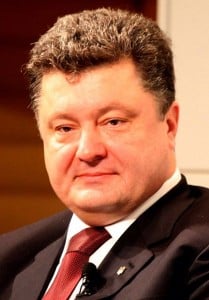
Ukraine’s President Petro Poroshenko requests the supreme court of Ukraine to declare that his predecessor, Viktor Yanukovych, was overthrown by an illegal operation; in other words, that the post-Yanukovych government, including Poroshenko’s own Presidency, came into power from a coup, not from something democratic, not from any authentic constitutional process at all.

In a remarkable document, which is not posted at the English version of the website of the Constitutional Court of Ukraine, but which is widely reported outside the United States, including Russia, Poroshenko, in Ukrainian (not in English), has petitioned the Constitutional Court of Ukraine (as it is being widely quoted in English):

“I ask the court to acknowledge that the law ‘on the removal of the presidential title from Viktor Yanukovych’ as unconstitutional.”

I had previously reported, and here will excerpt, Poroshenko’s having himself admitted prior to 26 February 2014, to the EU’s investigator, and right after the February 22nd overthrow of Yanukovych, that the overthrow was a coup, and that it was even a false-flag operation, in which the snipers, who were dressed as

18 julio, 2014

The Political Paralysis of the Ukraine Narrative

everythingleft.co.uk


mh17-crash


As the blame game begins and the conspiracy theorists start painting their pictures of what might have possibly happened to Malaysian Airlines flight MH17, political analysis based on inevitably futile investigations provide an unhealthy distraction.

The smoke was still thick in the air on Thursday as Ukrainian president Petro Poroshenko released his first statements declaring that “those responsible for the given tragedy would be brought to justice” as he also denied any involvement of the Ukrainian military in what he described as an act of terrorism. Meanwhile, a number of representatives of the self proclaimed “Donetsk Peoples Republic” claimed that not only were they not responsible for the alleged attack, but that they do not posess the military equipment or capabilities to shoot down an aircraft travelling at the altitude of Malaysian Airlines flight MH17. Nevertheless, the media delivered around the clock coverage analysing the event based on photographs emanating from social media as we listened to the guessing games of political analysts willing to take on the role of flight crash investigator.
The main problem of focussing efforts on trying to develop theories of what exactly happened in events of such magnitude, or even dealing with investigations of specific events of a sensitive nature, the sniper shootings at Maidan for instance or where certain weapons or funding in East Ukraine has originated, is that in the public sphere, we will never have access to the classified evidence needed to paint an accurate picture. Political analysis reduced to the realms of unsubstantiated suspicion will always fall into the realms of conspiracy and until we have access to the evidence, an assertion without it can be refuted without it.

In her book, “The Shock Doctrine”, Naomi Klein describes a paralysing shock that occurs following certain events throughout history. According to Klein, this state of shock is not necessarily something that happens to us at the moment of a specific event as it happens, but something that occurs when we lose our narrative and remain disorientated and vulnerable. It is only through rediscovering our narrative, our situation, within the context of our history that we become more alert and responsive. As each media outlet chose to report Thursday’s plane crash by focusing their reporting on issues concerning BUK Missile systems, supposed leaked phone calls and accusations or denials from both sides of the Ukrainian conflict, I was struck by the ongoing paralysis and vulnerability that we have become accustomed to with regards to any real political analysis of the situation in Ukraine, and to many aspects of geopolitical analysis in general.