Busca en Nuestros Archivos

Busca en Nuestro Blog

Translate / Traducir

Mostrando entradas con la etiqueta Six years on: The mysterious crash of Cocaine2. Mostrar todas las entradas

10 noviembre, 2013

The #NSA, #Drug #Trafficking, & the #Crash of #Cocaine 2


Daniel Hopsicker

This will someday be remembered as the year when shocking new discoveries about the National Security Agency became an almost daily occurrence. But amid the steady drumbeat of revelations, the one I’ve been waiting for hasn’t yet surfaced: 
The NSA’s involvement in the global drug trade. 

Surprised? So was I, at first. But the NSA does a lot more than just signals intelligence. More than a decade ago, long before the current brouhaha, I heard credible allegations about an NSA role in the cocaine trade in Bolivia, from someone who was there. What I know of the NSA’s links to drug trafficking requires a brief excursion back to the year 2000. More on that in a moment.
Today the NSA is mapping American’s social networks, using cell-phone geo-location to track their movements , cracking the encryption guarding their bank accounts, medical records, e-mails, Web searches, Internet chats and phone calls.
Just this week we learned that the NSA spied on everyone from Mohammed Ali to Martin Luther King to Republican Senator Howard Baker during the Vietnam War.
The NSA’s new Utah Data Center is already up and running, and they didn’t even announce it. No big "Grand Opening" sign outside, no balloons, no parade, no open house… and no sense of humor.

Art Buchwald, Enemy of the State.
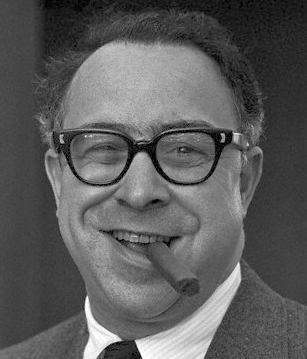
Here's two horrific facts about the NSA: The Surveillance State is menacing our basic political liberties. Equally important: they have no sense of humor.
The most revealing single nugget of information about the NSA which has come to light, to me, is the recent discovery that they even spied on humorist Art Buchwald. Many won’t remember him–Buchwald is dead, and from another era—but he was utterly harmless. Even his humor was gentle.
So how did he became a ‘person of interest’ to the NSA?
The answer tells you everything you need to know about why the NSA today represents a clear and present danger to the Republic. At the time (1967) someone had figured out that the Vietnam War was costing the Pentagon $300,000 per enemy combatant killed.
Buchwald wrote a column suggesting the US should offer any Viet Cong who defect to our side a new house in the US, a new car, a color television set and a paid-up country-club membership. We’d still be saving money, he figured, not to mention creating jobs right here in the US.

Running Bolivia for the NSA
“Spying is spying. You have to make up your mind that you are going to have an intelligence agency, protect it as such, and shut your eyes and take what is coming.” Senator John Stennis, Democrat from Mississippi.
It’s the year 2000. In the middle of a mild winter in Bay St. Louis, Mississippi, home to the John C. Stennis Space Center, a NASA rocket testing facility, on the banks of the Pearl River that forms the boundary between Mississippi and Louisiana, fifty miles east along the Gulf Coast from New Orleans. I’m there doing research for my book, “Barry & the Boys.”
At the invitation of a retired US Customs Agent, I’m At Dan B’s, a popular local bar and restaurant on a waterfront crowded with yachts and shipbuilders, to meet a man who knew and worked for more than a decade in Central and South America with life-long CIA pilot and famous American drug smuggler Adler Berriman “Barry” Seal.
With a touch of awe in his voice, the Customs Agent told me the man I’m there to meet was such a “big dog” during the ‘80’s that the US Customs Service had a 17-man squad (he was on it) assigned to do nothing but track every movement he made, both inside and outside of the U.S.
He had been running Bolivia for the NSA, the Customs Agent said, while Barry Seal was flying round-trips to South America on military cargo planes loaded with weapons and cocaine. American intelligence is a competitive world. So, of course, U.S. Customs was intrigued.

A visitor and a warning
From across the room I see a man slip into the restaurant almost unnoticed, heading this way. My NSA informant turns out to be a steely blue-eyed middle-aged man dressed in a tight-fitting olive drab t-shirt.
He moves across the room with a quiet sense of power that belies his smallish frame. He has the kind of erect former military bearing that becomes increasingly recognizable as you approach Mobile, Alabama, where they seem to congregate in the winter.
When we met, he requested anonymity. It was, he said, ‘mission critical.’
One reason for his reluctance to use his real name became clear with the first words out of his mouth. “The day after we first met, something happened,” he said with obvious annoyance.
“I got a visit from a well-known man I haven’t seen for a half-dozen years. He warned me against talking with you. Then he asked me if I had everything I need.
“‘Got enough money, Russ? Need anything?’" He shrugged.
So in “Barry & ‘the boys’” I called him “Gus.” But a few years ago he passed away. So there’s no harm now in using his real name.
His name was Russ Eakin.

In the here and now
"We are here," said muckraking American journalist H. L. Mencken, "and it is now. Further than that all human knowledge is moonshine.”
While this story is not about Russ Eakin, a sense of who he was may be important in understanding what comes next. Also, he was such a picture-perfect example of the type of American, for better and worse, who strode the continents of Earth during the American Century.
Russ Eakin was born in Bay St Louis in 1944 and raised in the small town of Bunkie, Louisiana (pop 5000), which bills itself, perhaps over-enthusiastically, as the “Best Spot Topside on God’s Green Earth!”
My first question to him was how had he become a spook.
“I was asked if I was interested in taking a trip to Honduras in the summer of 1964,” he replied. “I learned Spanish quickly, in two weeks, and loved the culture. And I ended up living in Central and South America and working for two different factions of the U.S. Government: Customs and NSA.”
Two weeks seems an incredibly short time to learn a language. Then I learned of his family’s record of achievement. His mother, one of Louisiana’s most celebrated historians, edited a scholarly edition of “Twelve Years a Slave,” the autobiographical memoir of a free black man who was kidnapped into slavery in 1841, working on plantations in Louisiana for 12 years before his release.
The book, considered “the best firsthand account of slave life in existence,” was turned into a movie starring Brad Pitt, and is being released this month.
His father, according to his obituary in the Feb 8, 1995 Alexandria Daily Town Talk, was a newspaper publisher who graduated magna cum laude from Louisiana State University. Among the children he left behind was “Russell Eakin of Mexico City, Mexico and Mandeville, LA.”


A job is a job is a job
“If they can get you to ask the wrong questions, they don’t have to worry about the answers.” Thomas Pynchon
“I first met Barry Seal in the lobby of the Hotel Maya in Tegucigalpa, Honduras, back in the mid-70’s,” he told me. “Barry was good friends with the owners of the hotel, which was the center of intrigue in Central America back then.”
“And just by looking at each other, we both knew what the other was doing, although neither of us stated it openly. It was just…understood. Besides, what we were doing wasn't as important as the fun we were having doing it. We were—both of us—making more money than we knew what to do with, and having a great old time.”
“What did you do down there?” I asked.
“My job was to corrupt the governments of Central America,” he stated crisply. “And I was so good at it I didn’t come back for 17 years.”
“I was working for NSA. I owned two arms manufacturing plants in Bolivia. They were set up through the Catholic Church. I worked out daily with (Bolivian) President Bandar. We built SM-90 machine guns.”
“We manufactured 5000 machine guns a day, using computer-driven lathes from Rockwell International. Each one cost us 35 bucks. And we’d sell ‘em for $1200 apiece.”
“We field-tested them against the Israelis, who had designs on the biz but could never get their foot in the door, because they were so mistrusted. Row after row of Bolivian Generals in tents, our weapons against the Israelis, and we won.”


The Great Cocaine Coup
Eakin was in Bolivia during the Cocaine Coup in 1980.
“Garcia-Meza brought in the neo-fascist paramilitary squads with the swastika armbands. They called themselves the ‘Fiancées of death.’ He put the Interior Ministry under the nephew of Roberto Suarez, the self-styled King of Cocaine.”
“I knew Roberto Suarez very well,” Eakin said quietly. “I was married to one of the Suarez’s.”
Eakin also knew Sonia Atala, the other well-known drug figure in Bolivia at the time. Known as the “queen of the cocaine business," she may be the most important figure of the Iran Contra era to avoid wide exposure.
“Sonia ran the cocaine biz in Bolivia,” said Eakin. “And that was where the business was run from. The guys you heard about—the Ochoa’s and the Escobar’s and the Lehder's—they were just Vice Presidents fronting for the company.”
“And Barry Seal worked directly for Sonia.”


Things take a turn for the worse
It was right about then that I pissed off Russ Eakin. I’d had a drink or two by then, and must have wanted to impress him with my knowledge of the drug business, a ridiculous thought, because peeking in through the window from outside is no substitute for being there.
Plus by that point in my investigation I’d lost interest in romantic tales of drug pilot daring do. Skimming ten feet over the surging waves of the Gulf of Mexico on a 'dangerous' drug run. Looking over your shoulder all the way.
But tracing the money back up the line–now there was an endeavor promising real adventure.
I tried to make my voice as casual as possible. “So, ah, Russ, what can you tell me about Bernardo Dominguez?”
I was unprepared for the vehemence of his response. There was instant silence. Then a glare.
“How do you know about Bernardo Dominguez?” he demanded. He didn’t bother to wait for a reply.
“Listen,” he told me. “I agreed to talk to you about Barry Seal, who died 20 years ago. And now you’re asking about Bernardo Dominguez. I don’t know if I can talk to you anymore.”
“I was only asking a question,” I said lamely. “I don’t know what I did wrong.”
“Don’t you know what you’re doing? Just by asking? You’re threatening to compromise current operations. And that can get you in real trouble.”

"Threatening to compromise current operations'
We’ll come back to Russ Eakin. He didn’t stay mad long. But he never said a word about Bernardo Dominguez, or even mentioned him, and neither did I. There were plenty of other topics I wanted to know about.
And we'll return to Bernardo Dominguez, and explain his links to Barry Seal, andhis links to, incredibly, the crew running the Venice Airport today, and how he represents the corporatization of drug trafficking.
You’ve got to look closely at the information they’re giving out. And then look even closer at what they’re leaving out.
Here's an example: A control tower employee in Ciudad del Carmen, the airport where the DSC-9 landed, causing something of a fuss, told authorities at a crucial juncture in what was an extremely tense situation, as the American-registered DC-9 carrying 5.5 tons of cocaine circled and requested permission to land, she was approached inside the airport terminal by an American she'd never seen before.
She described him as being 40 years old, with blond hair and a deep tan, and he was wearing a green polo shirt. The American, she said, hadn’t just wanted officials in the airport to let the plane land. He wanted the tower to certify the flight, meaning the DC-9 could then continue its journey, as a domestic flight, which would not need to clear Mexican Customs.
Its in. Passed ‘go.’ Pop the champagne.

Make sure everybody brought cash.
Said green polo shirt-wearing American remains unidentified. He just disappeared from narratives of the event… except for one respected journalist at Mexican newspaper Proceso, who wisely picked up on this detail, followed up, and then reported that among the contingent of drug traffickers awaiting the arrival of the plane on the ground with as much nonchalance as they could muster…the American had been in charge.
It’s not outlaws who run the drug trafficking industry. It’s the parasitic rich. The deviant elite. The bankers. There’s even a link in our story to Goldman Sachs.
In every country in the world in which drugs are present, and illegal, control of the drug trade is the most important tool in perpetuating that country’s oligarchy, more important than a police force with a billion Billy clubs.
Profits from the drug business can purchase a billion Billy clubs and have enough change left over to meet the needs of venture capital (cf: the British Empire).
The guys chopping off heads in Mexico while wearing bandoliers strapped across their bare chests are barely into middle management.
And the guys whose names you read in newspapers, where they're identified as bosses, jefes, and kingpins...
They’re not the guys that get the best girls.
08 octubre, 2013

Six years on: The mysterious crash of Cocaine2

Daniel Hopsicker
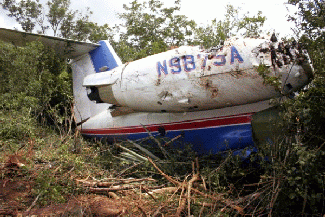
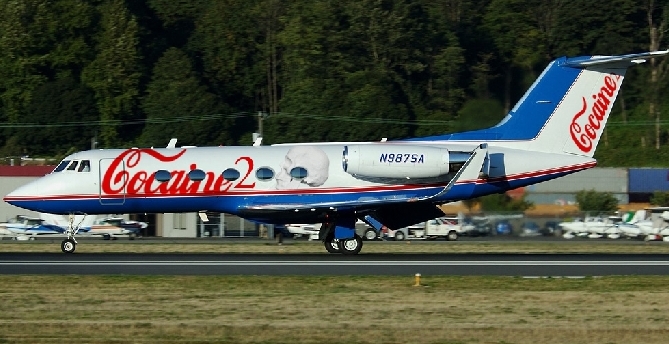
Six years ago this week an American-registered luxury jet, a Gulfstream II—later dubbed “Cocaine 2”—crashed just before dawn in the middle of the jungle in Mexico’s Yucatan carrying four tons of cocaine. The event, and its aftermath, changed forever an official narrative of the war on drugs which has for years been pushing the notion that there is no significant American involvement in the global drug trade, and no American Drug Lords.  
Cocaine2
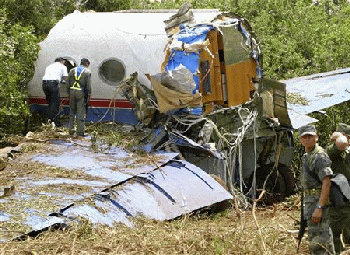
When the Gulfstream's fuselage split into pieces on impact, spilling cocaine across an area the length of three football fields, a chain of events was set in motion that would prove that nothing could be further from the truth.  
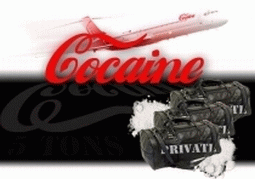
Several hundred miles away, and more than a year earlier, in May 2006, the Gulfstream’s ‘sister ship,’ a DC-9 which became known as “Cocaine1" because it was painted to impersonate an official US Government plane, had been caught carrying more than 5.5 tons of cocaine.
The two planes shared too many identifying characteristics, including interlocking owners and a shared base in the sleepy retirement Mecca of St Petersburg FL  on Florida’s Gulf Coast, to be coincidence. 
The twin events represented the biggest sea change in the global drug trade since the death of Pablo Escobar in 1992, or the assassination of Barry Seal in 1986. Today, despite the intervening years, new details continue to emerge about the case.
 
What could YOU buy with $378 billion in laundered drug money?
wachovia-habitAlmost every news story that day, September 25, 2007, played bigger than the downed drug plane: The dozen people who died in a suicide bombing in Baqubaa Iraq. The report that 829,000 Americans were arrested for marijuana possession the previous year. And the Forbes magazine story announcing that there were so many billionaires in the world that 82 of them weren't rich enough to make the Forbes 400 List.
But none would have the eventual impact that the story of the Gulfstream crashing in the jungle did. During the course of the investigation which followed it became clear that the money used to purchase both planes—the Gulfstream and the DC-9—was laundered and funnelled through Wachovia Bank, and more importantly, that it represented just a tiny sliver of the more than $380 billion of drug money that had been laundered during the past six years through what was then America’s 4th largest bank. 
Wachovia was fined a record $165 million. The sullied bank was forced to sell itself to Wells Fargo Bank in Salt Lake City.
Some observers found it ironic that America’s first full-service narco-bank was headquartered—not in New York or San Francisco—but in the conservative bastion of paleo-Republican Jesse Helms's North Carolina. 
 
The true meaning of "cartel du jour."
987SA-CRASH
At about three a.m. the normal quiet of the town of Tixkobob  (pop. 17000), located an hour outside of the Yucatan capital of Merida, was disturbed by the deafening noise of a low-flying twin-engine jet circling overhead, and the whine and buzzing of several military helicopters in pursuit. 
The noise went on for an incredible two hours until, out of fuel, the jet crashed three miles outside town on a plantation, Rancho San Francisco, identified by Mexican journalists as belonging to an American named Martin Wood.
Although remote, the crash site quickly drew a crowd. Slightly after dawn a Mexican Army unit from the Tenth Military Region deployed to the site, secured it, and then guarded it over the next 36 hours, repelling intrusions from other Mexican law enforcement agencies, as well as from the DEA, which flew six agents to the scene from Mexico City to reconnoiter, only to see them turned away from the site.
 
The history of the flight.
cancun
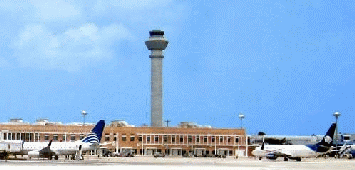
Days earlier, the Gulfstream jet had begun its journey at Fort Lauderdale’s notorious Executive Airport, flying southwest across the Gulf of Mexico to Cancun. There the pilot made arrangements with the airport’s general manager that they would be able to land without incident at the airport on their return from Colombia laden with cocaine. 
The next day, negotiations being successfully concluded, the Gulfstream  took off for Colombia. Nothing unusual was noticed. The plane was on a well-worn path. The airport in Cancun was the busiest drug port in Mexico.
After loading its cargo of cocaine the following day, the Gulfstream took off from the international airport just outside Medellin, in Rio Negro Colombia, bound once more for the exclusive Mexican Caribbean resort of Cancun, in the Mexican state of Quintana Roo.
Among the mysteries surrounding the flight, the one which looms largest is this: Why did authorities at the Cancun airport change their minds, renege on their promise, and refuse the plane permission to land? 
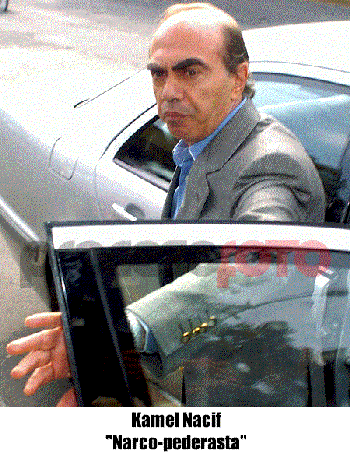
At a press conference a year earlier after the crash of the DC-9, Mexican Attorney General Daniel Cabeza de Vaca said officials from Federal security agencies in the Yucatan were known to be in collusion with drug traffickers. Curiously, with his next breath he mentioned Kamel Nacif, 69, a Lebanese businessman in Cancun who was in the news for alleged links to an international network of pedophiles.
knacif
On the off-chance the Mexican Attorney General was dropping hints, and not just free-associating, I did a quick search on Nacif, who I was surpised to learn is (or was) the biggest high-stakes gambler  in Las Vegas, a “whale” who won and lost millions of dollars at a time. 
In a Nevada Gaming Commission staff report questioning the association of Ted Binion, chairman and CEO of the Horseshoe Casino, with what the report called “certain individuals,” the report cited Kamel Nacif by name,  chiding Binion for putting up $2 million to bail Nacif out of jail. 
Nacif, the Commission staff reported, was associated with  “narcotics, firearms sales, and money laundering.” 
 
Unsung heroes of the drug trade: The Americans
dba2)
Today there is new information about many aspects of the case. As per usual when it comes to stories about drug trafficking, the really interesting bits concern aspects of the case that received something less than the full attention of the mainstream media.
An example is the matter of the Americn ownership of the downed plane.   
Soon after the crash it was learned that the now-mangled drug plane had been used for at least a decade by the CIA, flying "extraordinary renditions “to the US base in Guantanamo which housed prisoners suspected of being Al Qaeda, as well as the DEA, ferrying extradited drug traffickers from Colombia to the USA.
During that time the plane was “parked” or “sheepdipped” in the hands of a motley crew of politically well-connected ‘straw’ owners.  
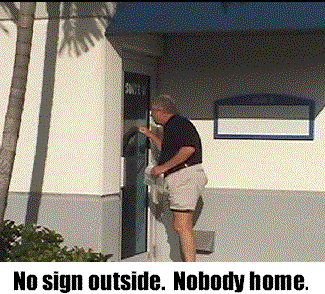
With that in mind, I paid a visit (along with a pilot friend pictured, above)  to the address, 4811 Lyons Technology Parkway #8 in Coconut Beach FL. that “Donna Blue Aircraft Inc” listed on FAA documents as well as with the Florida Dept. of Corporations.
What I found was an empty office suite with a blank sign out front, and no visible sign of any entity called Donna Blue Aircraft, Inc.
no-parkingWhat there was, however, oddly enough, were a half-dozen unmarked police cars parked directly in front of the empty suite.  
Today documents from the FAA cast new suspicion on the story told by two Brazilian businessmen in Boca Raton who had—just weeks earlier—purchased the Gulfstream II, according to the FAA, through a dummy company they owned called Donna Blue Aircraft (DBA,"doing business as," get it?).
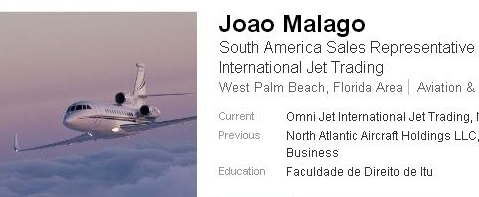
Joao Malago and Eduardo Dias Guimaraes both stated repeatedly that they were no longer responsible for the plane when it went down, having sold it to two pilots from Fort Lauderdale, the week before it scattered cocaine litter across the jungle floor. 
They may not have been telling the truth.  
Malago 
Two very very lucky Brazilians 
"We are not the owners of the plane," said Guimaraes, reached in Goiania in central Brazil.
He deferred most questions to his partner, Malago, who said from Sao Paulo that Donna Blue purchased the aircraft in July from a company that had owned it for 10 years. Then they quickly flipped it, reselling it to two Florida pilots who they said paid for it in full.
Malago, who said he'd been a pilot for 25 years and had bought and sold planes throughout Latin America, said he learned of the crash only after after receiving a phone call from an insurance company, had been unable to reach the new owner by phone and feared he was dead.
He stated that he knew nothing of the plane's history or what use it had been put to previously. "Generally, (when you buy a plane) you don't know the history of the plane," he said.
That was a red flag. Anyone with even limited knowledge of general aviation knows this statement to be untrue. Scrutinizing an airplane’s logbooks,which  contain its flight and repair history, is one of the first things checked out by potential buyers.  
Raising further suspicion was the company's website, which seemed a clumsy and half-hearted attempt to construct a plausible “legend,” or cover, for what was clearly a dummy front company. The company’s bogus phone number (415.555-5555) contributed to the effect. And when the site featured a quote from a supposedly satisfied Donna Blue Aircraft customer, it gave his name as “John Doe.” 
 
The FAA "weighs in"
N987SA1
On the FAA website, I discovered, on the final Deregistered Aircraft document for the crashed Gulfstream  N987SA when its registration was canceled five months later, Donna Blue Aircraft was still named as the plane’s owner.
So I contacted an FAA spokesman at the Agency's home office in Oklahoma, and followed up with an email.
“As you know,” my note began, “when a plane is sold, the owner is required to report the sale to the FAA. Yet when it was deregistered in February, 2008, five months after crashing, the FAA still listed the plane's owner as Donna Blue Aircraft.
“The Brazilian owners of Donna Blue Aircraft said they'd sold the plane a week before its last flight South for $2 million to two pilots from Fort Lauderdale, Clyde O'Connor and Greg Smith. Smith wrote them a check for $2 million to purchase the plane, the Brazilians claimed. 
“Yet within the aviation community in Fort Lauderdale Greg Smith is known to be so penurious that charter flight operators make sure to give him extra cash to take when he flies a charter for them, because he never has any money, and if the plane needs to refuel, they're stuck.
p3b
“Moreover, no documentation was ever provided by the Brazilians to prove that the plane actually did change hands.
If a plane crashes after being sold to a new owner, but while the transfer of registration is still in progress, when the FAA delists the plane months later shouldn’t the new owner be listed as the owner of record on the plane’s FAA decertification?”
“Thanks for any guidance you can offer.”
The note I got back was terse, and perhaps more notable for what it does not say than what it does. 
“N987SA is de-registered. The aircraft registration prior to de-registration was with Donna Blue Aircraft, Inc. I checked with the FAA Aircraft Registry; there has been no additional action."
The FAA wasn't throwing the two Brazilians under the bus, exactly. But they were clearly creating a bit of daylight between them.
 
A Chupeta connection?
Abadian)On the Colombian side of the equation, there are indications that the nationality of the two Brazilian owners of the Gulfstream offer a clue to clearing up a few unanswered questions.   
It may be that airport officials had a change of heart when they learned the plane had been tracked across the Caribbean from the US radar tracking station at Swan Island off Honduras, and was now being pursued by an Embracer jet from the Mexican Air Force, as has been widely reported.
In the drug trade, it is important to recall, the title “cartel du jour” is a designation which changes rapidly and without notice. Just ask the kingpins from the Medellin, or the Cali, cartels. 
It turns out that when the drug traffickers on the Gulfstream lost their "get out of jail free" card, a drug kingpin who the DEA has called the biggest drug trafficker since Pablo Escobar had just been captured.
On August 7, just over a month earlier, a joint operation between forces including Brazil, the US,  Argentina, Spain and Uruguay took down a drug kingpin who was recently profiled here. Before being caught, Juan Carlos Ramirez Abadia, known as “Lollipop” (El Chupeta), had been successfully holed up for more than five years in Sao Paulo Brazil. 
Three weeks after his arrest,  two Brazilians bought the Gulfstream.
Several weeks later,  it crashed in the Yucatan with 4 tons of cocaine.