Busca en Nuestros Archivos

Busca en Nuestro Blog

Translate / Traducir

Mostrando entradas con la etiqueta World Cup. Mostrar todas las entradas

31 octubre, 2014

Did Ed #Snowden & The #CIA Ruin #Brazil's #WorldCup?

tomatobubble.com


DID CIA BLACKMAIL RUIN BRAZIL'S WORLD CUP?

An Investigation


Snowden seemed fixated with Brazil


Brazil's incredible 7-1 loss left soccer-mad Brazil in shock


I HAD A SUSPICION
On July 8th of this year, 2014, there occurred a world sporting event so peculiar, so unprecedented, so improbable, that it got my Sherlock Holmesian mind to churning. As your former soccer-playing reporter here looked around at the stunned faces of the old-timers at the local Italian-American Sports Club where I was watching this surreal occurrence unfold, all one could hear was 'goombahs' muttering in between sips of espresso, "Mamma mia! I no believa. I no believa."
After the shocking event had ended, the first impulse was to go home, sit down and bang out a hypothesis for the world, or least my readership, to consider. But because this hunch was so 'out there', and I was only 50-50 on the proposition myself, the decision was made to spike the story unless and until more data surfaced.
Subsequent discoveries, events and strange happenings have since increased my personal rate of conspiratorial certainty to 75%; not enough to declare this conspiracy as an absolute fact, of course, but more than enough to elevate it to the realm of legitimate 'conspiracy theory' worthy of further investigation. In legal parlance, there is now 'probable cause' for an investigation.

This is not a sports story. Well, it is superficially, but at its core it is a drama about geo-political intrigue, blackmail, and even murder; the stuff that TomatoBubble.com specializes in exposing. It will take a bit of background explanation for this theory to make sense. Just stick with it, and you will see the big picture.


A "conspiracy theory' that began with a thought has been reinforced by other events.

A CRASH COURSE ON INTERNATIONAL SOCCER (FOOTBALL)

15 junio, 2014

#FIFA

El Lado Oscuro de la FIFA

La FIFA manda en todo el mundo y su palabra es literalmente la ley.
Cualquier país que quiera ser anfitrión de la Copa del Mundo debe prometer de antemano que no cobrará impuestos a la FIFA ni a ningún organismo que actúe en su nombre.
Este privilegio coloca a la federación por encima de la ley y priva a los países de miles de millones de dólares en ingresos.
Mientras que los anfitriones gastan fortunas en infraestructura, la FIFA gana sin invertir.
De acuerdo con reportes de la BBC, los ingresos que tienen los jugadores profesionales por motivo del Campeonato Mundial también se encuentran exentos de cualquier gravamen.
Además existen especificaciones legislativas concretas a las que se obligan los países anfitriones.
Brasil, quien durante años mantuvo una restricción a la venta de alcohol en los estadios por la alta tasa de muertes durante los partidos, se vio forzada a cambiar su ley por la FIFA.
La enmienda fue bautizada por los medios como la “Ley Budweiser”, ya que la empresa que vende cervezas es uno de los principales patrocinadores del organismo futbolístico.
De manera similar, durante la contienda mundialista del 2010 en Sudáfrica, la FIFA obligó a la creación de cortes especiales para resolver delitos cometidos a los turistas o reporteros durante el evento.
La impartición de justicia por estas cortes fue polémica pues, en su afán de impresionar, impartía con celeridad severas sentencias por robos menores cometidos contra extranjeros. Por ejemplo, por robar un celular a un turista, un joven fue condenado a cinco años de prisión tras dos días de juicio.
El mensaje es contundente, la FIFA manda en todos lados.

Millonarios sin fines de lucro
Continua Leyendo:


A World Cup for corporations
wagingnonviolence.org


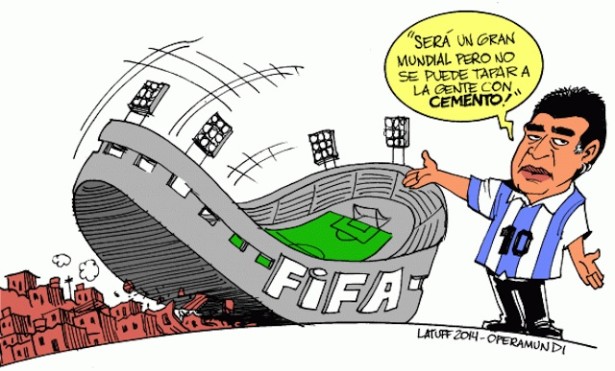
A political cartoon by Carlos Latuff depicting FIFA’s destruction of neighborhoods in Brazil. (Carlos Latuff)

The World Cup 2014 is set to begin today in São Paulo and end on July 13 in Rio de Janeiro. For this

Brazil on Strike: Class Struggle and the World Cup

By Sabrina Fernandes

Many labour unions are either in the process of negotiating with their respective employers (mostly municipal, state, or federal governments) in Brazil, while others are actively on strike. These include federal workers from the government bureaucracy, school teachers, city staff, and university staff and faculty. In this piece, I would like to highlight how unions in the transportation sector are highly represented in these labour struggles.
 
The Metro Workers Union of São Paulo is one of them and as of Monday, the 9th of June, it faces its fifth day of strike amidst layoff threats and a repressive state military police. Shortly before, the bus drivers of the city of São Paulo, represented by two unions, were also on strike. In both cases, the judiciary found the strikes to be ‘abusive’ and fined the unions hundreds of thousands of reais after ordering the workers back to their posts. The Metro Workers decided to continue the strike, with the support of a variety of social movements (including the Free Fare Movement – MPL, and the Homeless Workers’ Movement – MTST), political parties from the radical Left, and other labour unions. The judicial decision is being challenged for many reasons, but primarily for the fact that it is fuelled by illegalities committed on behalf of the employer that lead to the disavowal of the right to strike.[1]

A unified act in support of the metro workers was announced after the assembly for early Monday in the metro station Ana Rosa. The act was immediately interrupted by the arrival of the riot police squad. They advanced on the picketing metro workers, arresting some of them, and attempted to disperse the protesters who stood in solidarity with pepper spray, tear gas bombs, and raised weapons. Although some protesters attempted to kick the bombs back at the squad, the damage was done and even bystanders on their way to work were affected. A militant from the student movement and the PSTU was arrested, beaten, and humiliated by the police during an act of solidarity.[2] After recovering from the tear gas, the protesters assembled again at the metro station and, from there, they walked toward Praça da Sé in São Paulo, where they were joined by more social movements and political party representatives before marching again.