Sayer Ji
Nov 06, 2025
Read, share, and comment on the X post dedicated to this article here: https://x.com/sayerjigmi/status/1986629181216821364
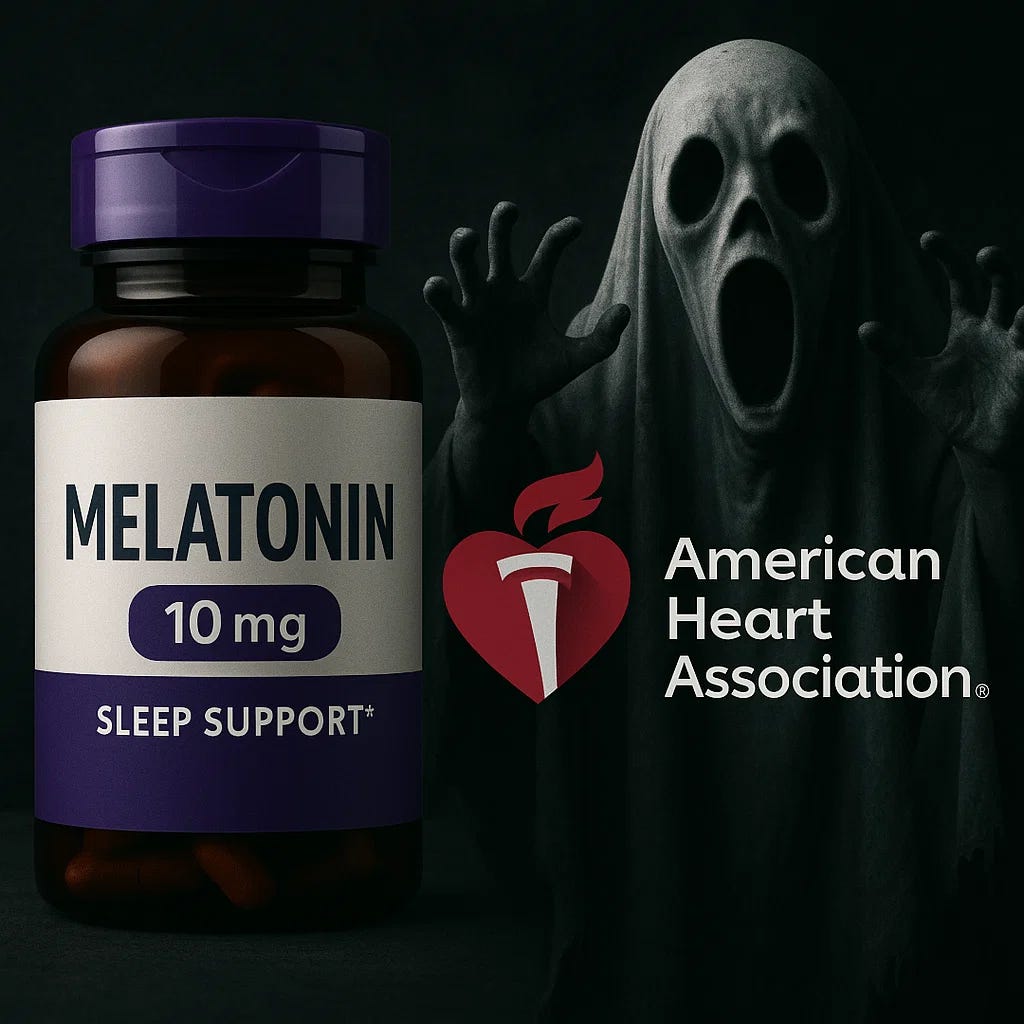
Last week, the American Heart Association (AHA) issued a press release titled, “Long-term use of melatonin supplements to support sleep may have negative health effects.” The headline alone was enough to ripple across health media, stirring anxiety among millions who rely on melatonin for sleep support.
But beneath the alarmist phrasing lies a truth far more mundane—and more troubling. The study behind the headline isn’t a peer-reviewed paper at all. It’s a conference abstract, a short presentation of unverified data shared at the AHA’s annual meeting. In other words: a preview, not proof.
The Anatomy of a Press Release Panic
The AHA release describes an analysis of over 130,000 patients with chronic insomnia whose electronic health records (EHRs) were examined through the TriNetX Global Research Network. Researchers claimed that those taking melatonin for at least a year were:
90% more likely to be diagnosed with heart failure
3.5× more likely to be hospitalized for it
Nearly twice as likely to die from any cause
Numbers like that would make melatonin sound more dangerous than cigarettes. And yet, the AHA’s own fine print quietly states:
“This study cannot prove a direct cause-and-effect relationship.”
“The findings are considered preliminary until published in a peer-reviewed journal.”
That should have been the headline.
The Media Echo Chamber of Fear & Distortion
Within hours, the world’s major news outlets reproduced the AHA’s talking points almost verbatim. The New York Times, CNN, USA Today, Healthline, People, and Fox News all issued headlines warning that “long-term melatonin use is linked to heart problems” or that melatonin users face a “90% higher risk of heart failure.”
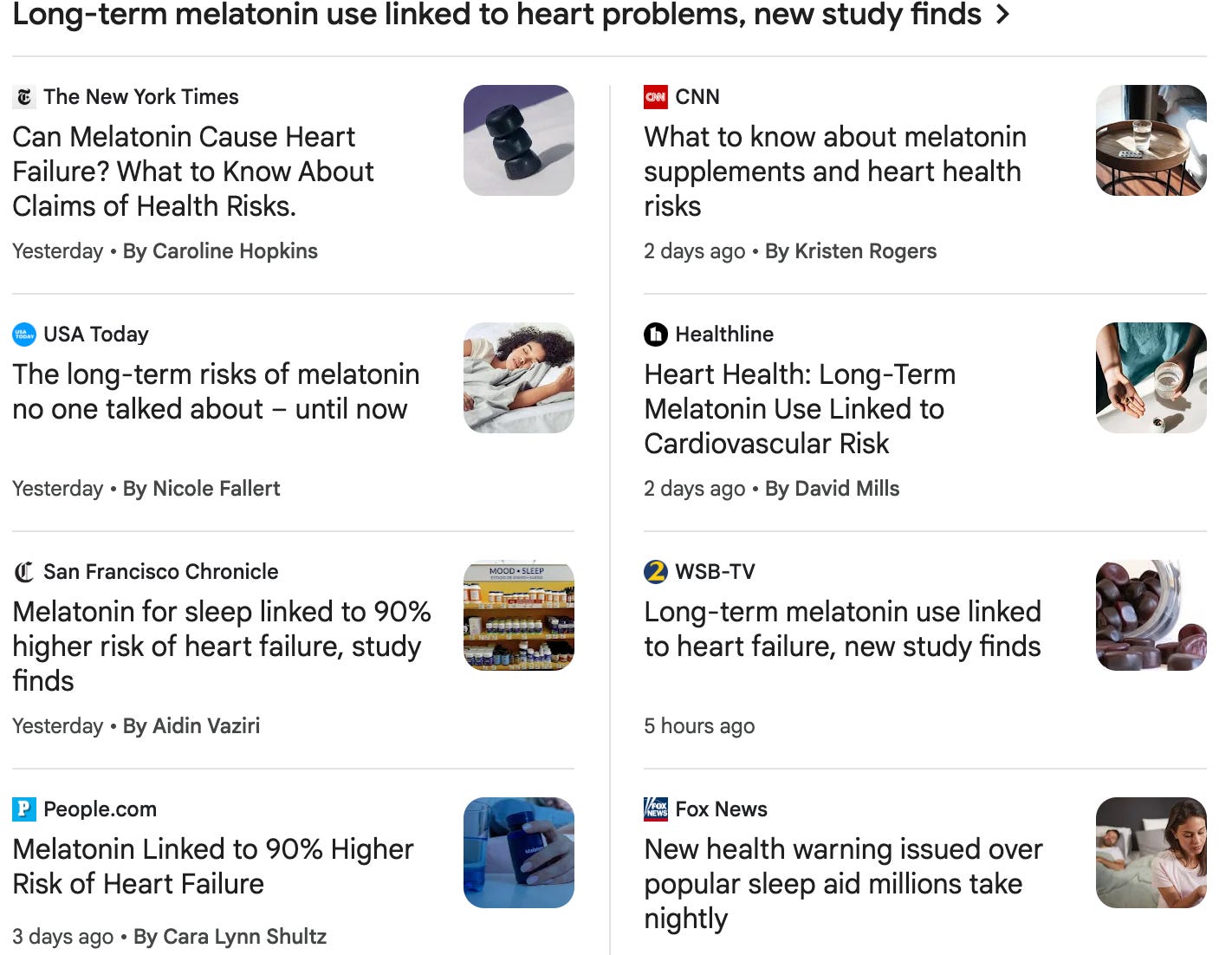
These headlines are textbook hyperbole—amplifying a non-causal, non-peer-reviewed finding into a sweeping medical warning. None of these outlets explained that the data were drawn from incomplete EHR records, that “melatonin use” referred only to prescription cases (not the far larger over-the-counter population), or that the researchers explicitly stated their results cannot establish causality.
This is how science by press release becomes science by soundbite. The public never reads the caveats; they only see the fear.
A Study Designed to Confuse
When we dig into the methods, the implausibility becomes obvious.
The study only counted people with a prescription for melatonin—which is common in the U.K. but almost nonexistent in the U.S., where melatonin is sold over the counter. As the authors admit:
“Everyone taking it as an over-the-counter supplement… would have been in the non-melatonin group.”
This means that millions of people who actually use melatonin nightly were classified as non-users, while the so-called “melatonin group” was composed almost entirely of patients sick enough to have their sleep problems documented and treated in medical systems requiring prescriptions.
That’s not a safety signal — it’s a statistical illusion.
Confounding, Not Causation
Even if the data were reliable, the confounders are overwhelming. Chronic insomnia often travels with anxiety, depression, hypertension, and metabolic dysfunction — each a major risk factor for cardiovascular disease. Matching patients by demographics or comorbidities doesn’t erase the underlying severity bias: those who seek prescriptions tend to be those who are already unwell.
Moreover, the researchers lacked basic data on:
Sleep quality and circadian rhythm disruption
Lifestyle factors (diet, alcohol, shift work, screen exposure)
Supplement dosage and purity
Psychiatric medications used concurrently
Without these, there’s no meaningful inference about melatonin itself.
Moreover, the study failed to account for several key pharmacological confounders. While the authors excluded patients taking benzodiazepines, they did not control for other pharmaceutical sleep drugs such as zolpidem (Ambien), eszopiclone (Lunesta), or trazodone — all of which carry well-documented cardiometabolic risks. Nor did they adjust for the use of statins, SSRIs, or antihypertensives, which are both common among insomnia patients and known to alter cardiovascular function (learn more about the cardiotoxicity of statin drugs) and sleep architecture. Failing to isolate these variables makes it virtually impossible to determine whether the observed risks stem from melatonin itself or from concurrent drug exposure.
The Biological Reality: Melatonin as a Protector
For decades, melatonin has been one of the most studied molecules in the realm of oxidative stress and cardiometabolic protection. Peer-reviewed studies have shown that it:
Reduces blood pressure and improves endothelial function
Protects mitochondria and heart tissue after ischemic injury
Mitigates oxidative damage and inflammation across numerous organs
A 2022 meta-analysis in the Journal of Pineal Research found melatonin to be broadly cardioprotective, not cardiotoxic.
This aligns with the GreenMedInfo research database, which has indexed nearly 1,000 studies on melatonin’s diverse physiological benefits across more than 400 health conditions, and documents up to 130 distinct pharmacological actions of the molecule — including antioxidant, anti-inflammatory, neuroprotective, and cardioprotective effects (see the research compendium here).

Within this body of literature, there are dozens of studies specifically identifying melatonin’s cardioprotective roles — from improving myocardial recovery to reducing ischemia-reperfusion injury and modulating autonomic balance (cardiovascular studies here).
To reverse that entire corpus of evidence based on a five-minute abstract summary would be scientifically reckless.
A Nuanced View on Hormonal Support
That said, it’s important to maintain nuance.
Melatonin, while natural and bioidentical, is still a hormone, and like any hormone, chronic supplementation can engage the body’s negative feedback mechanisms, leading to potential pineal gland downregulation or atrophy over time. Ideally, we should strive to restore the conditions for the body’s own melatonin production — through circadian alignment, light hygiene, nutrient sufficiency, and emotional regulation — rather than permanently replace it.
Yet even with that physiological caveat in mind, the AHA’s insinuation that melatonin poses a significant health danger borders on the absurd. In stark contrast, conventional pharmacologic sleep aids such as Ambien (zolpidem) have well-documented risks — including dependence, cognitive impairment, next-day sedation, motor vehicle accidents, and elevated fatality rates. Their use has led to thousands of emergency room visits each year and measurable public safety impacts.
By comparison, melatonin’s safety profile is remarkably benign, especially when used at physiological doses and with respect for circadian biology. Indeed, in 2019 the U.S. Food and Drug Administration (FDA) required all prescription insomnia drug manufacturers to add a boxed warning — the agency’s most serious caution — about rare but severe behaviors such as sleepwalking, sleep-driving, and accidental injury or death.
This is precisely why such a smear job against a safe, inexpensive, and physiologically compatible, endogenous molecule merits public comment — not because melatonin is beyond critique, but because science itself is being misused as a vehicle for fear and pharmaceutical dominance.
When “Safety Concerns” Become Market Signals
It’s worth noting that the AHA receives substantial funding from corporate donors, including pharmaceutical and device manufacturers. The press release’s focus on a non-patentable natural compound as a potential hazard conveniently reinforces dependence on prescription sleep aids — drugs that do carry serious cardiac and neurological side effects.
While the AHA insists that its donors don’t influence content, the optics speak for themselves: industry-aligned institutions often amplify alarm over inexpensive natural molecules that can’t be monetized.
The Deeper Issue: The Erosion of Scientific Literacy
This story isn’t just about melatonin. It’s about the collapse of epistemic integrity — how a single unreviewed data set can be transformed into a global warning by trusted institutions, echoed by media headlines within hours, and accepted as “science” by the public before peer review even begins.
It’s a microcosm of a larger crisis: the conversion of correlation into causation, and fear into funding.
Melatonin, Misrepresented
Melatonin is not a panacea, nor is it risk-free. But the notion that it doubles mortality is biologically implausible and methodologically indefensible. What this episode truly illustrates is not a danger of melatonin — but the danger of uncritical consumption of authority.
In an age of data abundance, the question isn’t whether science exists, but who interprets it — and for what purpose.
Final Reflection
When institutions that once embodied scientific integrity begin to act like marketing agencies, we are called to something higher: discernment. We must learn to read beyond the headline, question the premises, and remember that truth requires time, context, and courage — not just an embargo date and a press quote.
If the AHA wishes to reclaim credibility, it should insist that findings of this magnitude be fully peer-reviewed, transparently replicated, and contextualized within the broader body of evidence — rather than rushed into public consciousness as a fear-inducing soundbite.
Until then, sleep well — and think critically.
The REGENERATE YOURSELF Masterclass
Join over 400,000 enrollees who have discovered practical ways to implement these groundbreaking concepts in their daily lives. This comprehensive online program translates cutting-edge science into actionable strategies for optimizing your health through the principles of the New Biology.
Enroll entirely free at: regeneratemasterclass.com Or, get the entire course including advanced modules here now.


References
American Heart Association Newsroom. Long-term use of melatonin supplements to support sleep may have negative health effects. Abstract MP2306, AHA Scientific Sessions 2025.
Reiter RJ, Tan D-X, Rosales-Corral S. “Melatonin: A mitochondria-targeted antioxidant and bioenergetic modulator.” J Pineal Res. 2022;73:e12805.
St-Onge M-P et al. Multidimensional Sleep Health: Definitions and Implications for Cardiometabolic Health. AHA Scientific Statement, 2025.
No hay comentarios:
Publicar un comentario