Busca en Nuestros Archivos

Busca en Nuestro Blog

Translate / Traducir

Mostrando entradas con la etiqueta Wachovia. Mostrar todas las entradas

06 octubre, 2013

Colombian Drug Lord Vanishes After Conviction… in the US!

by Daniel Hopsicker
A major Colombian drug trafficker who willingly sought extradition to the United States—even offering a $40 million bribe to officials in Brazil to send him to the US—apparently knew what he was doing. After being extradited and convicted in Federal Court in New York of felony drug charges that could have put him in jail for life, he disappeared.
lolly2
His name is Juan Carlos Ramirez-Abadia (nickname: Lollipop). He's a figure in the recent scandal over the President of Costa Rica’s use of a drug plane belonging to Gabriel Morales Fallon, who was identified as one of his former lieutenants.
Juan Carlos Abadia's extradition to the US from Brazil in 2008 received major media coverage.The DEA was calling him the biggest drug cartel boss since Pablo Escobar. They say he led the world’s biggest drug cartel, exporting more than 500 tons of cocaine—worth in excess of $10 billion—just to the United States alone.
His name was in the news again several months later, when he asked (citing claustrophobia) to be placed in a bigger detention cell while awaiting trial in New York.
But when he pled guilty in March of 2010 to felony counts of drug trafficking and racketeering, not one newspaper in America carried the story. His conviction went completely unreported. The DEA didn't didn’t even issue a press release.
It was as if, when Pablo Escobar was gunned down in Colombia, the story didn't make the news.
 
Where is "My Boy Lollipop?"

lolli
Court documents indicate Abadia was sentenced to 25 years in Federal prison. But a search of the prisoner locater at the Federal Bureau of Prisons website does not list his name as among those currently incarcerated.
The Assistant US Attorney in charge of the Abadia case, Carolyn Pokorny, declined to comment on his whereabouts.  
And that’s where the trail ends, at least for the moment.
Another anomaly: There is no record of his sentencing.  Among the official court documents available through PACER is a transcript of a hearing held before the court accepted Abadia’s guilty plea, to ensure he understood his rights, and was pleading guilty voluntarily. There is a binding 9-page forfeiture agreement. Abadia agreed to forfeit $10 billion (that’s billion with a ‘b’) in currency and property to the US Government.  There is also an order by District Judge Sandra Townes accepting his guilty plea.
But—more than two years later—there is no record of his being sentenced. Whether the discrepancy concerns missing documents, years-long deferred sentencing, or some other cause is unknown at this time.
 
"Almighty Latin Kings and Queens" Beware
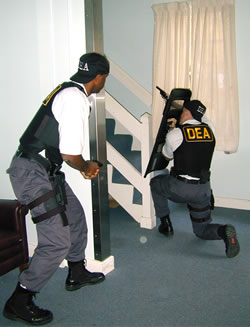
DEA-Agents
The situation is more than puzzling. On what should have been a banner day for the DEA and the Department of Justice, Drug Kingpin Juan Carlos Ramirez-Abadia was well on his way to being erased from public memory. 
As an organization, the DEA has shown that it excels at only one thing: shamelessly flogging its own dubious achievements. That, and putting the best face possible on the long-ago lost drug war.
So why did they pass up the chance to announce they'd bagged & tagged the biggest drug lord to walk the earth since Pablo Escobar fell off a roof?  
magart1005_page46_pic3
A search of March 2010 press releases on the Department of Justice’s national website turned up . headlines announcing that a member of the “Almighty Latin King and Queens,” sentenced to 210 months for his role in a drug conspiracy; and a “Maryland Man,” convicted of sex trafficking, firearms and gun charges.
But nothing about Abadia's conviction.
One headline looked promising. It announced that a “Leader of Colombian Narco-Terrorist Organization” had been sentenced to more than 20 years for conspiring to import tons of cocaine into the U.S 
Alas, the DEA, as is well-known, plays favorites, and the narco-terrorist kingpin fixin' to do time had been a leader of the gritty and perennially out-of-favor-in-Washington FARC. Abadia, on the other hand,  had taken over the remnants of the "bandana-free" Cali Cartel, and turned it into the powerhouse North Valley Cartel.
A search of contemporaneous press releases on the US Attorney’s own website in Brooklyn showed they hadn’t even issued the standard boilerplate press release, thanking the DEA and the hard-working men and women of law enforcement etc., while trumpeting the significance of Ramirez-Abadia's conviction. 
Bloods_by_TheChew
A check of that month’s press releases at the national Department of Justice's Eastern District of New York site turned up Bloods gang members indicted on murder and racketeering. There was a headline touting a “leader of violent drug crew” getting life in prison, while another, “leader of violent drug crew,” unconnected and slightly luckier than the first, was being dished out  27 years.
But not one word about the (local!) conviction of a man who’d just admitted to shipping 500 tons of cocaine to the US.
 
A lot of money changing hands
Authorities estimated that Abadia’s North Valley Cartel employed hundreds of people, and controlled 60 percent of the drugs leaving Colombia for the United States and Europe each year, a significantly higher percentage than the Medellin bad boys– who always lagged the Cali Cartel, never mind the DEA–controlled in its heyday. 
Lollipop-lives (6)
His employees weren’t stringing up narco-banners over highways, or sharpening their machetes, cutting up corpses into pieces small enough to fit into 55-gallon drums or strapping bandoliers across their chests.  They were international businessmen and women, manufacturing and transporting multi-ton loads of cocaine from Colombia to Mexico, destined for the US market for Abadia’s Drug Division; or counting and then launderering money, or couriering it for the Money Laundering Division.
They doled out bribes to police, politicians and military officials in the cartel’s Corruption Division; or carried out murder, torture, kidnapping and violent drug debt collections for the "Office of the Sicarios."
Law enforcement officials have confiscated more than 24 tons of cocaine from Abadia’s cartel associates, seized hundreds of properties; and dozens of legitimate corporations: pharmaceutical distribution companies, major currency exchanges, even thoroughbred horse breeding farms.
 
The Silence of those on the lam
!!COKELUGGAGE_SIMPLE
Excessive government secrecy has long been common in cases involving national security. Less understandably, it is also common—suspiciously common—in cases involving drug trafficking.
The level of secrecy in the Abadia case is reminiscent of what was recently reported here involving a key figure in the biggest drug seizure on an airplane in Mexican history, the 5.5 tons of cocaine on a DC-9 from St. Petersburg, Florida. 
Tracing the money from that massive drug bust led directly to the forced sale in 2008 of Wachovia, then America's 4th largest bank.
When a key figure in that case pled guilty to unrelated drug charges two years ago in a Federal Court in Miami, it was a secret to journalists, as well as to probation officials preparing his Pre-Sentence Report (PSI). It was even a secret to the Federal judge. Court transcripts reveal she was unaware the man she was sentencing had been a key figure in a case that brought down America's 4th largest bank.
 
Another "only in Miami" moment? Or something more?
kidan-and-abramoff
The temptation was to write the "oversight" off as one of those “only in Miami moments,” which are encountered regularly by observers of judicial proceedings in South Florida.
(Another is upcoming in two weeks, when men associated with the Gambino Family go on trail for the murder of Gus Boulis, more than seven years after their arrest in 2006.)
But now its happened in Brooklyn, too.
Are there similarities between events in Miami and Brooklyn?
One stands out: the Asst. US Attorney's in each case specializes in major drug traffickers. In Miami, Asst US Attorney Hoffman handles everything involving Colombians.  When asked to comment on the false identity under which she prosecuted a key figure in the 5.5 ton DC-9 story, she declined.
In Brooklyn, Asst US Attorney Carolyn Pokorny  handles "all the big Colombian cases." Regarding the current whereabouts of the man she two years ago helped send to Federal prison for 25 years, she offered to put us in touch with the Court's Public Information Specialist.  
Might the reason both appear so tight-lipped be that they’ve been “read into” a sensitive and highly classified US operation involving drug trafficking which has been ongoing for decades now, and whose survival demands that the rest of America remain ignorant? 
Are these two well-placed Asst US Attorneys privy to information which indicates that US drug policy differentiates between drug traffickers who smuggle drugs for US interests… and everybody else?

25 julio, 2013

DC-9 ‘Cocaine One’ kingpin’s secret conviction

Daniel Hopsicker
It was the biggest drug seizure on an airplane in Mexican history. It led directly to the forced sale of Wachovia, then America's 4th largest bank. And it threatened to become America’s most notorious drug scandal since Iran Contra.
Yet when a leader of the drug smuggling organization responsible for the flight of the DC-9 airliner dubbed “Cocaine One” that was busted in the Yucatan carrying 5.5 tons of cocaine quietly pled guilty to unrelated drug charges two years ago in a Federal Court in Miami, his role in the massive drug move was kept secret from officials preparing his Pre-Sentence Report (PSI),  from journalists, and even from the Federal judge in the case.
cocaine-one
Since the omission was recently discovered, tongues on two continents have been wagging.
A catch & release arrest policy for drug traffickers
Since it began, in April 2006, the scandal of the “Cocaine One” DC-9 busted carrying 5.5 tons of cocaine in the Yucatan has seen its share of bizarre developments.
The drug pilot flying the DC-9, Carmelo Vasquez Guerra, for example, had been arrested and released in three separate countries—Mexico, Guinea Bissau, and Mali—before Venezuela finally stepped in and put him (at least temporarily) behind bars.
img_3087
But with a shocking new revelation, the scandal has taken a sudden turn for the surreal.
The man in charge of bringing the 5.5 tons of cocaine north in one fell swoop was identified by investigators as “Raul Jimenez Alfaro.
Turns out, that's not his real name.
When cartel kingpin Jimenez Alfaro was convicted on unrelated drug charges two years ago in a Federal Court in Miami, according to investigative reporter Joseph Poliszuk at El Universal in Caracas, his role in  running the massive 5.5 ton drug move, which eventually brought down America's 4th largest bank, went undisclosed, and  remained secret.
Thus ended the indifferently-motivated but highly secretive US investigation, which concluded that  the finger of blame in the scandal should point to Venezuela, to Colombia, and to Mexico.
The finger of blame should point to, in other words, anywhere but here.
 “Operation Seven Trumpets.”
463px-BambergApocalypseFolio019v7AngelsWith7TrumpetsAnd1WithCenser The trial two years ago was of a man who had used the alias Raul Jimenez Alfaro.
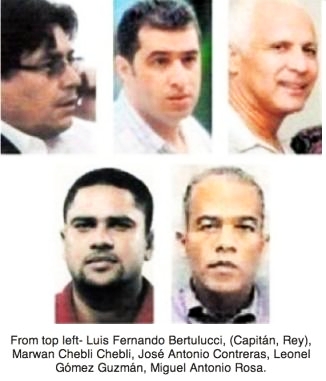
His name, as listed on the indictment, was Luis Fernando Bertulucci Castillo. 
Turns out, that’s not his real name either.
He was busted along with 34 others in something the DEA, FBI & ICE were calling  “Operation Seven Trumpets," presumably a reference to the seven trumpets which sound as the cue for the Apocalypse, according to the Book of Revelations.
15889BAF-9C6C-4182-93E5-4D7509A0D0B8.jpg__460__390__CROPz0x460y390 (1)The man with a deliberately foggy past is a 52-year old Mexican commercial pilot of Italian ancestry, whose Sinaloa cartel nicknames are “El Capitan" and "The King."
His real name (he says) is Fernando Blengio-Cesena.
He has also gone by Fernando Blengio Cesena; Luis Fernando Bertulucci; Fernando Bertulucci Castillo; Fernando Blengio Cesena Bertulucci; and Luis Fernando Castillo.

A Miami Moment
img_3087It was one of those “only in Miami moments” encountered every so often in judicial proceedings involving drug trafficking in South Florida.
In a hearing before District Court Judge Patricia Seitz, Raul, or rather Fernando, modestly admitted to having three aliases. Courthouse observers suggest that if he’s admitting to three, he probably forgetting another half-dozen.
While Assistant US Attorney Andrea Hoffman looked on, Fernando Blengio admitted using the alias "Raul Jimenez Alfaro" before a Federal Judge.
The admission elicited no comment from either.  From court transcripts:
JUDGE: How many aliases do you have?
A. The truth, besides the other one, Luis Antonio Ortega Sandoval.  With the other aliases that I had I was also flying,  and I had the license, and I was also doing commercial jobs, executive flights, charters and aerial ambulance flights.
JUDGE: Under the Bertulucci name?
FERNANDO: Well, unfortunately also under the name of Raul Jimenez Alfaro.
falcon018009hdWhy "unfortunately?' Fernando is not asked. But  observant reporter Poliszyk noted that this was an admission that he was the man who had helmed the drug operation moving 5.5 tons of cocaine from Colombia to the US.
As Raul Jimenez Alfaro, he had coordinated bribes to Mexican officials at three regional airports which were receiving deliveries of part of the 5.5 ton cocaine load went unmentioned.  
He also owned the Falcon business jet which had mysteriously flown to the Yucatan to meet the DC-9 at the airport in Ciudad del Carmen in the Yucatan. The Falcon was under contract to the Mexican Water Commission, which was run by the former head of Coca Cola de Mexico, a long-time crony of Mexican President Vicente Fox.
None of this came to light at his sentencing.
Lying is okay if it's a matter of national security.
MOBTAMPAFernando was sentenced to 13 years in prison. His light sentence was a reward for serving as an informant for the Assistant US Attorney in charge of his case, Andrea Hoffman, who prosecutes many of Miami’s big-time drug cases, including all those from Colombia.
Yet Hoffman must have known of the role he had played in the 5.5 ton DC-9 saga, because she had also been involved in the prosecution of Mexican currency exchange Casa de Cambio, which laundered the money used to purchase the DC-9, investigators determined, through Wachovia Bank.
Why would Hoffman keep information on Fernando's past exploits secret? Was her job, in part, keeping the U.S.'s dirty drug dealings secret—not from drug cartels, who presumably know all about them—but from American citizens?
Assistant US Attorney Andrea Hoffman, in fact, has secrets of her own which may offer an answer. For example, this is not the first time she  has faced questioning while serving as lead prosecutor over her conduct in a criminal case.
Hoffman has been accused or faced sanctions for withholding crucial information from the defense in felony drug trafficking cases on at least several other occasions.
"Everybody bugs defense attorneys. Ask the NSA"
Because of recent miscues, two of Fernando’s "associates" from Colombia—who might have been expected to spend a decade or more in prison—will soon be heading home.
SUITCASEGATEMIAMI
John Winer and Jose Buitrago were accused of conspiring with drug traffickers from Colombia to secure airplanes for the purpose of transporting drugs, basically the same thing Fernando was charged with.
Lawyers for the two, from the office of the Federal Public Defender of the Southern District of Florida, asked prosecutors to turn over records of payments from the DEA to officers who investigated their client.
The men's attorney's suspected that Colombian police officials had been paid to implicate them.
The prosecution was ethically and legally bound to turn the information over to the defense. But Andrea Hoffman insisted that no payments were made to Colombian law enforcement.
That was contradicted by the first witness, an officer from the Colombian police, as well as a DEA agent, who testified that Hoffman knew about the payments. Over the course of three years, 11 members of Colombian law enforcement received payments of $200 per month from the U.S.
A pattern of deception
17721_1Nobody thought the error had been an innocent mistake.
The judge said she was "personally frustrated and disappointed" at Hoffman and did not believe the prosecutor's claims that she had not been aware of the payments at the start of the trial.
"I think the United States was aware that Colombian police officers, in the course and scope of their duties, received payment," she said at a hearing last month.  
"I think they were aware of it and for whatever reason, did not disclose that to defense counsel."
Hoffman was suspected of other examples of deception, even more egregious.
"2 FEDERAL PROSECUTORS CONDEMNED" read the headline in the South Florida Sun – Sentinel.
In another case, after two prosecution witnesses secretly recorded their phone conversations with the defense team, with approval from prosecutor Hoffman, U.S. District Judge Alan Gold ordered the U.S. government to pay sanctions topping $600,000 to the defense.
Calling the actions of Andrea Hoffman "profoundly disturbing," Gold grilled the government team at a two-day hearing to determine whether the U.S. government should pay part of the defense's  legal fees.
Then, in a harshly-worded order, he wrote that the "win-at-any-cost behavior" of federal prosecutors Andrea Hoffman and Sean Cronin raised “troubling issues about the integrity of those who wield enormous power over the people they prosecute."
"Forget integrity. Look at the history of lies."
chapovista5Fernando Blengio-Cesena was a trusted lieutenant of cartel boss Shorty Guzman. The criminal network which Federal authorities in Mexico and the US claim to have dismantled is part of the Sinaloa Cartel.
Today the Sinaloa Cartel serves as the DEA’s all purpose drug cartel bogeyman.  There are reasons to be skeptical of the truth of the claim, or whether, if true, it is telling anything like the whole story.
Consider the criminal network’s leaders: Fernando Blengio-Casena, of obvious Italian parentage, was born and raised in Mexico, and when arrested was living (he told the judge) in the UK.
evpol0728_quema_lmr_1Perhaps not coincidentally, Fernando Blengio-Cesena's brother, Alejandro Blengio Cesena, works for the Federal Police in Mexico. His job?
Overseeing the destruction of drugs the government confiscates in drug busts.
Another cartel ringleader, Marwan Chebli Chebli, who is Lebanese, was living in the Dominican Republic.
contrerasThen there’s José Antonio Contreras. He's supposedly from the Dominican Republic, but  (see pic at left) he looks a little too pink to be a native.  Here's a clue: his name (Contreras) is the Spanish spelling of the last name of a notorious Sicilian Mafia family, the Controni’s, that have ruled Montreal’s narcotics underworld since the 1960’s.
Italian involvement in organized crime predates the Sinaloa Cartel by hundreds of years.  And there has been a substantial Lebanese and Syrian presence  in the illicit narcotics business for decades. There are several Lebanese, and Syrian drug kingpins in Mexico, for example, whose names are well-known in Mexico.
The demonizing of the Sinaloa Cartel serves a purpose. Consider what happened to the Medellin Cartel.
Pablo-Escobar-Long before it became Public Enemy No 1., the Medellin Cartel had played the same role, as the DEA’s bogeyman, during the 70’s and 80’s, when they were responsible, according to the DEA, for 75% of the cocaine flooding American streets.
Yet when the last Medellin cartel kingpin still free, Pablo Escobar, was killed in 1992, the amount of cocaine available in the US didn’t drop by 75%.
It didn’t drop at all. One year later, cocaine was no more difficult to find on the streets of America than it had been while Escobar was alive.
After Shorty Guzman and the Sinaloa Cartel have been defeated, and are no more than a fading memory, cocaine will be as plentiful and available as it ever was, and will continue to be re-stocked on America’s “shelves” as efficiently as Procter & Gamble replenishes supplies of Crest toothpaste and Charmin bathroom tissue.
Andrea Hoffman knows this. You should too.