
Introduction
One of the authors (WP) and his colleagues have compiled 32 lines of discrete and independent evidence [1-3], concluding that exposure of susceptible babies and children to acetaminophen is responsible for many if not most cases of autism spectrum disorder (autism). President Trump and Secretary Kennedy did, as most readers know, bring this issue to the attention of the world in September of 2025.
This article will point out what’s gone wrong following the President’s announcement. And, later in the article, we will present a 33rd line of evidence for the first time.
The primary scientific blunder holding up progress
The response of the mainstream scientific establishment to the President’s announcement can be described as bizarre, perhaps even surreal. To understand the situation, first we need to understand that all available data are consistent with the conclusion that acetaminophen and susceptibility combine to cause autism. In some cases, the available data are exactly what we predict if acetaminophen and susceptibility combine to cause autism.
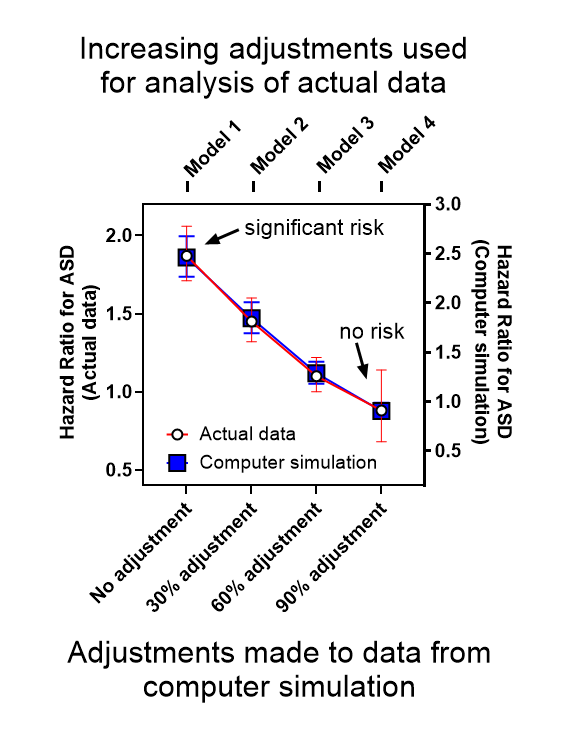
The Figure below shows two sets of data that are very close to identical. One is the actual data from Sweden published by Ahlqvist and colleagues in 2024 [4]. This data shows the risks of autism in offspring of women who used large quantities of acetaminophen during pregnancy. To date, this is the most comprehensive and robust data set published comparing acetaminophen use during pregnancy and autism spectrum disorder (autism). The second set of data on that graph is a computer simulation that shows what we expect to see if acetaminophen use during pregnancy and susceptibility cause autism.
For the sake of public health, we should interrupt this discussion of data to point out that the most dangerous period for acetaminophen exposure is NOT during pregnancy. The most dangerous periods are immediately after birth, which means that labor and delivery is important, and in early childhood, up to six years of age [2]. Now we can return to the data focused on exposure during pregnancy, which are shown in the figure.
The real data, which match the computer simulation extremely well (figure), show that acetaminophen use during pregnancy is associated with a significant risk of autism. This risk is indicated by numbers that are greater than 1.0 on the left of the graph (Model 1 or No adjustment). For example, a risk or “hazard ratio” of 2.0 would indicate that the risk of autism with acetaminophen use is twice as much as the risk with no acetaminophen use during pregnancy.
In the graph, the real data and the data from the computer simulation have both been “adjusted” using a specific statistical method called a Cox regression analysis. In both cases, the adjustments factored out susceptibility. In a nutshell, the adjustment is a mathematical way to see what happens if there is no susceptibility. Both sets of data, the real data and the computer simulation, show that the risk goes away (the data on the right side of the graph: model 4 and 90% adjustment) if we factor out susceptibility. This absence of risk is indicated by numbers that are less than or equal to 1.0. In other words, we can see that if an individual is not susceptible, then acetaminophen use is not connected with autism. We have known this for a long time [5], so it’s not really new information. Babies that are not susceptible will not get autism. Nothing new.
To summarize, this graph shows what we actually see, and it also shows what we expect to see in theory if acetaminophen plus susceptibility causes autism. They are the same.
In science, when the results that we expect to see in theory match what we actually see in real life, normally this means that we are on the right track. When the results match almost exactly, then we are in really good shape. Normally.
But this is not what has happened in the case of acetaminophen and autism. At the present time, in August of 2026, about 13 months after President Trump and Secretary Kennedy made their announcement, 34 articles have been published in the medical literature stating that there is no connection between acetaminophen use during pregnancy and autism [6-39]. These 34 articles are all based on data such as the data shown in the figure.
Those 34 articles are cited on PubMed, the online database maintained by the prestigious National Institutes of Health. This is the same database that AIs (“artificial intelligences”) use when they formulate their answers. This is the same database that reporters for the media use when formulating their articles. And it’s the same database used by trusted on-line sources of health information.
All of the authors of those 34 studies are assuming that susceptibility, or something that is somehow related to susceptibility, is causing autism. This is an assumption that ignores a vast body of scientific evidence, including known facts about the metabolism of acetaminophen in human beings. The graph itself constitutes one discrete and independent line of evidence out of 32 total. So, to conclude that heavy acetaminophen use during pregnancy is not connected with autism, scientists ignore 31 lines of evidence and completely misinterpret the 32nd line of evidence.
And then, if we publish the same mistake dozens of times, get the world’s most prestigious medical organizations to approve of the mistake, and finally allow our AI engines and media to propagate the mistake, we arrive at the situation today.
If you want more information about how the computer simulations were done, we have described that work in detail [1, 3, 40], and the information is publicly available. If you want more of a description of what exactly has gone wrong here, one of the authors (WP) has discussed this issue and most of the evidence in some detail in a recent book [41].
A skeptic might think that, somehow, we must be hiding something that is really important. There must be something going on that we haven’t disclosed, and that’s why this isn’t accepted by most scientists and medical professionals. If you are one of those skeptics, I would encourage you to get the book [41]. In the book, I let readers see inside the peer review process that guards the medical literature cited by PubMed. When you look behind the curtain and the actual correspondence with the world’s leading experts, you’ll see that the king has no clothes. There is no valid scientific reason to ignore this evidence.
New evidence and a new scientific blunder
Earlier in this article we promised to reveal a 33rd line of evidence. To understand this 33rd line of evidence, it is helpful to examine one of the original 32 lines of evidence. This original line of evidence comes from a study by two scientists named Frisch and Simonsen. Frisch and Simonsen were interested in the idea, first proposed by Bauer [42], that acetaminophen use with circumcision might induce autism. They looked at all Danish children born from 1994 to 2003, and found that the prevalence of infantile autism was about double if a child was circumcised [43]. This is one of many very compelling lines of evidence pointing at a causal relationship between acetaminophen exposure and autism.
Our 33rd line of evidence involves a very recent study looking at the connection between circumcision and autism in a sample of US children born from 2003 to 2023. This study, by McGrath and colleagues, was funded by the aforementioned National Institutes of Health and co-authored by 27 scientists from no less than 18 prestigious US institutions [44]. Before we describe the results of that study, let’s first consider what we expect to see if our conclusions about the connection between acetaminophen and autism are correct.
When first considering what results we might expect from the McGrath study looking at US children born from 2003 to 2023, we might naïvely guess that we will see the same results that we saw in the study of Danish children born from 1994 to 2003. It is, however, difficult to imagine any professional scientist working in the field who would be so naïve. In fact, we suspect that most individuals with no scientific training would be rather suspicious of this guess.
As any scientist interested in the connection between acetaminophen and autism should know, there’s a vast number of differences between Danish boys born from 1994 to 2003 and US boys born from 2003 to 2023 that are going to make the expected results different. Here is that story.
Due to differences between neonatal and adult metabolism, human newborns are ill-equipped to safely metabolize acetaminophen after the umbilical cord is clamped [2, 45, 46]. This susceptibility starts to diminish in most individuals after approximately two months of age, but other individuals remain sensitive for years [2, 47]. Unfortunately, several factors have driven up exposure to acetaminophen in the first two months of life. First, intravenous acetaminophen was developed and approved in 2011, and efficiently delivers drug more rapidly and at higher peak plasma concentrations than the oral medication [48]. Second, acetaminophen has become widely used during labor and delivery [49-51] as a result of opioid-sparing protocols that followed the opioid crisis that occurred during the 2010s. These first two factors work together to cause inadvertent exposure of the newborn to acetaminophen that was administered to the mother during labor and delivery. Such exposures are strongly associated with autism [52]. Third, acetaminophen has increasingly become a cornerstone of pain management in the neonatal intensive care unit [53], again in large part to avoid opioid exposure following the opioid crisis of the 2010s.
Another big difference between the Danish and the US children is that the US children would have received numerous vaccines within two months of birth, including a birth dose of hepatitis B vaccine, compared to zero vaccines within the same period for the typical Danish child. Not surprisingly, independent studies have shown that a majority of parents give acetaminophen to alleviate the pain and fevers of vaccination [54, 55]. We should keep in mind that the first two months are the riskiest for acetaminophen exposure based on how a baby’s metabolism works.
What all of this means is that any effects from the exposure to acetaminophen for circumcision in the Danish children are going to be “diluted out” in the US children by other exposures. On top of that, we know that susceptibility to injury by acetaminophen is caused by inflammation and something called oxidative stress that comes hand-in-hand with inflammation [5]. With that in mind, we expect that acetaminophen exposure following a potent inflammatory stimulus (e.g., an infection or a vaccine) is going to be riskier than acetaminophen exposure for reasons that do not involve a potent inflammatory stimulus (e.g., typical teething or uncomplicated circumcision).
Thus, not only do we expect that the effects of acetaminophen use for circumcision in the Danish children will be diluted out in the US children, but those effects will also be overshadowed by the impact of other, riskier exposures to acetaminophen in the US children. Because of this, we expect to see more autism in the US children, and we should see much less of an effect of circumcision, if any. Further, since the more recent NIH study has far fewer children than the Danish study, it seems unlikely that any small effect of acetaminophen use for circumcision in the US children, if it exists, will be observable. Scientists call this a lack of statistical power.
That is what we expect, or, in scientific terms, predict.
What did McGrath and colleagues observe in the US children? They saw that 9.0% of uncircumcised US boys in their sample group had autism, compared to only 1.5% of the Danish children. In addition, they saw no effect of circumcision.
Everything is as we expect it to be. We can’t know how much of the huge difference between the US boys (9.0 % autism) and the Danish boys (1.5 % autism) is due to the specific acetaminophen exposures we mentioned above. Indeed, boys born in the 1990s were born at a time when marketing for acetaminophen had just begun in full force [47, 56, 57], and at-home use of the drug had possibly not yet reached its zenith. Much of the overall increase in autism can likely be attributed to that. However, the boys we expect to have more autism definitely have more autism. And the signal from circumcision seen in the Danish boys is not present in the US boys. No surprises.
The data reported by McGrath and colleagues potentially did something even more important than confirm an expected result. The data may have corroborated very concerning data recently released by the California Public Schools. The California public school data [58] reveal that almost 10% of all Black Children born in Los Angeles County, California born in 2019 have been diagnosed with autism, and that autism prevalence in a California community strongly correlates with the socioeconomic status of that community.
A dramatic, adverse, drug-drug interaction between acetaminophen and cannabis was first reported in laboratory mice in 2019 by investigators at the University of Arkansas Children’s Hospital [59]. An adverse drug-drug interaction between acetaminophen and cannabis use disorder (CUD, not occasional cannabis use) is suspected as the culprit behind the dramatic, socioeconomic class-dependent increases in autism seen in the data from the California public school system [60]. The dramatic rise of autism in California based on socioeconomic status began in about 2017 [58], when the state legalized recreational marijuana. With more than half of all Americans living in an area with legalized recreational cannabis use in 2026, a potential adverse interaction between acetaminophen and CUD is of great concern. Both cannabis and acetaminophen affect human cognition by interacting with the brain’s endocannabinoid system. Further, CUD is strongly associated with socioeconomic status, and may be a particular problem in some Black communities [60].
The data reported by McGrath and colleagues [44] seem to corroborate the data released by the California School System. Examination of the data provided by McGrath reveal that 11.4 % of Black boys in their sample were diagnosed with ASD, more than double the prevalence (5.3 %) found in white boys (ethnicity based on maternal ethnicity, p = 0.0013, chi-square test).
This brings us to our 33rd line of evidence: Current trends in the increasing prevalence of autism can be explained by factors related to acetaminophen exposure.
The idea that the ever-increasing prevalence of autism is due to changing awareness, changing diagnostic criteria, and other factors such as funding for treatment is not tenable. With the last change in diagnostic criteria that expanded the definition of autism fading into the past (DSM-5 in 2013), alternative explanations for the increasing prevalence are becoming increasingly harder to accept by all except the most naïve. As one of us (WP) has discussed in great detail [41], multiple lines of evidence demonstrate conclusively that the prevalence of autism has increased dramatically since acetaminophen replaced aspirin as the go-to pediatric drug in the early 1980s.
Here we will add that the situation in Denmark has, as might be expected, changed since Frisch and Simonsen evaluated autism in Danish children born from 1994 to 2003. Bliddal and colleagues, evaluating Danish children born as recently as 2024, noted that
“The high proportion of Danish children diagnosed with ASD (autism) and ADHD (attention deficit hyperactivity disorder) highlights the importance of reflecting on current practices, including the widespread use of medication with limited knowledge of long-term side effects, and the need to consider non-pharmacological interventions.”
We would argue that this statement by Bliddal and colleagues so dramatically underemphasizes the apparent solution that it is entirely useless. The solution, to stop using “medication with limited knowledge of long-term effects” and start using “non-pharmacological interventions” needs to be implemented immediately and urgently, not simply reflected upon. One of us (BH), working with colleagues at Children’s Health Defense, has recently urged the FDA to make necessary changes in a citizen’s petition to the FDA [61].
Finally, we will return to the observation that scientists today, when faced with evidence that exposure of susceptible individuals to acetaminophen is causing autism, will come to a nonsensical conclusion that acetaminophen is safe.
The question here is, how did McGrath and colleagues [44], the 27 investigators from 18 renown institutions working on a program sponsored by the prestigious National Institutes of Health, interpret their results?
First, they ignored the incredibly high prevalence of autism in their sample of Black children. The issue is not mentioned in the text of their document, although it is evident in the data tables. Second, they seem to have concluded that acetaminophen is probably safe. In their words, “an analgesic mediated pathway is likely not relevant.” Third, McGrath and colleagues questioned the validity of the earlier study by Frisch and Simonsen.
Why did McGrath and colleagues question the results of Frisch and Simonsen? They put their list of potential problems with the Frisch and Simonsen study in a paragraph with a first sentence pointing out that their study and the Frisch and Simonsen study yielded different results. Thus, apparently, the authors were looking for reasons to explain the difference between the two studies, and resorted to pointing out potential problems with the Frisch and Simonsen study. This is quite the bold move, since The Frish and Simonsen study had many more children than the McGrath study, and didn’t contain dramatic effects of ethnic status evident in the McGrath study.
Thus, apparently, 27 investigators from at least 18 renown institutions working on a program sponsored by the prestigious National Institutes of Health were so naïve that they expected the results seen in Danish children born from 1994 to 2003 to be the same as results in US children born from 2003 to 2023. We can’t be sure, but it seems apparent. What we can say is that McGrath and colleagues did not point out any of the reasons why we would expect to see the differences between the two studies that they observed. Maybe they aren’t naïve, but if they aren’t, they did a beautiful imitation of naïveté.
Brandolini’s Law (the bullshit asymmetry principle: it takes much more effort to address nonsense than it does to create nonsense) prevents us from evaluating the list of “problems” with Frisch and Simonsen’s study proposed by McGrath and colleagues in this limited space. However, one of us (WP) coauthored an extensive study evaluating the use of invalid but scientific-sounding arguments to undermine several studies, including the Frisch and Simonsen study, and the reader is referred to that work [40].
It is disappointing that current investigators working with the NIH on the causes of autism seem to interpret their data in ways that defy elementary and intuitively obvious scientific reasoning. It is our opinion that this problem is likely pervasive. One of us (WP) has been trying to publish a current list of evidence pointing at a causal relationship between acetaminophen and autism since January of 2025. That manuscript is available to the public [1], but has yet to pass the peer review process. The peer review process, in this case, has failed completely to provide any legitimate criticism of the work, and thus stands only as an impediment to progress rather than an effective mechanism for evaluating quality science. Thus, the peer review process, when it comes to the cause of autism, serves simply as a tool for application of the Planck Principle: Science moves forward one funeral at a time (paraphrase).
The pediatric and scientific establishment seems to be intent on avoiding the profound loss of prestige and credibility that will follow from the inevitable, widespread realization that acetaminophen does indeed trigger autism. With that view in mind, perhaps the only way that the science of autism can be moved forward is to inform parents and perhaps high-ranking government officials willing to listen. It is the experience of the authors that these individuals can be an effective force for change.
No hay comentarios:
Publicar un comentario