Pennsylvania’s Department of Health lost the school-mask case in 2021. Its 502-page disease-rules rewrite gets that power back — in its own words.
Sayer Ji
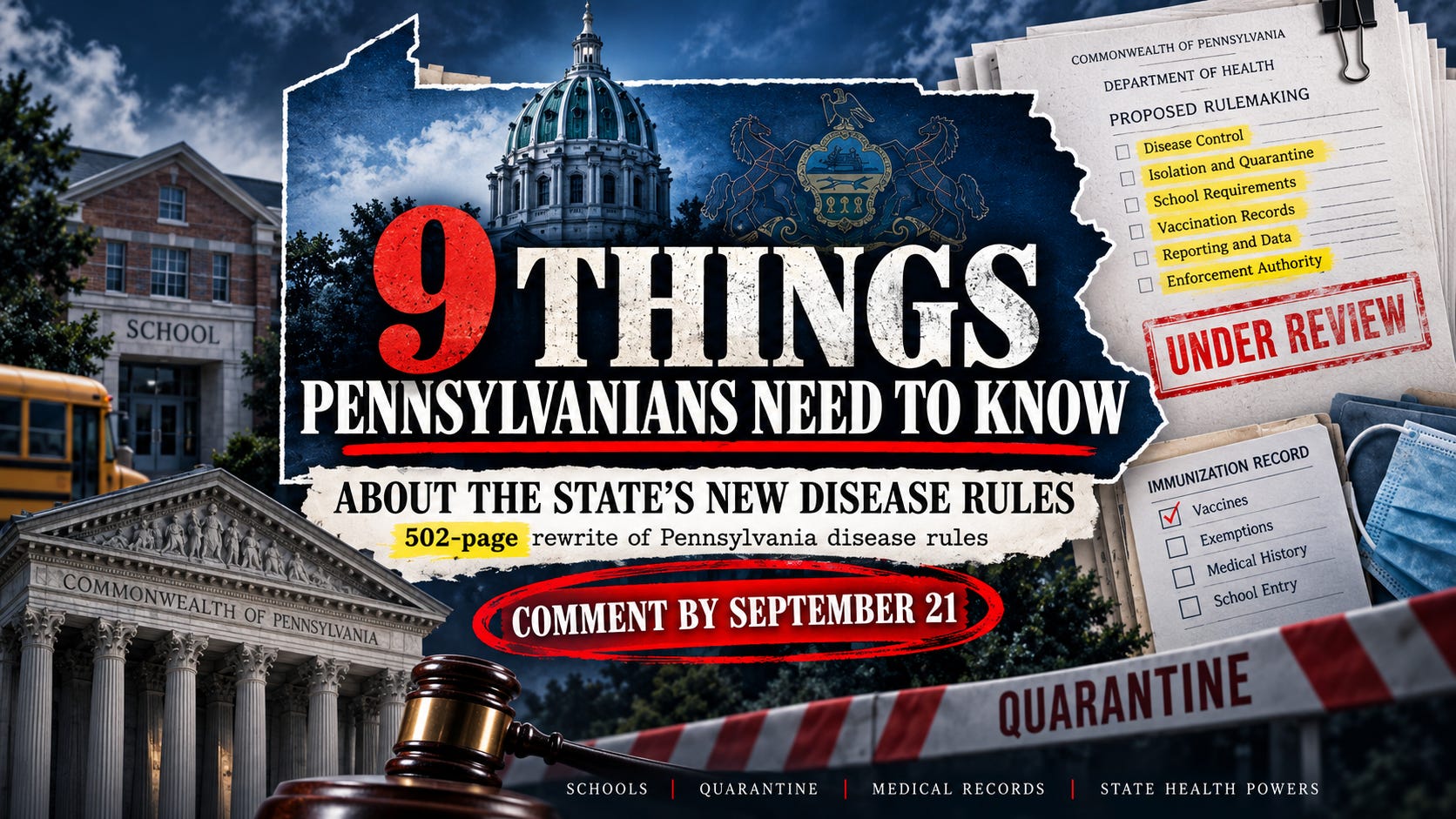
The Department of Health lost the school-mask case in 2021. Its 502-page rewrite of the disease rules gets that power back, in its own words. That’s item one. It gets worse from there, and all too reminiscent of COVID Era tyrannical measures the public is no longer willing to tolerate.

The Department took the hint. It is now doing precisely that, and it says so on page 3 of the regulatory analysis it filed on June 4.
The rewrite is Regulation 10-242, IRRC #3490 — 502 pages rewriting 28 Pa. Code Chapter 27, the rulebook that governs reporting, quarantine, isolation, school exclusion, and vaccination in Pennsylvania. It was published August 8. Public comment closes September 21. About 990 people have already filed. Almost none of them have seen what follows, because it is on pages 362 through 492 of a package the Department describes as “much needed amendments” to “reflect current terminology and enhance readability.”
It is also a textbook administrative-state maneuver: an agency that lost in court rewriting its own powers back into existence, through a process the public never votes on. More on that after the list.
Here is what is actually in it.
The deadline is September 21. Here is how to comment.
Email the Department of Health at RA-DHCHAPTR27PROPREG@pa.gov with “Regulation #10-242 / IRRC #3490” in the subject line, or file directly with the Independent Regulatory Review Commission. Sign your name. Cite a page. Write it in your own words — identical form letters are bundled into a single file on the docket.
The full 502-page filing is here. Every comment filed so far is here. Specific, page-cited points you can make — one for each of the problems below — are at the end of this piece.
1: They lost the mask case. This gets the power back — and they say so.
Today, § 27.60(a) lets the Department order “any other disease control measure” it considers appropriate “for the surveillance of disease.” The rewrite changes that to “surveillance, prevention, containment or mitigation of disease” (p. 417).
Three words. Here is the Department explaining them, verbatim, on page 3:
“The foregoing decision influenced the Department’s proposed amendments to § 27.60(a), which propose to add ‘prevention, containment or mitigation’ as justifications for the implementation of all disease control measures available to the Department under the Disease Prevention and Control Law.”
“The foregoing decision” is Corman v. Acting Secretary — the case that voided the mask order. The preamble goes on to describe what the new words are for: “measures to restrict access or unprotected access to the affected location,” and less restrictive measures “such as use of a disinfectant, cleaning or social distancing” (p. 250).
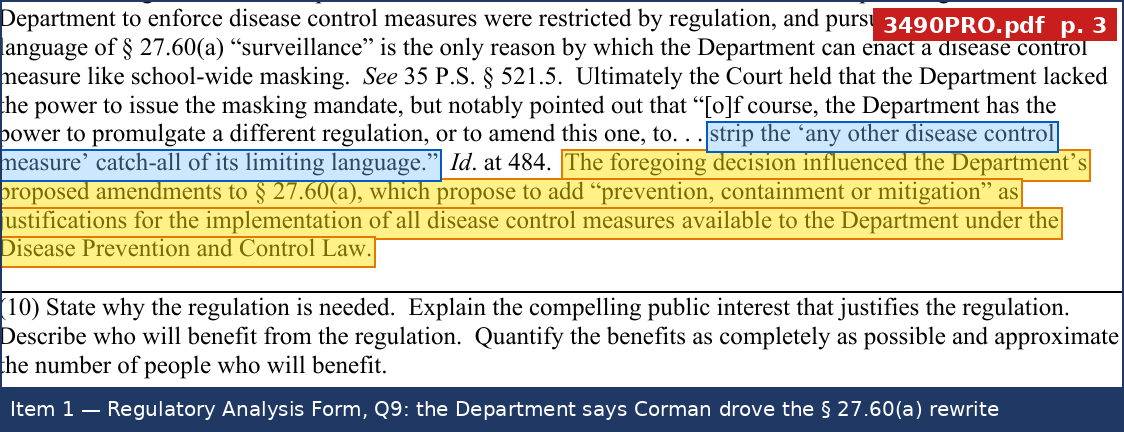
the admission, with the Court’s line in blue
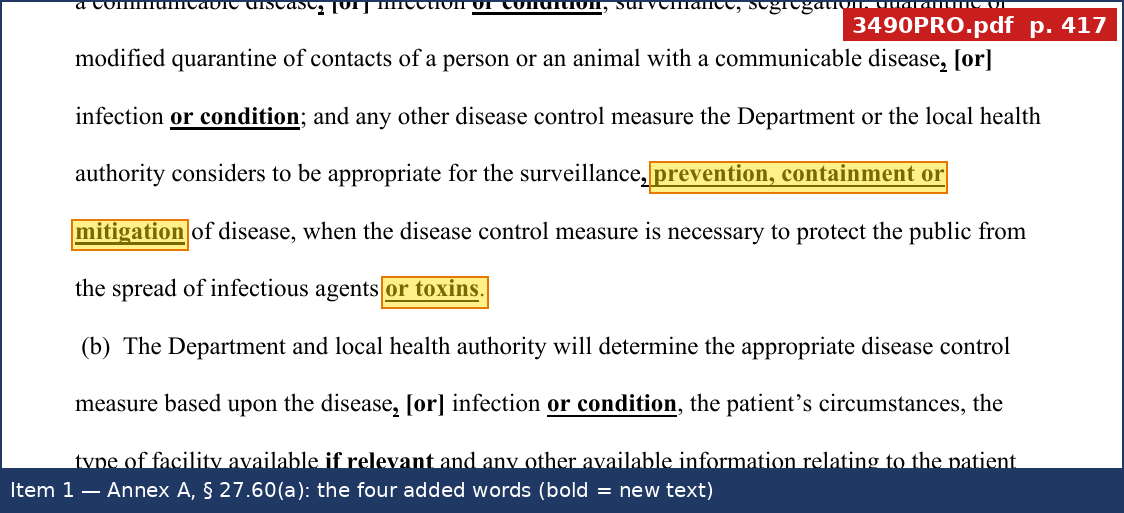
the four words, in bold, in the rule
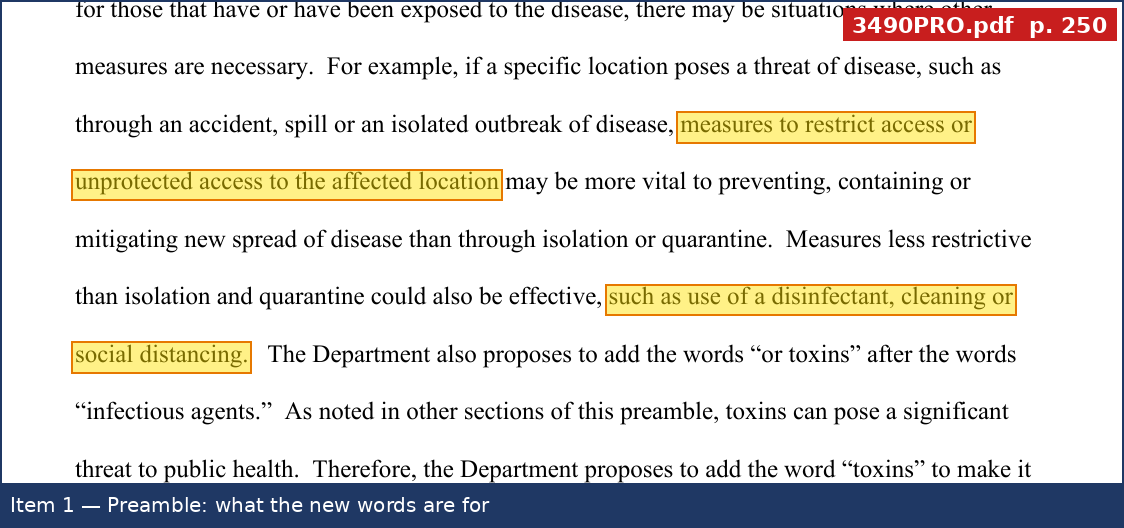
“restrict access,” “social distancing”
No time limit. No emergency declaration required. No hearing. No appeal. The only test is that the Department “considers” the measure appropriate and “necessary.” That was the test in 2021 too. The difference is that in 2021 the rule said surveillance, and a court could read it.
They are doing this through the front door — the regulatory-review process, not an emergency order. Good. That is also the point: an agency is using a process built for technical rule updates to restore a power a court said it lacked, with a five-member review commission and a rarely used legislative veto as the only things standing between it and the rulebook.
2: Refuse the state’s “approved” treatment and you can be confined. The one religious protection is being erased.
This has been Pennsylvania law for decades, § 27.87(a), and the rewrite leaves it untouched (p. 470): a person with a communicable disease who “refuses to submit to treatment approved by the Department” shall be “isolated in an appropriate institution designated by the Department . . . for safekeeping and treatment until the disease has been rendered noncommunicable.”
Also on the books for decades, § 27.87(c): approved treatment “may include treatment by an accredited practitioner of a well recognized church or religious denomination which relies on prayer or spiritual means alone for healing.”
The rewrite deletes it (p. 471) — the paragraph is bracketed and marked “{Reserved},” regulatory-drafting shorthand for gone. The Department’s entire explanation:
“The Department proposes this amendment for clarity. In practice, the Department relies on evidence-based treatments and would only approve of a church, religious or spiritual treatment to the extent that it is evidence-based.” (p. 318)
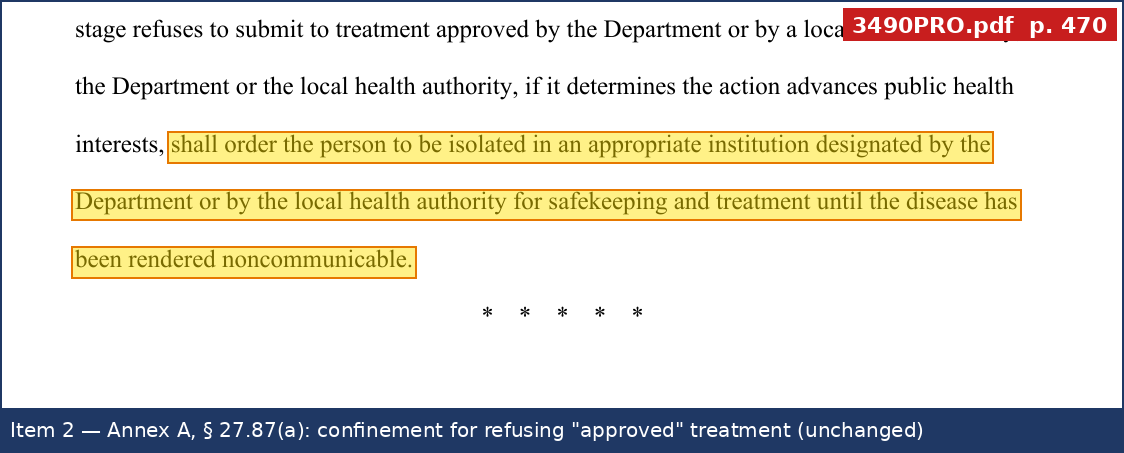
the confinement power, unchanged
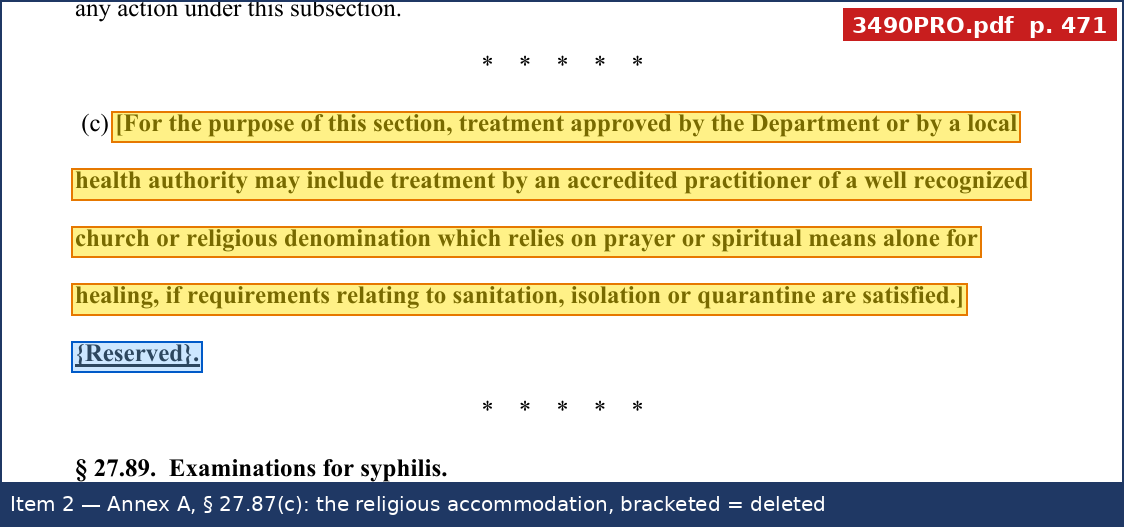
the accommodation, bracketed for deletion
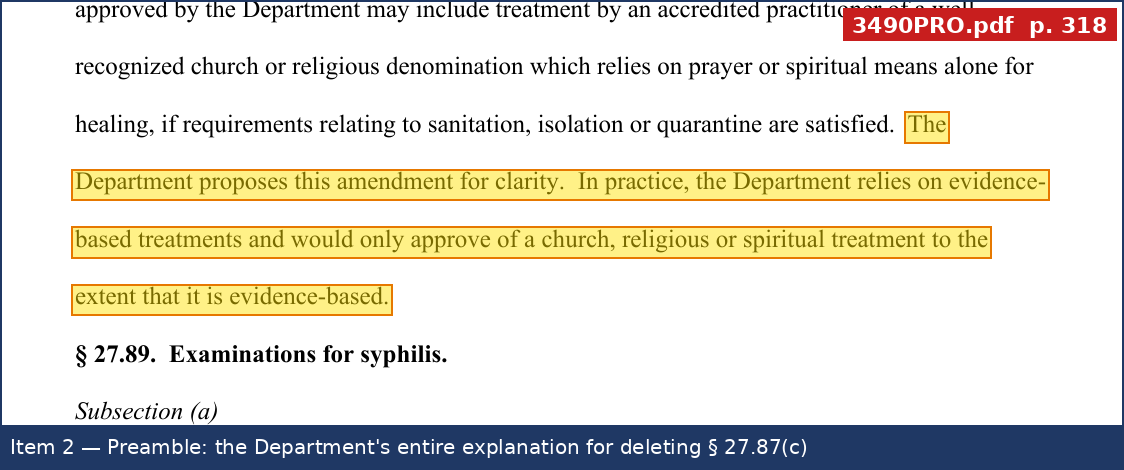
“for clarity”
A prayer-based treatment approved “only to the extent that it is evidence-based” is a prayer-based treatment never approved. That is not clarity. That is the accommodation gone and the confinement power kept — and nowhere in 502 pages does the Department say what makes a treatment “approved,” who decides, or how you contest it.
3: Unvaccinated kids out of school for weeks at a time — for six diseases, not one.
Right now, Chapter 27 spells out one school-wide power of this kind: during a measles outbreak, § 27.160 lets the Department order every “presumed susceptible” — unvaccinated, non-immune — student out of the school until vaccinated, until they prove immunity, or until the school goes fourteen days without a new case.
The rewrite scraps that section and rebuilds the power for diphtheria, measles, mumps, pertussis, rubella and varicella (pp. 432–453). Out until vaccinated, until you prove immunity, or until the school goes 14 to 26 days without a case. Measles goes from 14 days to 21. Mumps is 26. And the clock restarts with every new case: in a school with rolling infections, an unvaccinated child’s exclusion has no end date except vaccination. Every one of the six now operates “in the course of conducting disease control measures under Subchapter C” — item 1’s catch-all.
How many children? How many days? What does it cost districts? The Department’s fiscal analysis: it “is not able to estimate.”
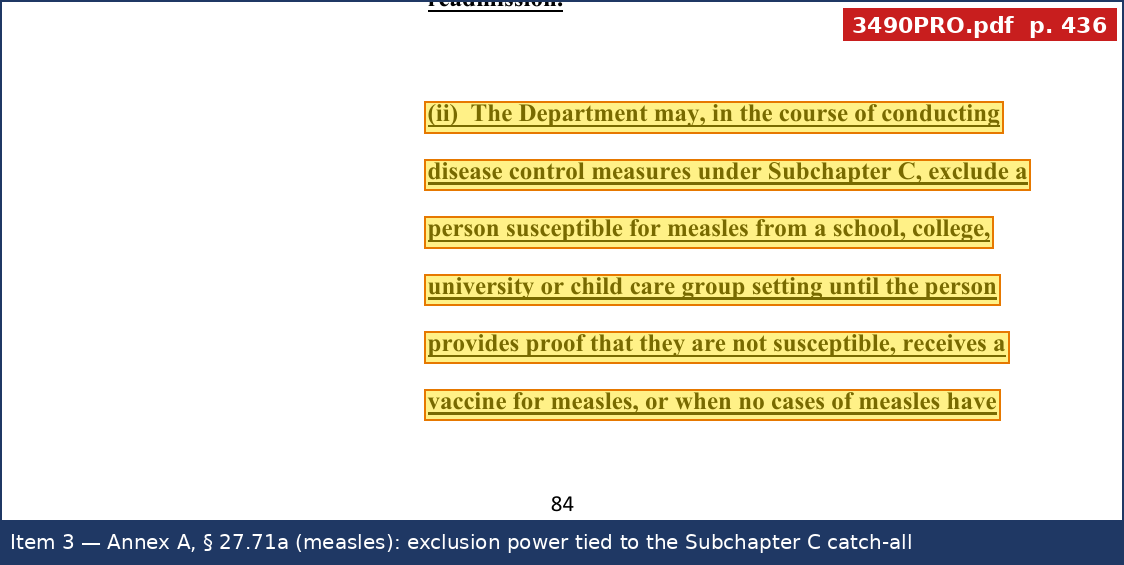
the power, tied to Subchapter C
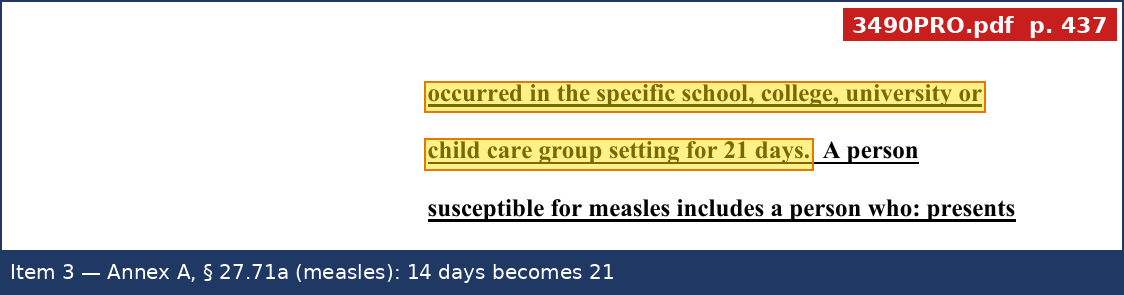
21 days
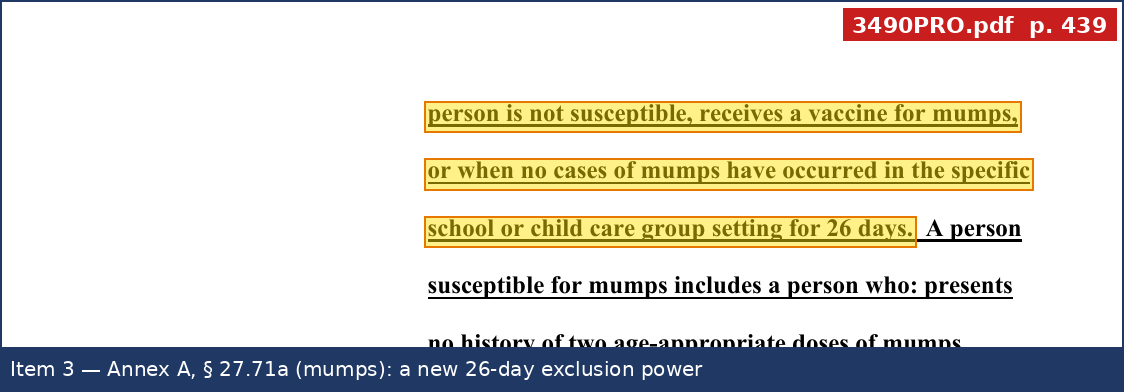
mumps, 26 days
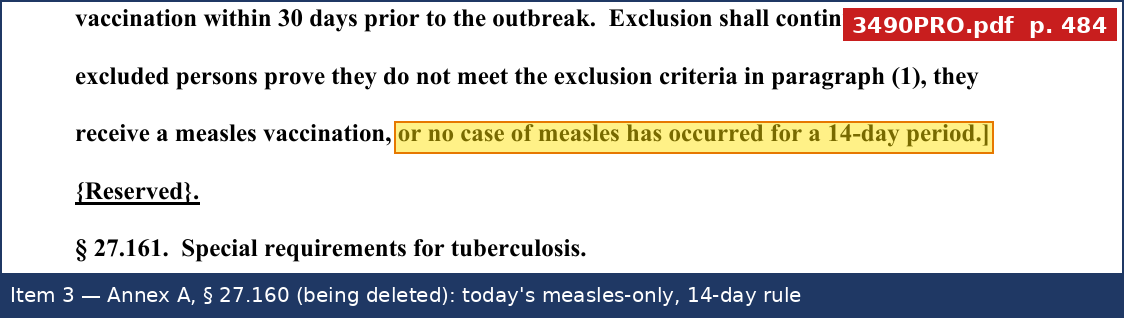
today’s rule: measles only, 14 days
4: Their new measles rule doesn’t apply to a single child. Read the sentence.
Page 437, the new definition of who counts as “susceptible” to measles:
“A person susceptible for measles includes a person who: presents no history of two age-appropriate doses of measles vaccination . . . ; does not have a diagnosis of measles disease . . . ; does not demonstrate serological evidence of measles immunity . . . ; and was born before December 31, 1956.”
And was born before December 31, 1956.
The rule being deleted says “after” (p. 484) — because federal guidance presumes anyone born before 1957 caught measles as a child and is immune. The new rule, joined by “and,” says a susceptible person is one who is unvaccinated, never had the disease, has no antibodies, and is at least 69 years old this year.
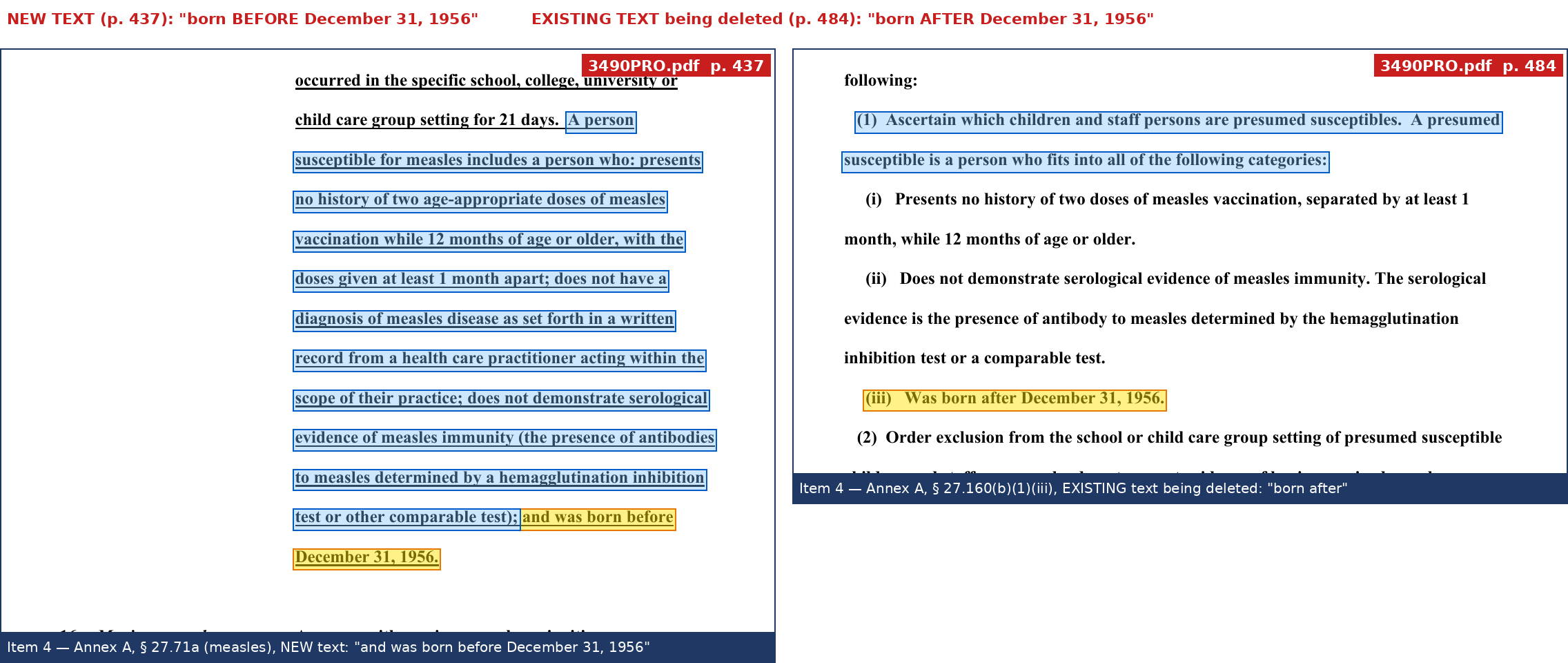
p. 437 “before” and p. 484 “after,” side by side
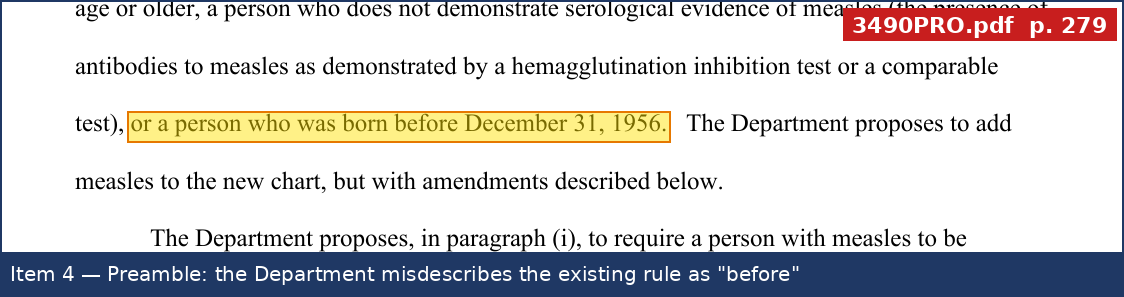
the preamble gets the existing rule backwards too
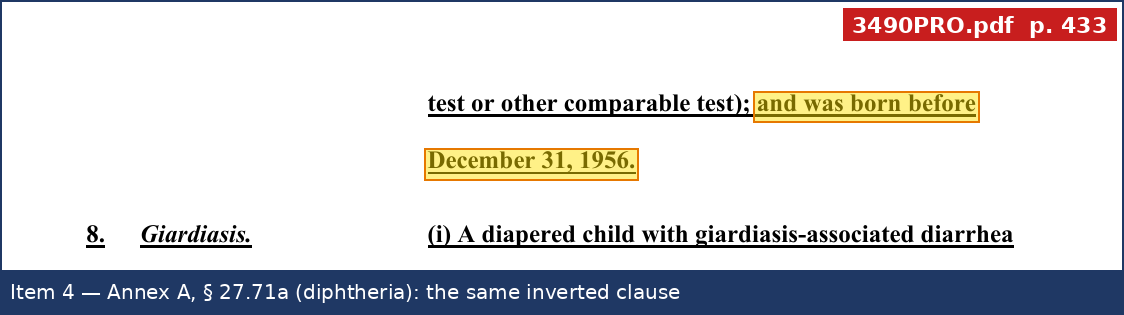


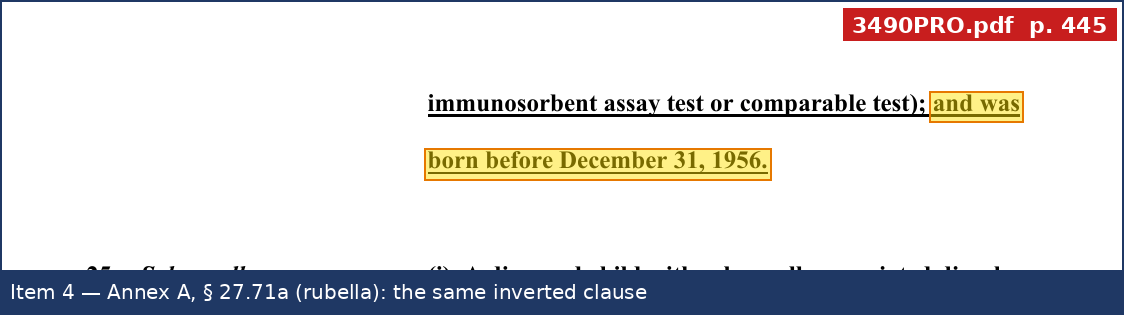
the same clause, four more times
Read as written, no child in Pennsylvania can be excluded from school as susceptible to measles. The same clause is pasted into diphtheria (p. 433), mumps (p. 439), pertussis (p. 442) and rubella (p. 445). Diphtheria and pertussis have no birth-year immunity presumption in any CDC guidance — the clause was copied and never read. The preamble describing the existing rule gets it backwards too (p. 279).
This is the flagship provision of a package that took eight years, a Board vote, and two rounds of government lawyers. It was filed in the third month of the biggest measles outbreak in a generation. It doesn’t work.
5: The Department can declare its own “emergency.” Then it can decide who attends your funeral.
Chapter 27 has never defined “public health emergency.” Now it does (p. 362): any event that “has the potential to seriously affect” the health of “a significant number of persons” and “threatens to overwhelm routine medical or public health capabilities.” Read it again. No declaration by anyone is required — not the Governor, not HHS, not a court. The definition needs only a potential and a threat, and the Department judges both. A declaration by the Governor or HHS is merely “included” — one more way in, not the door.
Then the term goes to work. Thirty-minute reporting deadlines (§ 27.3). Department-ordered reporting by child-care centers (§ 27.23). Faster registry reporting (§ 27.36). Restrictions on the movement of animals (§ 27.191). And § 27.204 (p. 492): a funeral “with the body” of anyone who died of a listed disease “or other known or suspected communicable disease associated with a public health emergency” shall be private when the Department orders it. Private means “only the immediate relatives of the deceased, the officiating person and the necessary number of pallbearers.”
Today that order is limited to diseases that require isolation or quarantine. Tomorrow it reaches any disease the Department links to an emergency the Department defined into existence. Think about which communities in this state hold funerals that fill a barn.
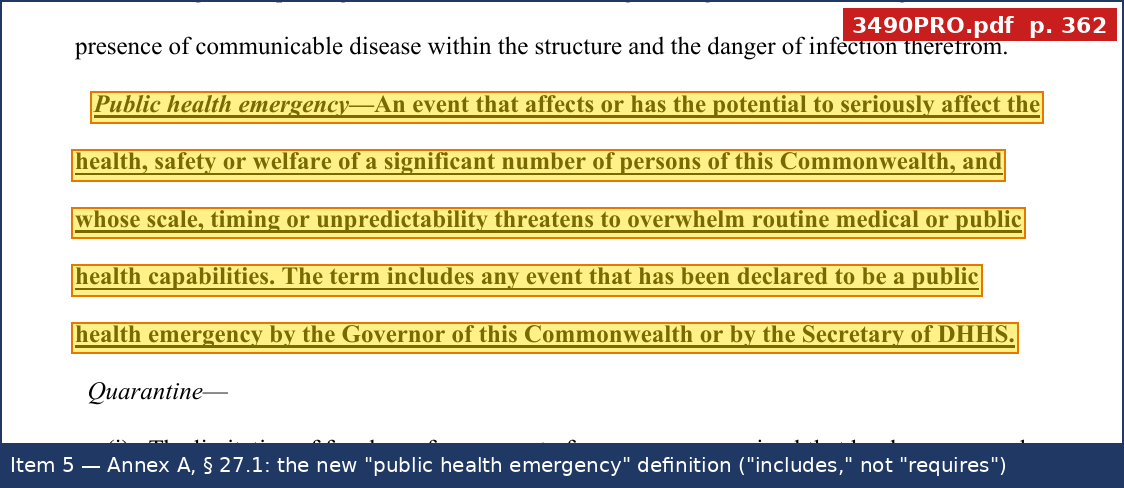
the definition
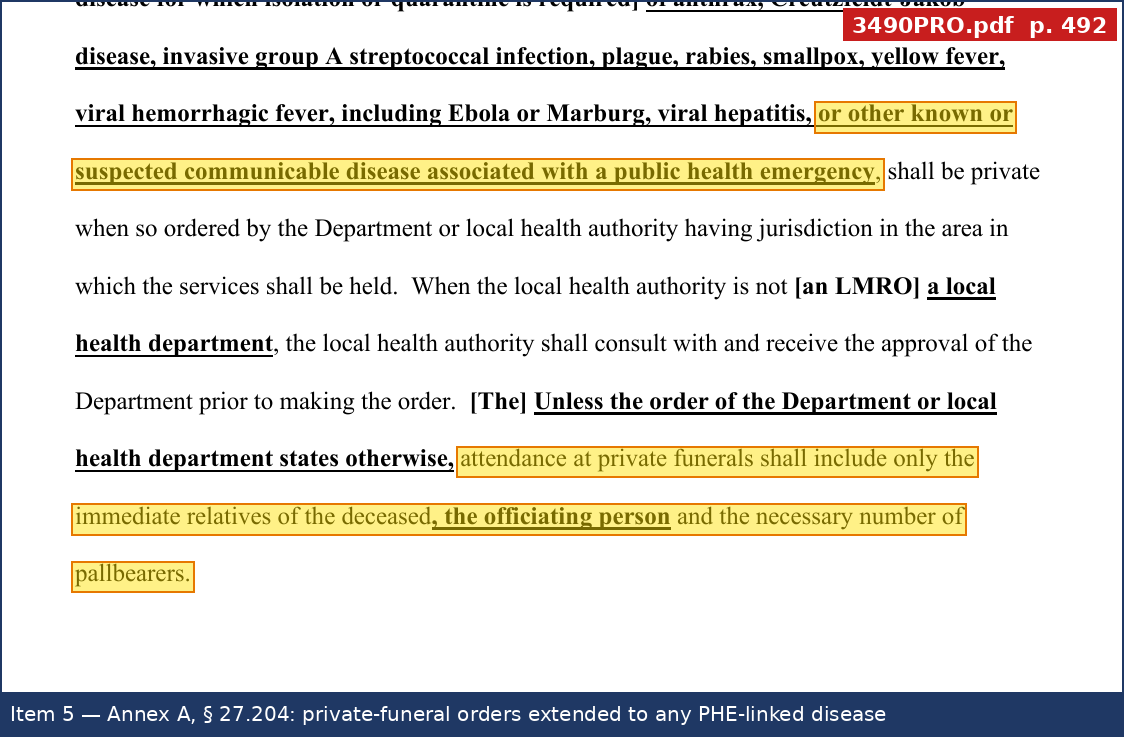
§ 27.204
6: State officials can pull your kid out of class and talk to them alone. Parents aren’t in the rule.
Section 27.60c did not exist before. It requires every school to give the Department “reasonable and timely access to a person for the purpose of contact tracing or partner services, including access when classes are in session.” Then (p. 419):
“A person, including an employee or official of a school, shall permit the Department or local health authority to meet and speak with a student or other person in private, and may not interfere with the student or other person’s ability to exercise their right to give consent under 35 P.S. § 10103.”
That statute is the 1970 minors’ consent law: a minor may consent to services for “venereal disease and other diseases reportable under” the disease-control law, “and the consent of no other person shall be necessary.” The Department didn’t write the statute. It wrote a rule that installs it in every school in the state, forbids the school from “interfering,” never defines “interfere,” and does not mention telling a parent.
Why now? “There has been confusion in the past regarding whether the existing provisions of the regulations specifically apply to schools” (p. 255). What confusion? Where? It doesn’t say.
And for the first time, “school” is defined to include “any school operated by a bona fide church or other religious body” (p. 363) — the category Amish and Mennonite parochial schools fall under.
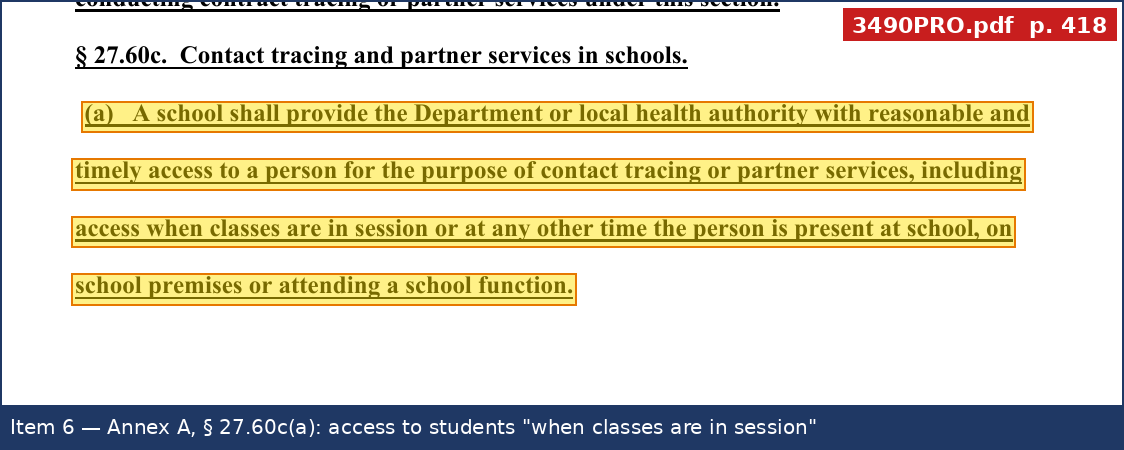
“when classes are in session”
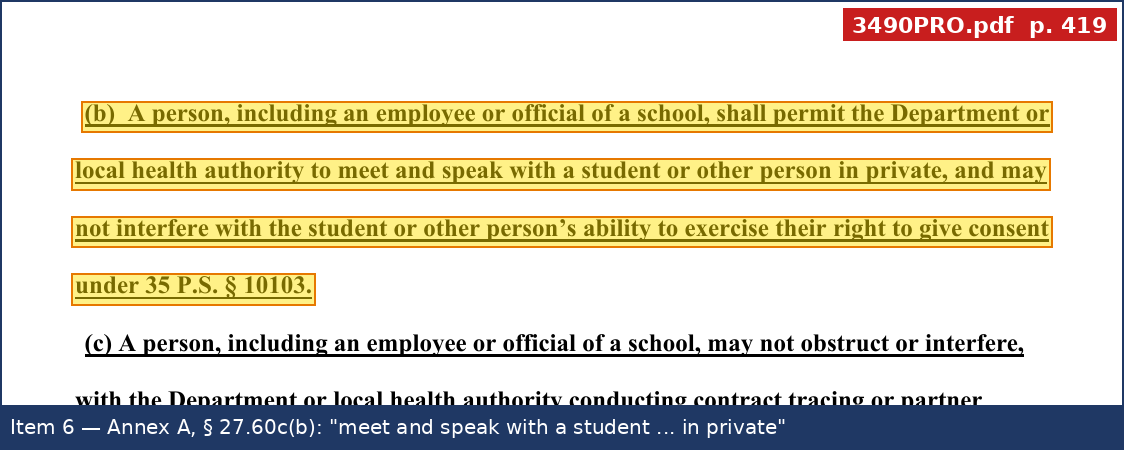
“in private”
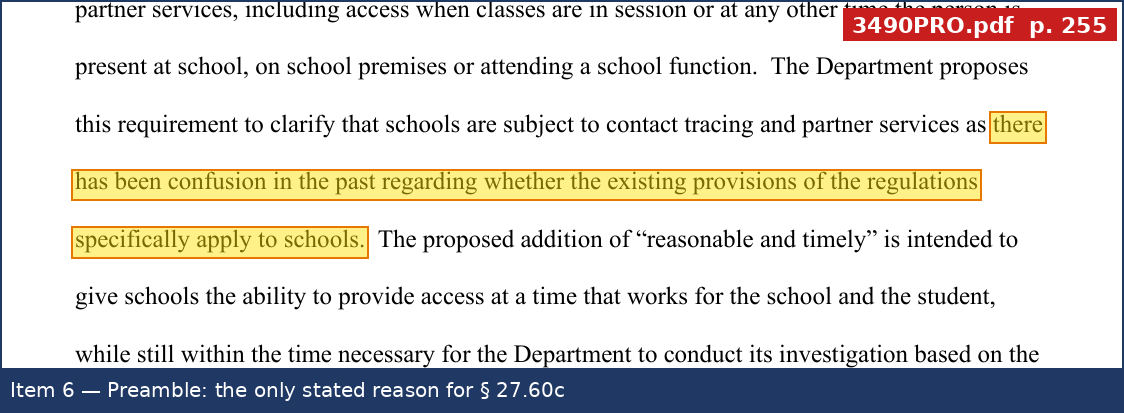
“confusion in the past”
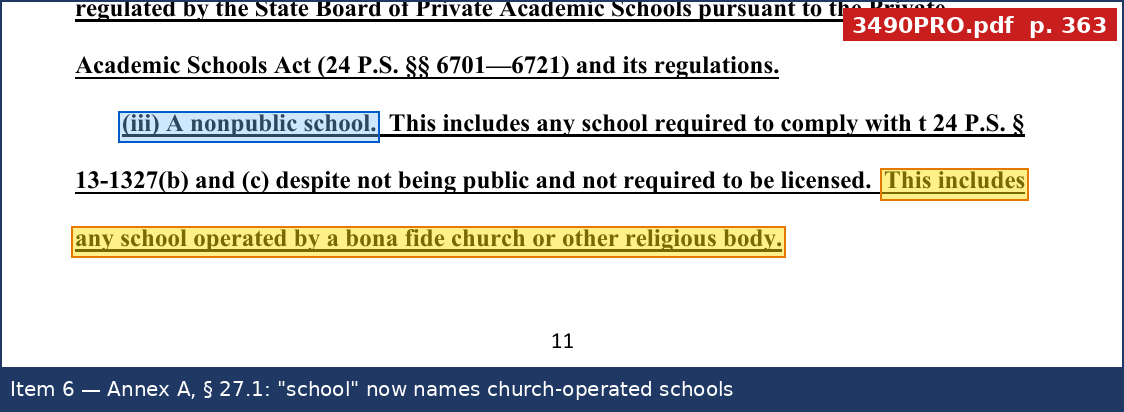
the school definition
7: Every shot. Every ER visit. Your medical records. And they tell you what it’s for.
Four pieces, each small, together not:
Every vaccine dose given in Pennsylvania outside Philadelphia goes to the state registry with your name, date of birth, address, race, ethnicity, and the lot number (§ 27.36, pp. 412–413). Voluntary today. You can decline “in writing” — but nothing requires anyone to tell you that.
Every emergency-room visit, within 24 hours: a patient identifier, age, zip code, diagnosis codes, whether you died — and “[o]ther data elements deemed necessary by the Department” (§ 27.4a, pp. 367–368). Voluntary today.
“Any additional reports deemed necessary . . . upon request of the Department.” That’s the whole of new § 27.4b (p. 368).
Your medical records. During any investigation the Department “shall have access to” them, may demand copies, and copies “shall be transmitted electronically” (§ 27.60e, p. 419). The old rule allowed a review. Access and copies are new.
Then there is child care. Centers’ annual immunization report is replaced with on-demand access and on-site review of each child’s status (p. 466). The Department explains why, in a sentence it apparently didn’t expect anyone to read (p. 314):
“necessary for the Department to effectively conduct investigations as vaccination status is an indicator as to which children are susceptible and may need to be quarantined in cases of illness or disease.”
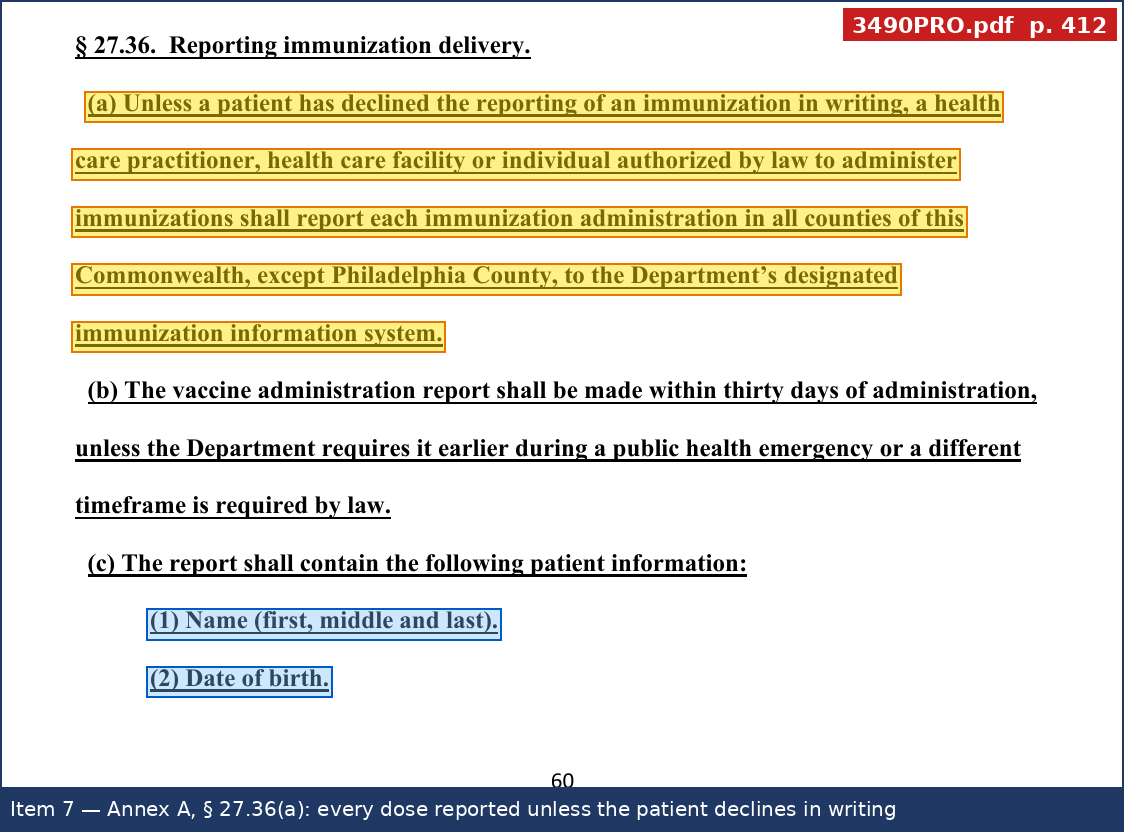
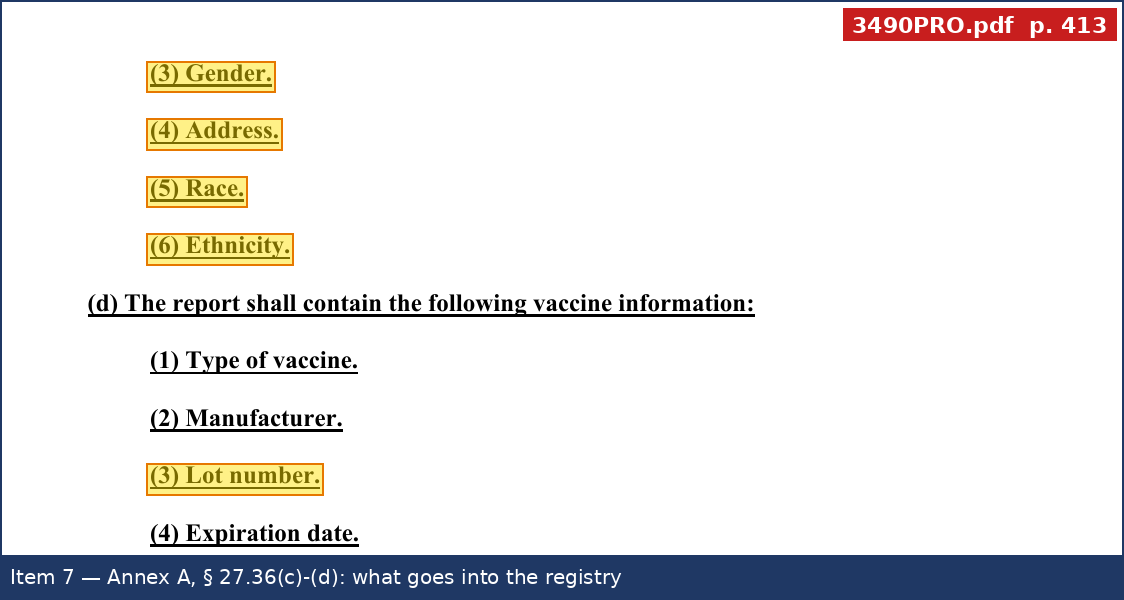
the registry mandate and its fields
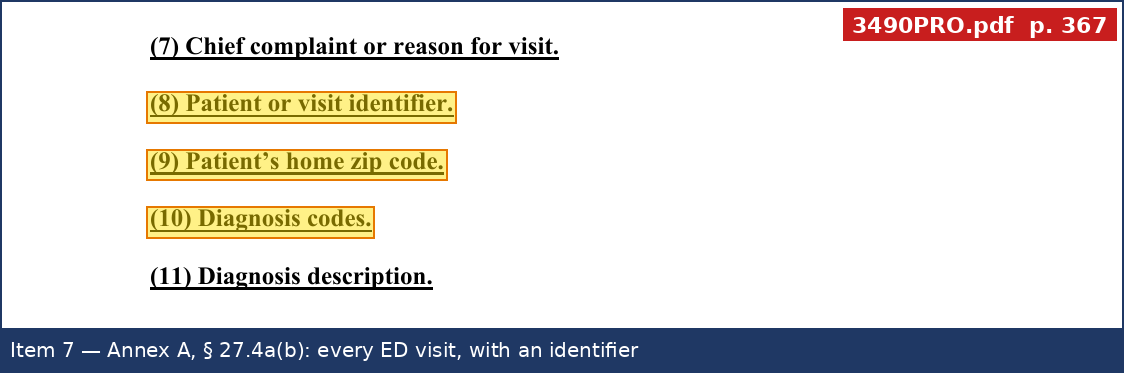
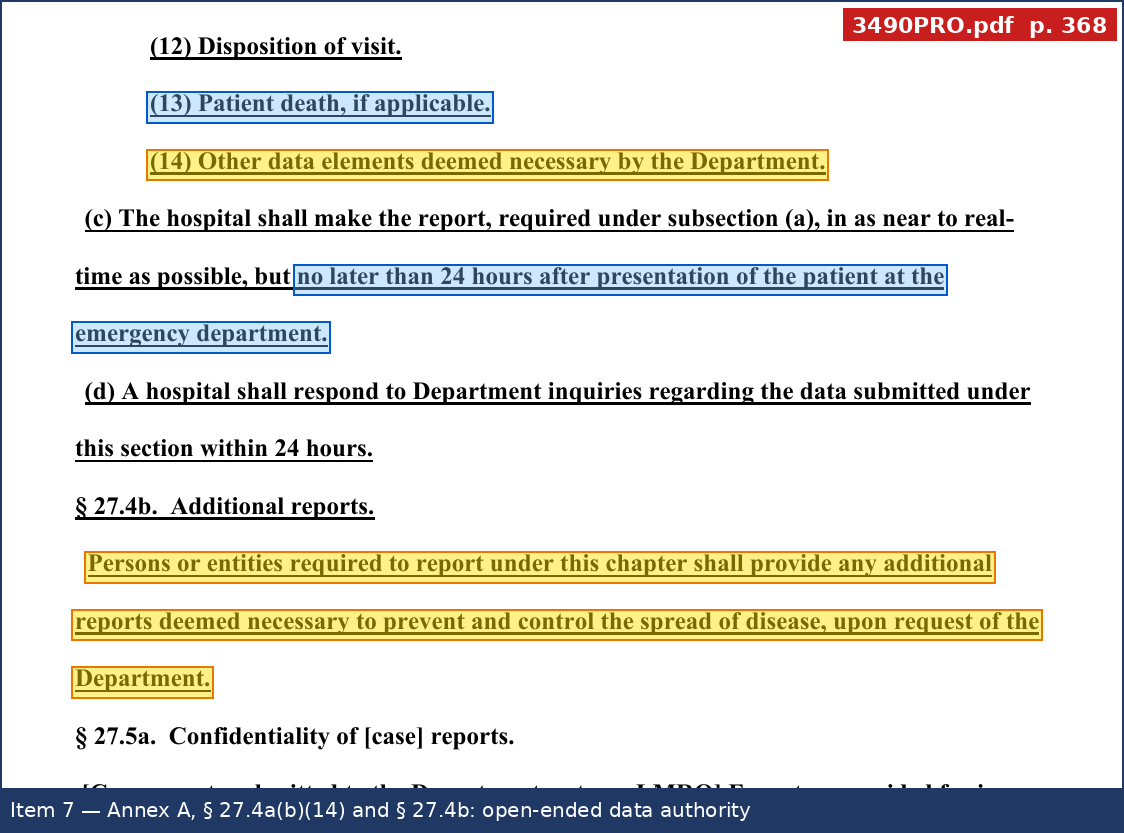
every ER visit; “other data elements deemed necessary”; § 27.4b in full
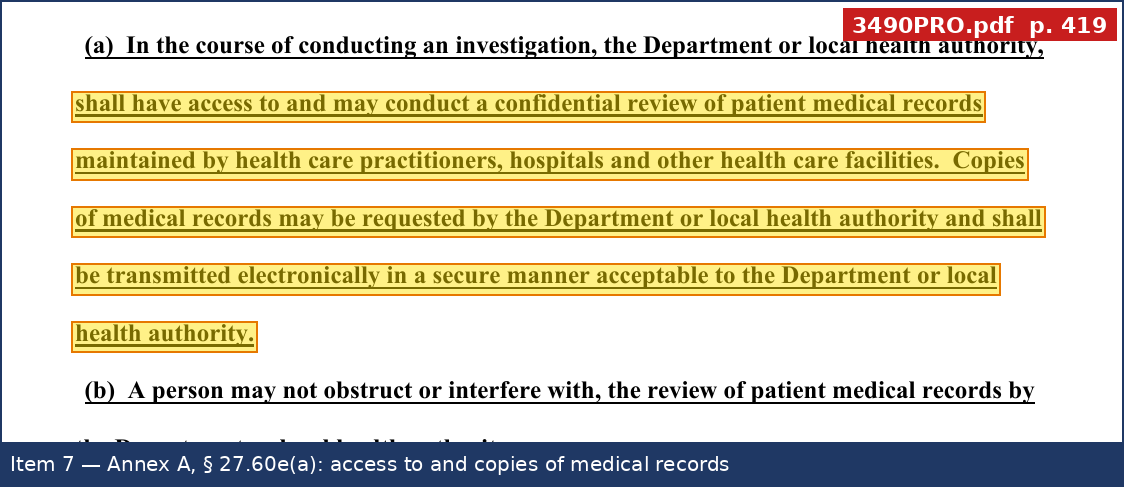
access to and copies of records
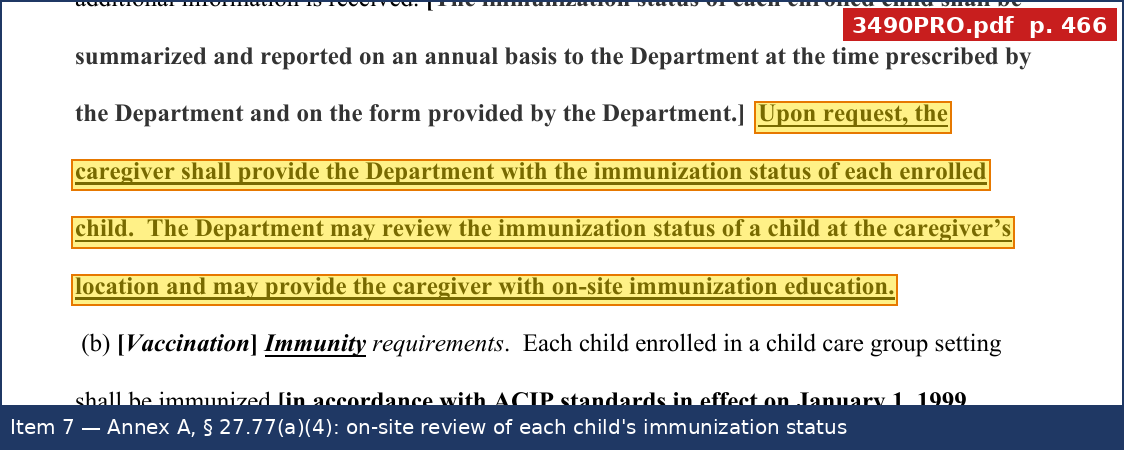
on-site review
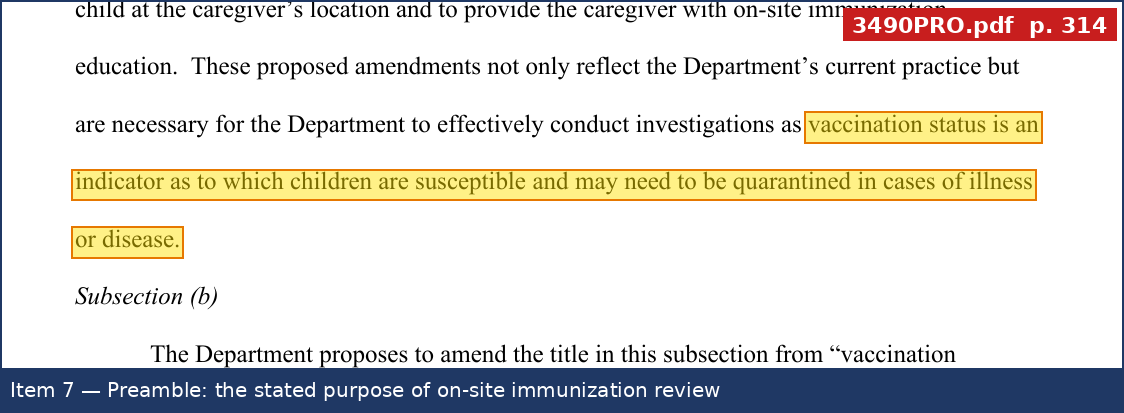
“may need to be quarantined”
8: They decide when to identify you publicly.
Disease reports are confidential under § 27.5a. The rewrite adds an exception (pp. 368–369): identifying information may be disclosed “when disclosure is necessary to inform the public of the risk of a communicable disease, as determined by the Department.”
The statute allows this. But hold it next to August 25, when the Department announced two “measles-associated” deaths in Lancaster County and said it “will not release additional details that could personally identify them.” Who gets identified, when, and why is now a decision the Department makes alone, against no stated standard, with no one to appeal to. Readers of this series know why that matters.
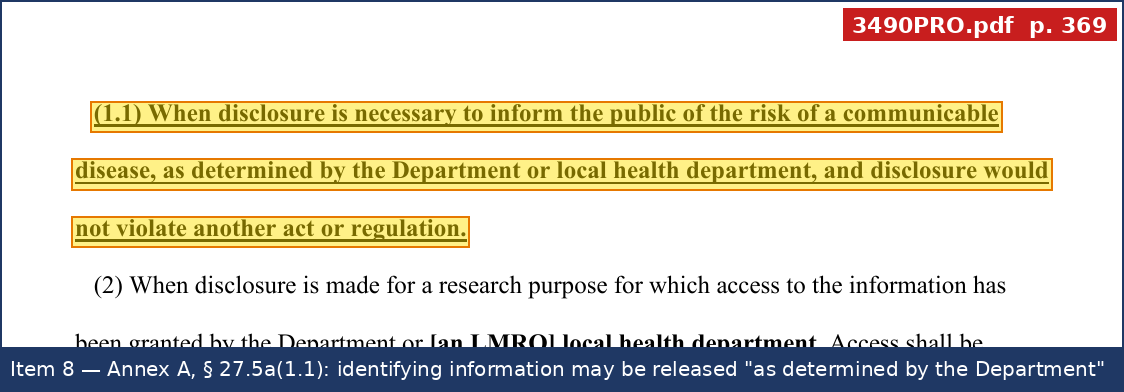
§ 27.5a(1.1): identifying information may be released “as determined by the Department”
9: Nobody counted the cost — and it’s not clear who approved this text.
The Regulatory Review Act requires the Department to estimate what its rules will cost. For the expanded reporting lists, the registry mandate, the birth-defects registry, the six-disease exclusions, the school-access rules, and the new rule that a child excluded for symptoms stays out “until a health care practitioner acting within the scope of their practice determines that the symptom is not due to an infectious cause” — replacing today’s standard, a school nurse being “satisfied” the child isn’t contagious (pp. 459–461) — the analysis says the same thing more than a dozen times: the Department “does not have sufficient data” and is “estimating no overall fiscal impact” (pp. 18–31). Four thousand seven hundred fifty providers who don’t report to the registry will have to start. Districts will pay substitutes. Parents may pay for practitioner visits that a school nurse’s judgment used to settle. Nothing is quantified.
Then the procedural question. The State Advisory Health Board — the body the 1955 statute says issues these rules — approved the amendments on July 17, 2025 (pp. 10, 38). The text filed eleven months later cites an executive order signed October 1, 2025 (pp. 4, 315) and a pediatric vaccine schedule dated 2026. Either the Board approved language citing documents that didn’t exist yet, or the text changed after the vote. The filing doesn’t say which.
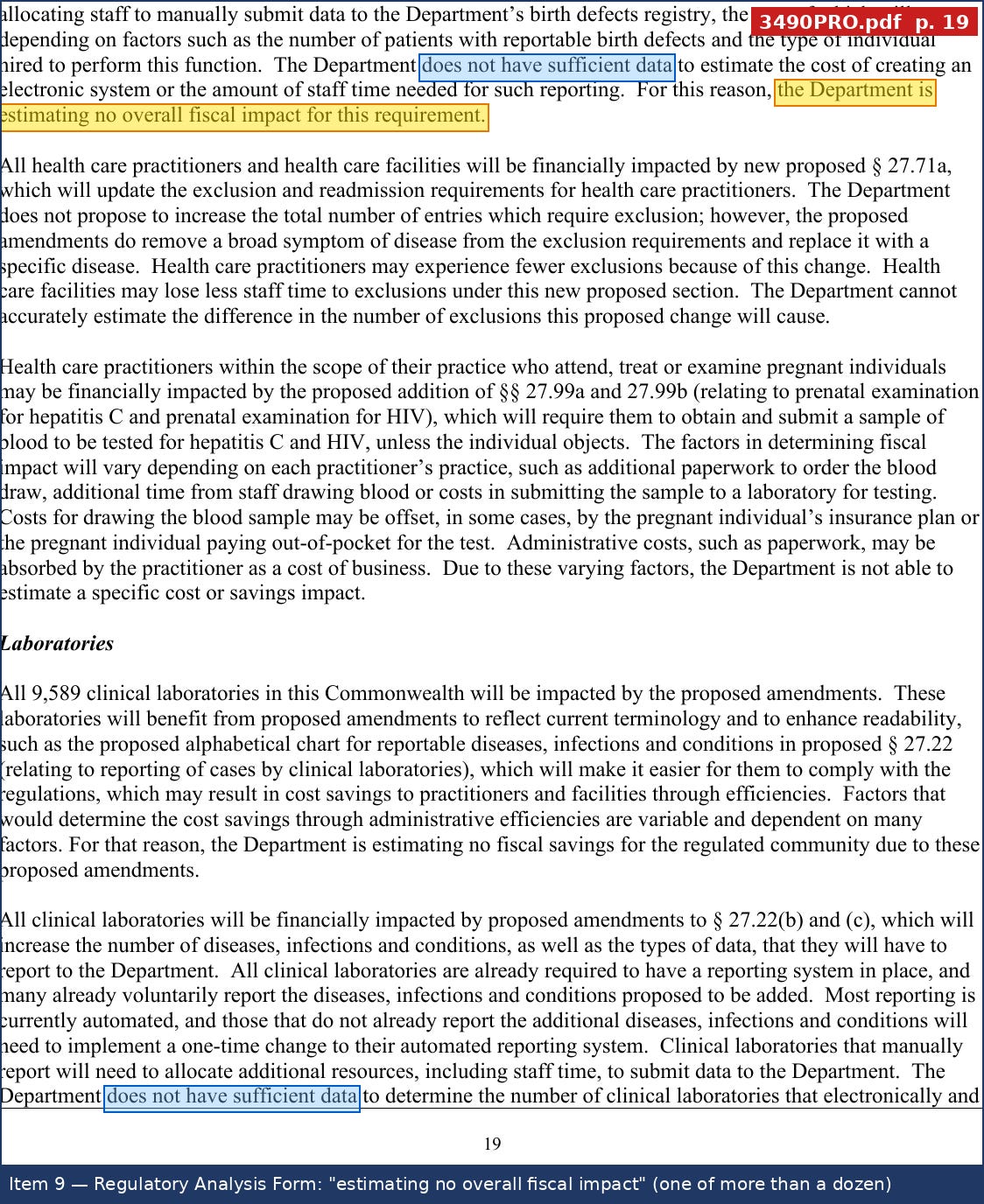
“estimating no overall fiscal impact,” every instance on one page highlighted
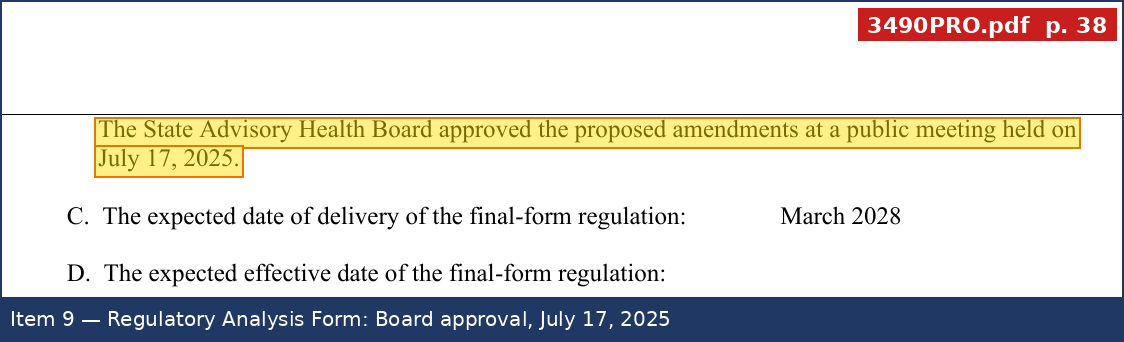
the Board vote
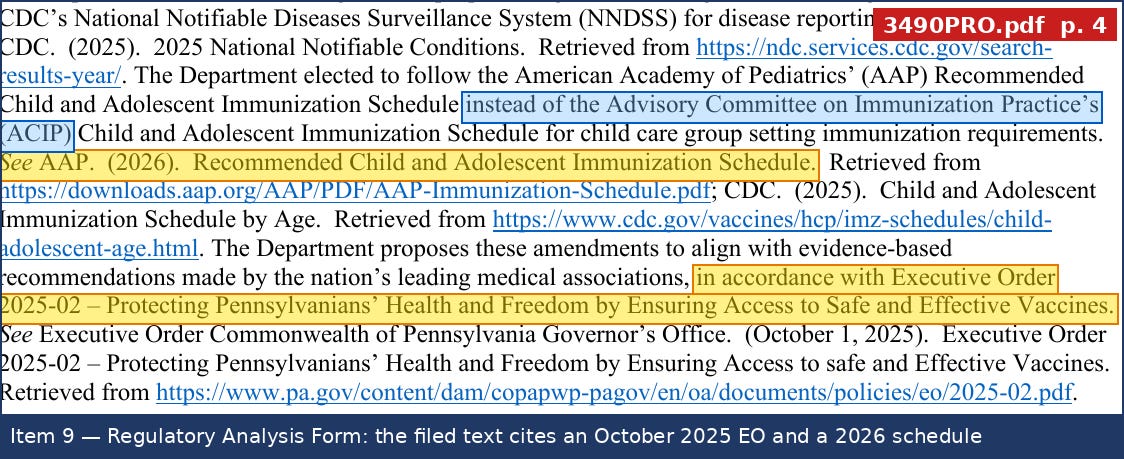
the October 2025 EO and the 2026 schedule, in the text the Board supposedly approved in July 2025
This is the administrative state, working exactly as designed
Step back from the nine and look at the machine.
No legislator will vote on any of this. The rule is issued by a board the Governor appoints, under a statute from 1955, through a review process most Pennsylvanians have never heard of. The Department wrote the text. The Department defines what counts as an emergency. The Department decides what measure is “appropriate,” which treatment is “approved,” which records it needs, which children are “susceptible,” and when to identify you publicly. The Department reviews compliance, investigates violations, and — when you object — the Department writes the response to your objection.
The check is a five-member commission of appointees and two legislative committees. If a committee disapproves the final rule, the General Assembly can pass a concurrent resolution against it — which the Governor can veto, and which then needs two-thirds of both chambers to override. The legislature, in other words, needs a supermajority to stop a rule written by the Governor’s own agency. That has happened a handful of times in forty years.
And the specific move here is the purest form of the genre. A court said: your regulation does not give you this power. The agency did not go to the legislature to ask for it. It went back to its own regulation and wrote the power in — and then told the review commission, in writing, that the court’s decision “influenced” the change. Power that the people’s representatives never granted, restored by the body that wanted it, through a comment period.
That is not a Pennsylvania problem or a Shapiro problem. It is how administrative government works everywhere, and it is why the remedy is structural: emergency-type disease-control powers should require a sunset and a legislative vote, not a filing. A co-sponsorship memo to that effect is already circulating in the Senate. It deserves a bill number.
This wasn’t a panic. It took eight years.
You will hear that this regulation was rushed out to exploit the measles outbreak. It wasn’t, and saying so hands the Department its easiest rebuttal.
The Chapter 27 rewrite first appeared on the Governor’s regulatory agenda on August 4, 2018 — under Governor Wolf — promised for February 2019. It was promised again in 2019, twice in 2021, in 2023, twice in 2024, twice in 2025. The Board approved it July 2025. The Department’s lawyers signed off March 25, 2026, before the outbreak began in April. The Attorney General signed May 20. It reached IRRC June 4.
That chronology doesn’t excuse the regulation. It convicts it. Eight years, a Board vote, two sets of lawyers — and it still came out with a broken measles rule, a deleted religious protection, a self-declared emergency, and not one hearing right anywhere in it. Haste isn’t the explanation. Intention is.
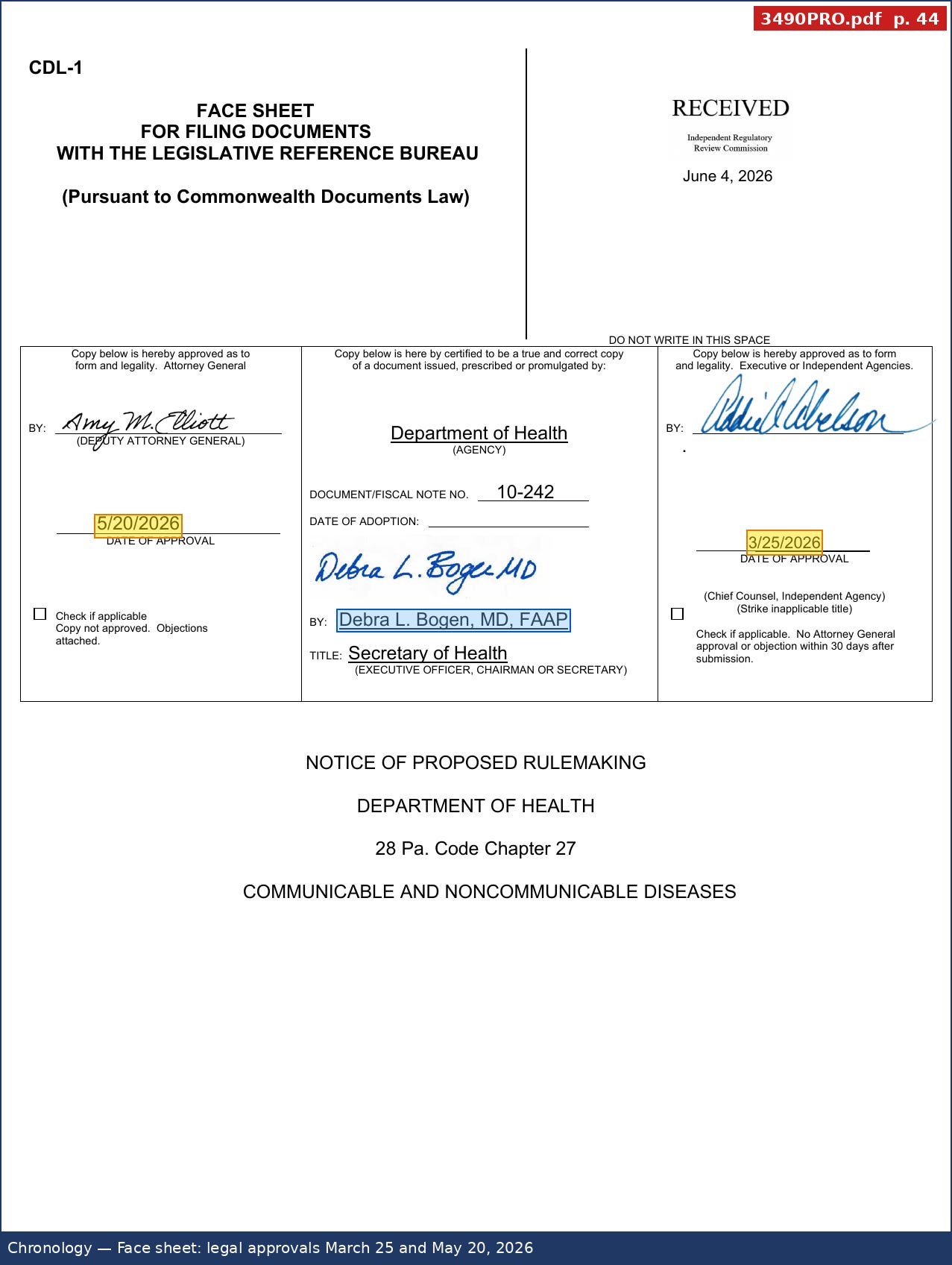
the face sheet: March 25 and May 20, 2026
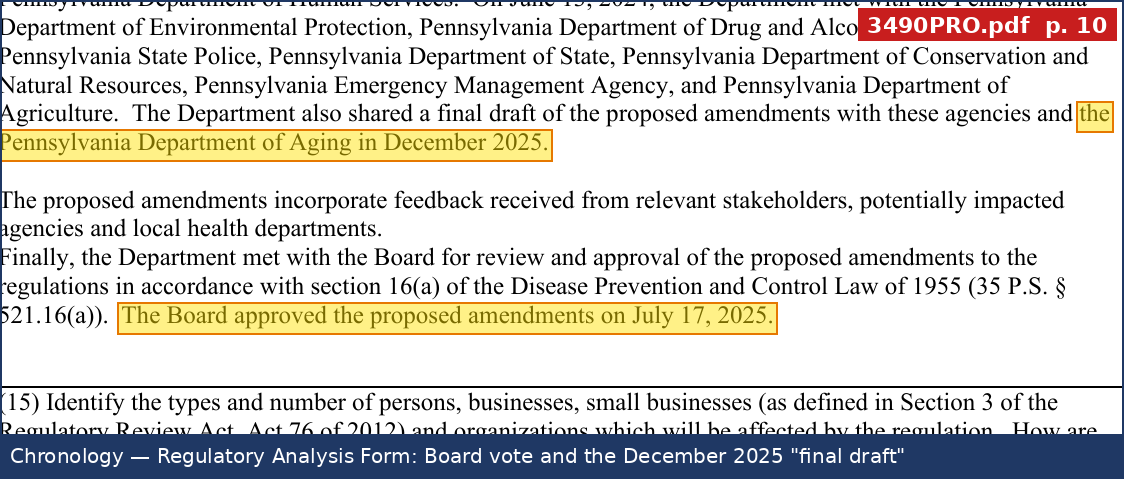
Board vote; December 2025 “final draft”
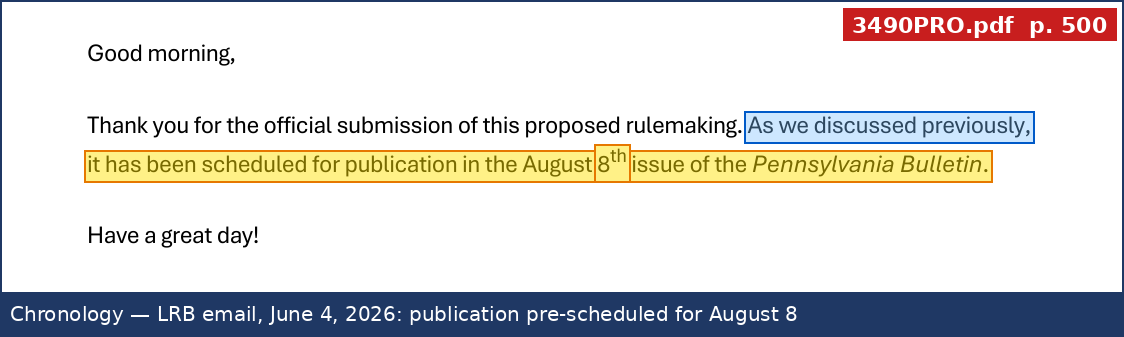
August 8 was scheduled on June 4
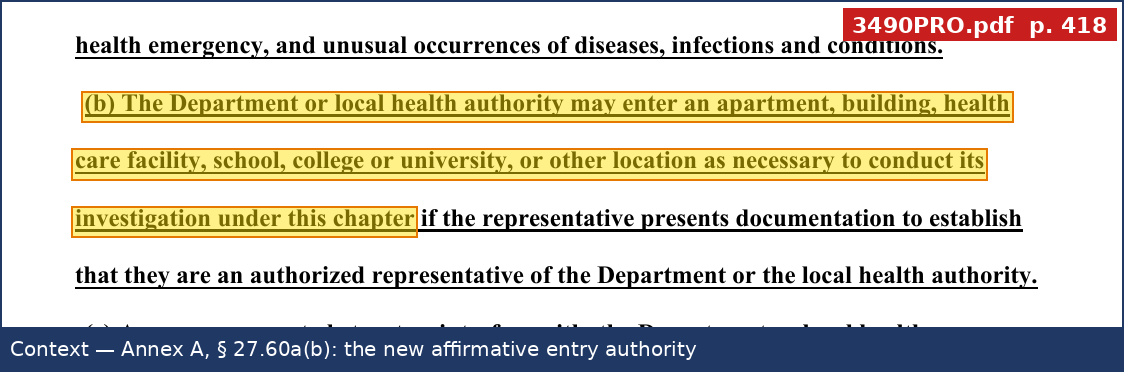
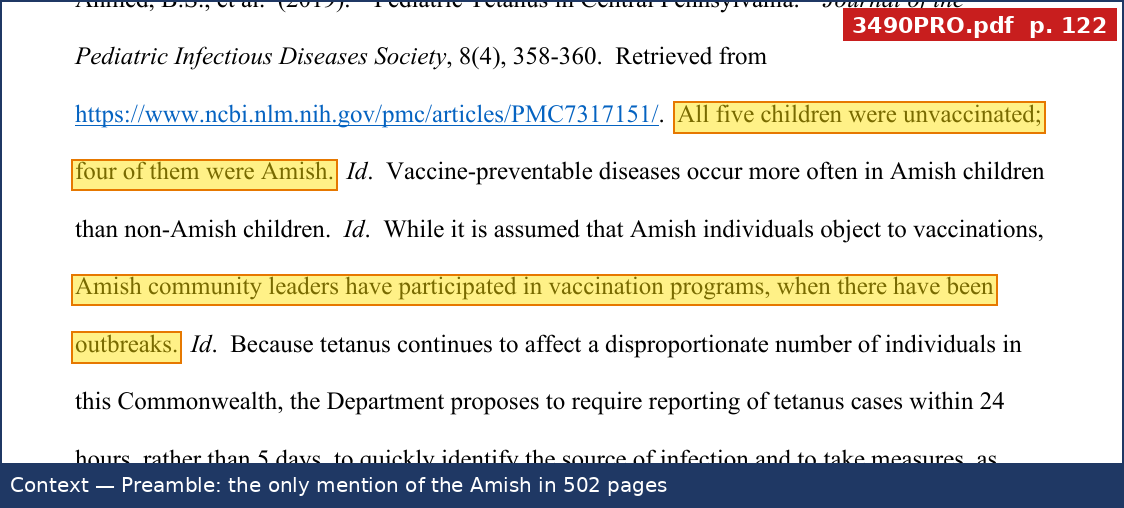
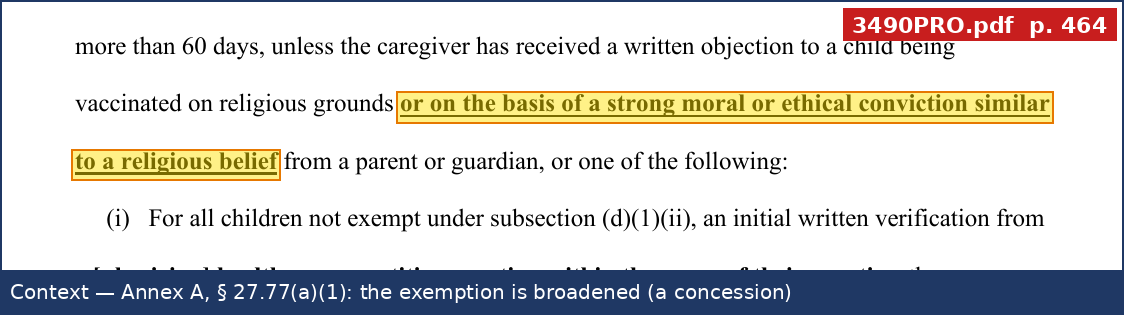
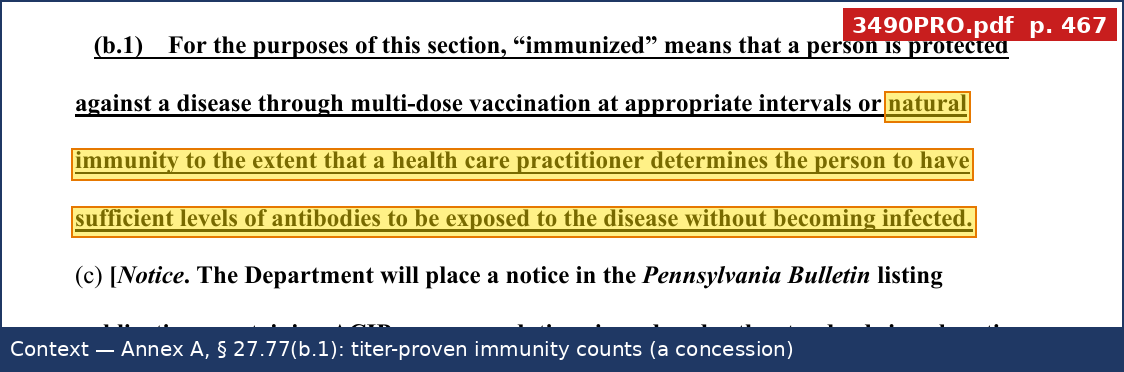
Three more things you’ll hear that aren’t true. Warrantless entry isn’t new; the current rule already bars obstructing an official “who seeks to enter a house.” What’s new is the affirmative power to “enter an apartment, building, health care facility, school, college or university” (p. 418) and the deletion of the requirement that a case be “judged . . . to be a potential threat to the public health” before it’s investigated at all (p. 477). Nothing in 502 pages touches speech. And the Amish are named exactly once — in a tetanus paragraph that credits Amish leaders with cooperating in vaccination drives (p. 122). Two things the critics haven’t credited: the child-care exemption is broadened to “a strong moral or ethical conviction similar to a religious belief,” and a positive antibody test now counts as immunity (pp. 464, 467).
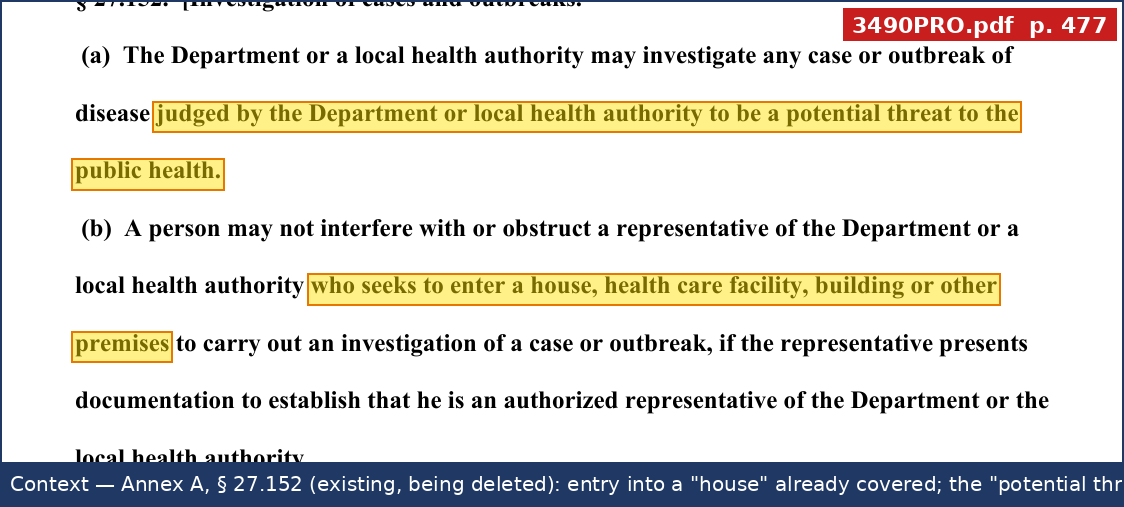
the old rule
the new rule
the two concessions
What the outbreak changed wasn’t the regulation. It was the room it landed in. Published August 8. A re-election attack line by August 21. On August 25 — seventeen days into the comment period — two deaths announced and a Governor at a Lancaster podium. The regulation didn’t come from the deaths. The deaths were announced into the middle of its fight.
Editor’s note — remove before publishingLinks: earlier pieces in this series.
What 2,800 comments missed
I pulled every comment on the IRRC docket through September 4 — 927 files. IRRC bundles identical form letters, and 27 bundles carry 1,934 signatures, so the real number is about 2,830. One bundle — PA Family Council’s “Please Withdraw the 502-Page Proposed DOH Regulation” — held 1,706 of them when it posted on August 31 (1,710 with the four added since). The signer counts are IRRC’s own, printed on each bundle. About sixty percent of the docket is one paragraph.
Of roughly 900 individually written comments: a third raise privacy, a third the private student interviews, a quarter the COVID years, a fifth warrants. Eight percent cite a section. Zero mention the 1956 error. Zero identify the six-disease expansion. Zero raise the Board’s July 2025 vote. Five mention § 27.87. Four mention funerals. One mentions the disclosure exception.
And from the other side: silence. As of September 4, no hospital association, medical society, school board group, teachers’ union, county health department, or civil-liberties organization had filed. The Children’s Hospital of Philadelphia — first on the Department’s 2024 stakeholder list, the building where the executive order this rule cites was signed — hasn’t filed. The only organization on the docket is the Pennsylvania Society for Respiratory Care, which supports the rule and wants one word changed.
Institutions file at the deadline. Watch what they ask for.
Do this. It takes ten minutes.
IRRC’s analysts judge five things: statutory authority, legislative intent, fiscal impact, public health, clarity. They read what’s filed. A thousand copies of a form letter is one file on their desk. Five hundred people each making one specific, page-cited point in their own words is five hundred files. Pick yours:
The error. Does the Department mean “before” or “after” December 31, 1956 at pp. 433, 437, 439, 442 and 445? Will it correct the text? Why is a birth-year presumption applied to diphtheria and pertussis?
The catch-all. What limit remains on “any other disease control measure” under § 27.60(a)? Is it meant to authorize school-wide masking, restricted access to locations, or “social distancing” orders, as the preamble describes? What time limit, notice, and review apply?
The deletion. Retain § 27.87(c) — or define “approved treatment,” name who decides, and provide a hearing before anyone is confined for refusing it.
The emergency. Require an actual declaration — Governor, HHS, or a published Departmental finding with a basis and an end date — before “public health emergency” can trigger § 27.204 or anything else.
The schools. Require parental notice in § 27.60c wherever the law doesn’t forbid it; define “interfere” so a school calling a parent isn’t obstruction; explain the “confusion in the past.”
Send to the Department at RA-DHCHAPTR27PROPREG@pa.gov (it must forward to IRRC within five business days) or to IRRC directly (irrc.state.pa.us/contact/comments.cfm; 555 Walnut Street, Suite 804, Harrisburg, PA 17101). Reference Regulation #10-242 / IRRC #3490. Sign your name. It’s all posted publicly.
What should be asked of the Department
Does the Department intend “before” or “after” in the susceptibility definitions at § 27.71a entries 7, 15, 19, 21 and 24, and will it correct the text?
Did the State Advisory Health Board on July 17, 2025 approve the text as filed on June 4, 2026, including the provisions citing Executive Order 2025-02? If not, which sections changed after the vote?
Editor’s note — remove before publishingSTATUS: insert response, or “The Department had not responded as of publication.”
A Right-to-Know request should be filed for the Board’s July 17, 2025 materials and minutes, the December 2025 draft circulated to sister agencies, and the Department’s correspondence scheduling the August 8 publication.
COVID-Era Tyranny Returns to Pennsylvania — and It Falls Hardest on the Amish
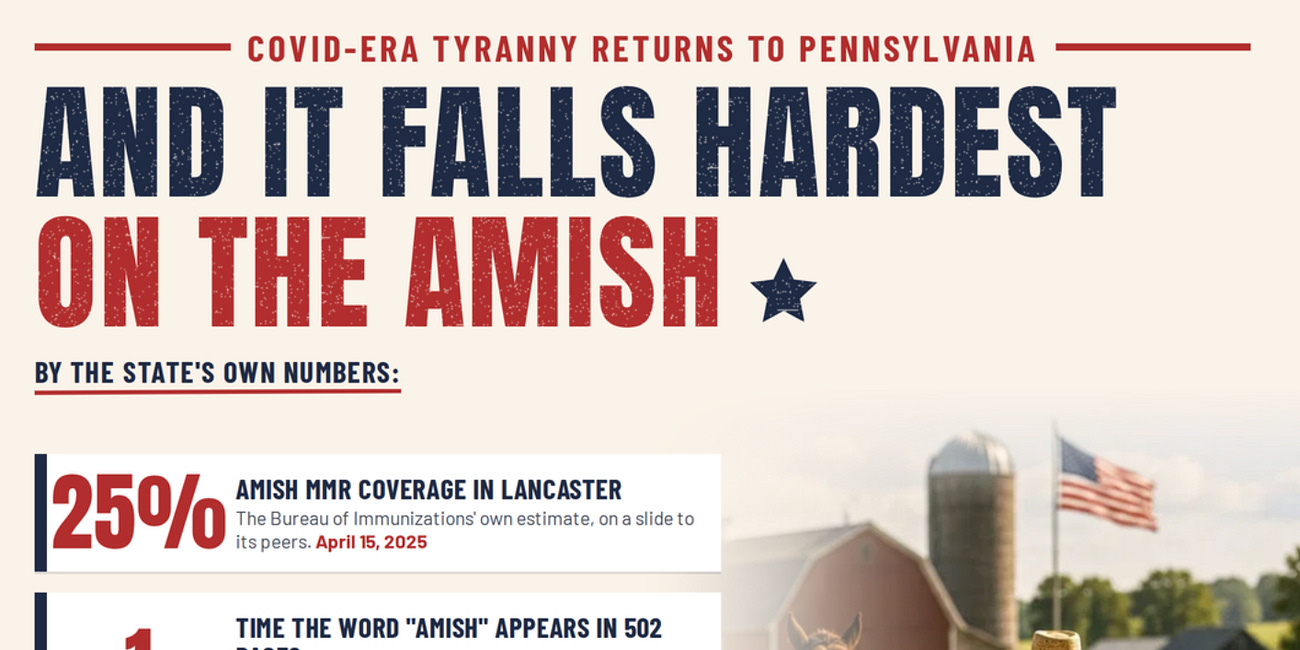
The Department of Health lost the school-mask case in 2021. Its 502-page rewrite writes the power back in — and the community with the fewest ways to resist is the one the text reaches first. By the state’s own estimate, their MMR rate is 25 percent. Comment closes September 21.
Dates
September 21 — comment closes.
~October 11 — House Health and Senate HHS committees’ comment window closes.
October 21 — IRRC’s comments due.
By September 21, 2028 — final-form due; IRRC votes in public; either committee can move to disapprove.
No hay comentarios:
Publicar un comentario