Sayer Ji
Dec 07, 2025
Read, share, and comment on the X post dedicated to this breaking report here: https://x.com/sayerjigmi/status/1997702899283992780?s=20
Story-at-a-glance
Historic Policy Shift: The U.S. State Department has issued an internal directive instructing consular officers to deny visas to foreign nationals who participated in content moderation, fact-checking, or any activity constituting censorship of protected American speech—marking the first federal codification that speech suppression by foreign actors constitutes a threat to constitutional governance.
Transnational Censorship Exposed: Evidence now confirms that the Center for Countering Digital Hate (CCDH), co-founded by a strategist who serves as Chief of Staff to the UK Prime Minister, helped drive coordinated deplatforming campaigns against American citizens—with its CEO reportedly facing imminent visa revocation under the new policy framework.
Personal Vindication: The author, placed on the “Disinformation Dozen” blacklist in 2021 and subjected to four years of coordinated suppression, witnessed YouTube restore his channels in October 2025 with formal admission that no policy violations occurred—while Alphabet’s congressional testimony confirmed White House officials had exerted unlawful pressure to censor constitutionally protected content.
Constitutional Reawakening: This policy shift signals the beginning of a “digital civil rights era” in which online speech protections are recognized as inseparable from founding constitutional principles—establishing legal and diplomatic consequences for those who participated in what courts have characterized as government-directed censorship.
There are moments in history when the ground moves beneath our feet—when a shift occurs so profound that it reshapes our understanding of the past, clarifies the present, and defines the future. We are living in such a moment right now.
For years, a hidden architecture of digital control operated across borders, institutions, agencies, and platforms. Millions felt its reach. Many suffered under its effects. Some—including myself—were thrust into its crosshairs.
But now, for the first time, the United States government has taken an extraordinary step: it has officially recognized that the act of silencing Americans—especially by foreign entities—is itself a grave threat to the Republic.
And with that recognition, something extraordinary has begun:
A historic turning of the tide.
This is not administrative housekeeping. This is not political theater. This is a constitutional recalibration on a scale we have not seen in decades.
The U.S. Government Names the Unnamable
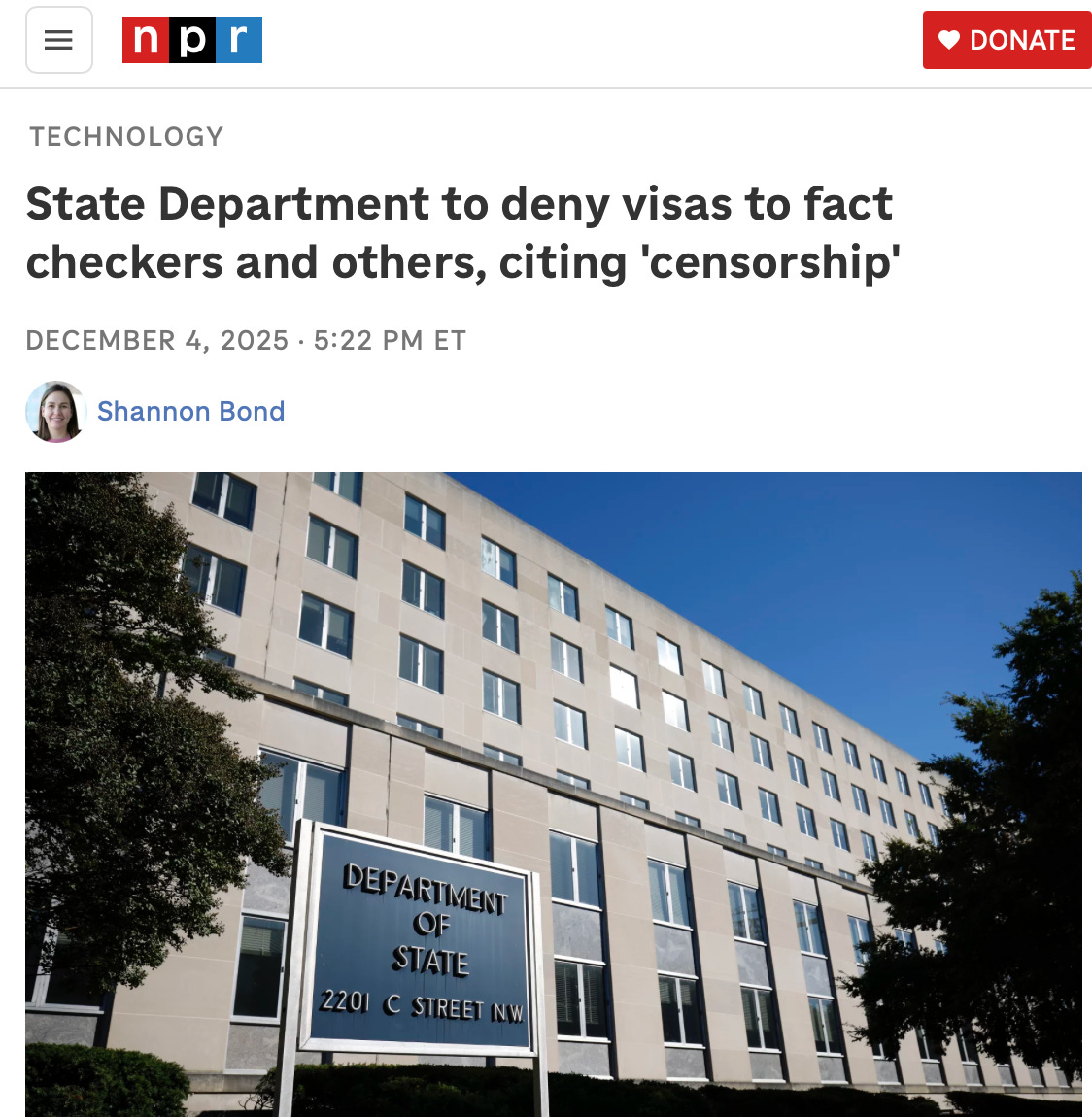
The internal State Department directive, revealed by NPR , is nothing short of landmark. Visa officers across the world have now been instructed to deny entry to foreign nationals who took part in content moderation, fact-checking, disinformation policing, Trust and Safety work, or any activity that contributed to the censorship of Americans.¹
But the true magnitude of this shift lies in the details of the directive. It orders consular officials to engage in enhanced vetting—a level of scrutiny generally reserved for national security threats.
Officials are now required to:
Examine résumés and employment records for roles tied to misinformation, content moderation, compliance, or platform policy.²
Review LinkedIn profiles for job titles, project descriptions, employer affiliations, and public endorsements connected to censorship initiatives.²
Search media articles, NGO publications, academic papers, and digital footprints for mentions of involvement in “combatting misinformation,” “disinformation research,” “false narrative removal,” or campaigns pressuring U.S. platforms.²
Investigate prior collaborations with foreign regulators—particularly those, like the UK’s Online Safety Act regime, that sought to influence American speech standards.
Document any evidence that an applicant played a role—direct or indirect—in suppressing protected American expression.²
And the memo leaves no ambiguity as to what must follow:
If evidence emerges that an applicant “was responsible for, or complicit in, censorship or attempted censorship of protected expression in the United States,” officers “should pursue a finding that the applicant is ineligible.”¹²
This is a profound departure from the posture of the last five years.
The Guardian added a critical dimension to the story: its reporting emphasized that the directive not only authorizes visa denials but mandates deep, multi-layered scrutiny of digital work histories—including the systematic review of applicants’ LinkedIn activity, media visibility, and prior engagement in misinformation or online safety roles—signaling a decisive shift in how Washington intends to identify and screen out foreign censorship actors.³

This is the first time the federal government has codified what millions of Americans instinctively understood:
Censorship was not a public service. It was a civil rights violation.
And it was committed at scale.
After Years of Suppression, the Truth Surfaces
When I was placed on the “Disinformation Dozen” list in 2021, the accusations were incendiary—that I was somehow responsible for deaths, that my work was dangerous, that my existence online was harmful to society.⁴ These claims were not made in the spirit of debate or inquiry. They were tools—weapons—designed to eliminate dissent.
At the time, few understood how deeply transnational this machinery was. But what has now come to light is even more striking than the suppression itself:
A foreign political network helped shape the boundaries of American speech.
In recent years, we learned that:
CCDH was co-founded by a top strategist who now serves as Chief of Staff to the UK Prime Minister⁵
CCDH helped drive Britain’s Online Safety Act—a law antithetical to American free-speech principles⁶
Its founder boasted of engaging in “black ops” against a U.S. presidential candidate⁷
UK regulators asserted authority over U.S.-based platforms, imposing penalties for speech legal in America⁸
In hindsight, the pattern is unmistakable:
Foreign influence reached into the heart of America’s digital public square.
The Imran Ahmed Case: The First Domino
The report that the U.S. government is preparing to revoke the visa of CCDH’s CEO, Imran Ahmed, is not an isolated administrative decision.⁶ It is part of a broader recognition that foreign actors played a significant role in shaping—and suppressing—constitutional freedoms.
Because the CCDH’s “Disinformation Dozen” initiative did not cease but mutated into more sophisticated hybrid-warfare tactics, some of which appear to remain operative against RFK Jr., now serving within the U.S. Cabinet, ensuring accountability for Imran Ahmed and all who coordinated with him is not only a moral imperative — it is a present and continuing national-security necessity.
When a government identifies a problem, it may hesitate. When a government names the source of the problem, it has begun to act. But when a government takes concrete steps, a turning point has arrived. This is that turning point.
A foreign architect of American censorship (and his network) is now under formal scrutiny by the United States itself.
The Sea Change: America Reclaims Its First Principles
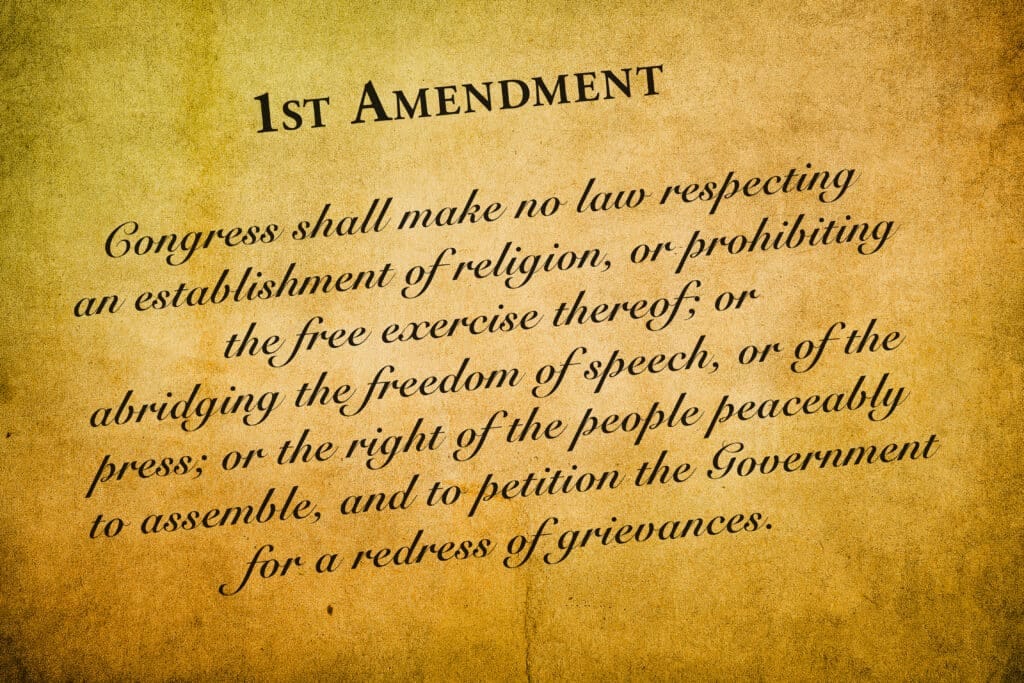
For years, many of us felt something was deeply wrong—not just politically, but civilizationally. The suppression of ideas, voices, research, and discourse violated not only the letter of the First Amendment but the spirit of a free people.
What the new visa policy signals is that the First Amendment has reawakened. Not as nostalgia, not as abstraction, but as law.
For the first time, the federal government is acting as if:
The right to speak freely is not a privilege. It is a boundary that shall not be crossed—not by agencies, not by NGOs, and not by foreign actors.
This is not about left or right. It is about sovereignty and dignity. It is about the constitutional Republic finally remembering itself.
My Perspective as a Witness to This Turning
I lived through the era of coordinated censorship—the smears, the erasure, the presumption of guilt for expressing perspectives that later proved justified. I also experienced the surreal moment when my writing—created in the United States under the protection of the First Amendment—was pulled into a UK criminal proceeding without my knowledge or permission.⁹
Those years carried a heaviness that cannot be fully conveyed.
But what I feel today is something very different:
A sense of historical clarity. A sense of momentum. A sense that the tide is finally, unmistakably turning.
And not for me alone. Not for a dozen people. But for every American who was silenced, shadowbanned, deplatformed, or intimidated for speaking their conscience.
The truth has a long memory. And the Constitution has a longer one.
What Comes Next
We are witnessing the beginning of a digital civil rights era—a recognition that the rights we exercise online are inseparable from the rights enshrined in our founding documents.
The new visa policy is not the endpoint of this shift. It is the opening salvo.
From here, the work will require:
Continued transparency
Legal accountability
Public vigilance
And a commitment to restoring the culture of open inquiry that once defined us
The censorship era will be studied for generations. But so too will the moment it ended. And I believe we are living through that moment right now.
A moment when truth is resurfacing.
A moment when constitutional order is reasserting itself.
A moment when history is turning—decisively—away from the silencers and back toward the people.
The tide has changed.
And it will not be turning back.
References
1. Shannon Bond, “State Department to Deny Visas to Fact Checkers and Others, Citing ‘Censorship,’” NPR, December 4, 2025, https://www.npr.org/2025/12/04/nx-s1-5633444/trump-content-moderation-visas-censorship.
2. Ibid.
3. Richard Luscombe, “Trump Administration Moves to Deny Visas to Factcheckers and Content Moderators,” The Guardian, December 5, 2025, https://www.theguardian.com/us-news/2025/dec/05/trump-administration-us-visa-crackdown.
4. Sayer Ji, “Breaking: Trump Admin To Deport CCDH Founder Imran Ahmed—Restorative Justice for the ‘Disinformation Dozen,’” Substack, November 11, 2025, https://sayerji.substack.com/p/breaking-trump-admin-to-deport-ccdh.
5. Matt Taibbi and Paul D. Thacker, “Election Exclusive: British Advisors to Kamala Harris Hope to ‘Kill Musk’s Twitter,’” The DisInformation Chronicle, October 22, 2024.
6. Sayer Ji, “Breaking: Trump Admin To Deport CCDH Founder.”
7. Leaked CCDH internal memorandum, documented in Taibbi and Thacker, “Election Exclusive.”
8. Joakim Scheffer, “JD Vance Bashes EU over Free Speech as Brussels Prepares to Fine X,” Hungarian Conservative, December 5, 2025, https://www.hungarianconservative.com/articles/current/jd-vance-eu-free-speech-fine-x/.
9. Sayer Ji, “Four Years of Lawfare and Black Ops: The Silence Ends Here,” Substack, May 5, 2025, https://sayerji.substack.com/p/four-years-of-lawfare-and-black-ops.
Additional Sources Consulted
Sayer Ji, “The BBC’s Reckoning: From Mass Criminalization to Exposed Censorship Networks,” Substack, November 21, 2025.
Sayer Ji, “The King of Censorship: How Prince Harry’s Anti-Trump Rhetoric Collides With a Global Speech-Control Regime Now Being Exposed,” Substack, December 4, 2025.
Sayer Ji, “The Rise of Transnational Censorship and the Fight for Sovereignty of Speech,” Substack, September 12, 2025.
Alphabet Inc., Congressional Testimony and Letter on Government Pressure to Censor Content, October 2025.
YouTube, Letter to U.S. Congress re: Channel Reinstatement and Policy Compliance, October 2025.
Finn et al. v. Global Engagement Center, Federal Civil Rights Lawsuit, U.S. District Court, Florida, 2025.
No hay comentarios:
Publicar un comentario