May 13, 2026
Why an 8.2 mmHg blood pressure reduction from a $0.10/day food gets less press than a new statin drug
Share the X post dedicated to this article.
There’s a 2011 study sitting in Nutrition Journal — open access, peer-reviewed, freely available to anyone with an internet connection — that should, by any honest read of its data, have reshaped how we talk about prehypertension. It didn’t. Fifteen years later, almost nobody has heard of it. I want to explain why that silence is itself the most interesting part of the story.
This piece is a continuation of an argument I made in What Really Causes Heart Disease — And Why Pennies’ Worth of Missing Nutrients May Prevent (and Reverse) It — namely, that cardiovascular disease is fundamentally a deficiency-and-toxicity condition driven by oxidative damage to the endothelium, and that the “pharmaceutical era” of cardiology has been a thirty-year exercise in suppressing downstream readouts while leaving the upstream pathology untouched. The sesame study is a near-perfect case study in what root-cause intervention actually looks like in clinical data — and in why such data systematically goes unfunded, unreplicated, and unreported.
What the study actually found
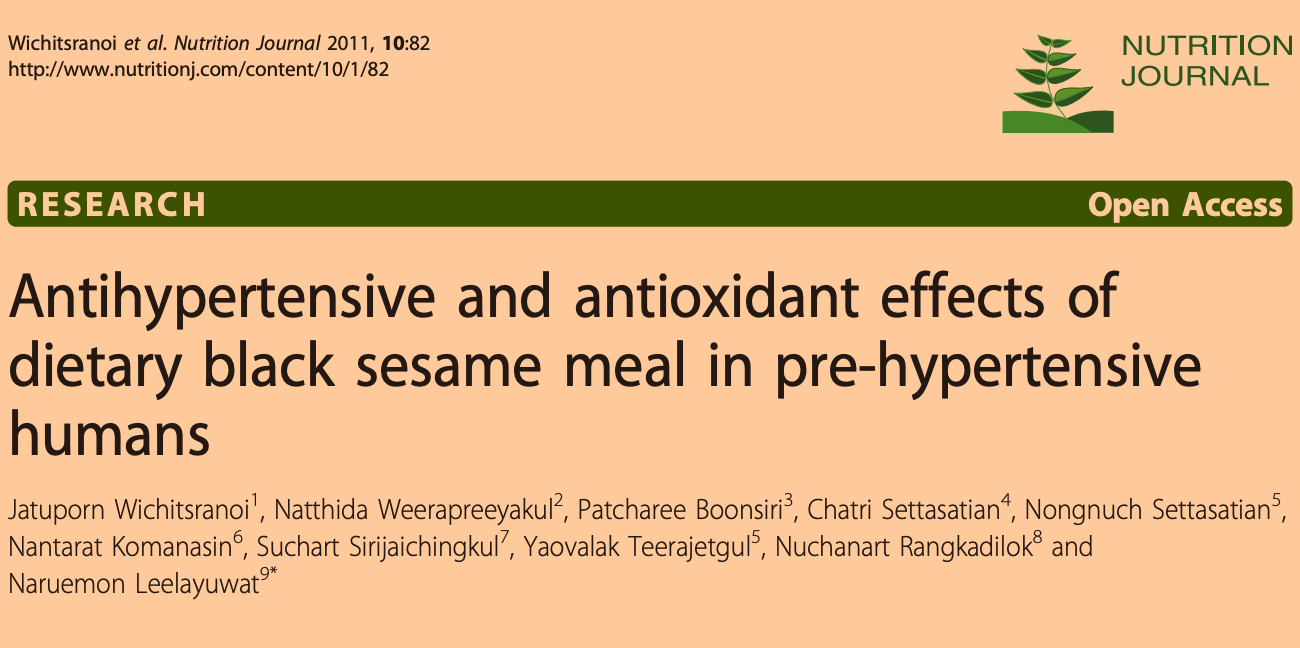
Thirty prehypertensive Thai adults (SBP 120–139 or DBP 80–89) were randomized to either 2.52 g/day of black sesame meal in capsules, or an identical-looking placebo, for four weeks. Double-blind. No one was on antihypertensive medication. Endpoint: blood pressure, plus two biomarkers — malondialdehyde (MDA, a marker of oxidative stress) and serum vitamin E.
The results:
Systolic BP dropped 8.2 mmHg in the sesame group (129.3 → 121.0), versus essentially no change in placebo. P < 0.05. (A note on units: blood pressure is reported in millimeters of mercury — mmHg — virtually everywhere in the world, including the US, Thailand, the UK, and continental Europe. Some physiology and ICU contexts also use kilopascals (kPa); 8.2 mmHg ≈ 1.09 kPa. No conversion is needed to interpret this number as a US reader.)
MDA fell by a third in the sesame group (1.8 → 1.2 μmol/L), unchanged in placebo. P < 0.05.
Vitamin E rose 30% in the sesame group (29.4 → 38.2 μmol/L), unchanged in placebo. P < 0.01.
Within the sesame group, change in SBP correlated with change in MDA (R = 0.50), and change in DBP correlated negatively with change in vitamin E (R = -0.55). The biomarkers moved together with the clinical outcome, in the directions the antioxidant hypothesis predicts.
No detected side effects.
Let me put 8.2 mmHg in context. Standard antihypertensive monotherapy at typical starting doses — thiazide diuretics, ACE inhibitors, ARBs, calcium channel blockers — produces SBP reductions in the range of 7 to 13 mmHg. An 8.2 mmHg reduction is pharmaceutical-magnitude. Not “nice supplement bump.” Not “directionally encouraging.” It sits squarely inside the range of effects we accept as clinically meaningful and prescribe medications for.
The authors invoked the INTERSALT framing for what such a reduction would mean if sustained long-term: a 2–3 mmHg drop in SBP at the population level is associated with roughly a 4% decrease in CVD mortality in Western populations and 6.4% decrease in cerebrovascular disease mortality in Japan. Extrapolating linearly, an 8.2 mmHg reduction could plausibly translate to a 16% reduction in CVD mortality and 26% reduction in stroke mortality. Those are not small numbers. Those are generational public-health numbers, on the order of what statins are credited with.
From a food. That costs less than coffee.
And here is what the headline number doesn’t capture
There is a second layer to this that the BP-magnitude comparison alone obscures, and it matters more than the millimeters of mercury.
Antihypertensive drugs lower blood pressure. That is what they do. They do it by blocking calcium channels, or inhibiting ACE, or antagonizing angiotensin receptors, or beta-blocking the heart’s response to catecholamines, or forcing the kidneys to dump sodium and water. Every one of these mechanisms is a downstream intervention. The underlying endothelial dysfunction, the oxidative stress, the impaired nitric-oxide signaling, the inflammation — those are the soil that hypertension grows out of, and the drugs do not touch them. The drugs adjust the readout. The dysfunction continues.
What this study suggests black sesame meal is doing is something categorically different. The MDA reduction is a marker of less lipid peroxidation — less oxidative damage to cell membranes. The vitamin E elevation is a marker of more endogenous antioxidant capacity. There is also literature, cited in the paper itself (Ikeda et al. 2007, J Nutr Sci Vitaminol), showing that sesame lignans stimulate endogenous ascorbic acid (vitamin C) biosynthesis in animal models — meaning the body’s own antioxidant production is being upregulated, not a vitamin being shoveled in from outside. The mechanistic story isn’t “we found a molecule that suppresses a symptom.” It’s “we fed people a food and their oxidative redox balance shifted toward homeostasis, and their blood pressure followed.”
This matters enormously when you place it inside the framework I laid out in my earlier piece on what really causes heart disease: the endothelium — that single-cell-thick lining of every blood vessel — is the unified site of cardiovascular pathology. Every classical “risk factor” (oxidized LDL, hyperglycemia, smoking, homocysteine, fluoride, heavy metals, hypertension itself) converges on a final common pathway of endothelial injury, oxidative stress, and compromised nitric-oxide signaling. The Pauling–Rath unified theory takes this further: the structural failure underlying atherosclerosis is collagen weakness from chronic subclinical vitamin C deficiency, with Lp(a) acting as the body’s emergency patch. Hypertension, in this view, is an early-stage manifestation of the same underlying soil — pressure rising in a vascular tree whose endothelial signaling is impaired and whose oxidative balance has tipped.
A four-week dose of a food that simultaneously (a) drops a primary lipid peroxidation marker by a third, (b) raises plasma gamma-tocopherol by 30%, (c) upregulates endogenous ascorbate biosynthesis (animal data), and (d) reduces systolic blood pressure by a pharmaceutical-magnitude 8.2 mmHg is doing the exact thing the Pauling/endothelial framework predicts a root-cause intervention should do. It is feeding the antioxidant defense, quieting the oxidative drive, and letting the vasculature reassert its native homeostasis. The blood pressure drop is not the mechanism — it is the signature of the mechanism working upstream.
This is a root-cause intervention, or as close to one as a four-week nutritional study can plausibly suggest. The blood pressure didn’t drop because something blocked the vasoconstriction signal. It dropped because the vasoconstriction signal got smaller, because the oxidative drive behind it got smaller.
There’s a second layer worth naming. As Albert Szent-Györgyi discovered in the 1930s, isolated ascorbic acid never reproduced the full healing power of the whole food it came from — paprika cured hemorrhagic conditions that pure vitamin C alone could not. The missing ingredient turned out to be the flavonoid co-factors he called “vitamin P.” This is why every isolated-vitamin-E megadose trial in the antihypertensive literature has either disappointed or backfired — and the sesame paper’s authors themselves note this. The studies that gave hypertensive or diabetic patients pure alpha-tocopherol at supraphysiologic doses produced no benefit, or worse, mild increases in blood pressure. Black sesame meal is not a vitamin E megadose. It is the whole food matrix: sesamin and sesamolin lignans, gamma-tocopherol (not the alpha form pharma keeps testing), fiber, protein, minerals, and the dozens of unmeasured cofactors that come bundled with any real food. The result is what whole-food nutrition does that isolated chemistry cannot — a coordinated upregulation of the body’s own restorative machinery.
Drugs cannot do this. Their mechanism forbids it. And this is why — to put it bluntly — pharmaceutical antihypertensives have side effects that are often not really “side” effects at all. They are primary effects of a mechanism that was never designed to restore function, only to override it. ACE inhibitors give people a chronic cough because bradykinin accumulation is what their mechanism does. Beta-blockers cause fatigue, exercise intolerance, depression, and erectile dysfunction because suppressing sympathetic tone is what their mechanism does. Diuretics cause electrolyte disturbances, gout, glucose intolerance, and sexual dysfunction because forcing sodium and water excretion is what their mechanism does. Calcium channel blockers cause peripheral edema and constipation because blocking calcium influx is what their mechanism does. The “side effects” are the mechanism, witnessed from a different angle. (This is the same critique I have made of statins as a paradigm — suppression of a downstream marker while the upstream fire continues to smolder.)
And the literature on outcomes is not as clean as the marketing suggests. The well-documented J-curve phenomenon — established in the HOT trial, the INVEST trial, ONTARGET, and multiple meta-analyses — shows that when antihypertensive treatment drives diastolic blood pressure too low (generally below 70 mmHg, and especially in patients with coronary artery disease, diabetes, left ventricular hypertrophy, or in the elderly), all-cause mortality and cardiovascular events increase, not decrease. The coronary arteries are perfused during diastole; drop the diastolic pressure too far and you starve the heart muscle of the very blood the treatment was meant to protect. This isn’t a fringe finding. It’s in the mainstream cardiology literature. It just isn’t the part of the story that makes the brochures.
There is also a separate body of evidence on antihypertensive medication classes and elevated risk for specific cancers (calcium channel blockers, diuretics, and beta-blockers have all been associated, in various meta-analyses, with increased risk of certain malignancies including breast cancer — findings that remain contested but are not absent from the literature). And the well-replicated finding that intensive BP lowering provides diminishing or negative returns in older adults and those with multiple comorbidities.
A food that lowers blood pressure by reducing the oxidative pathology that drives the elevated blood pressure does not have a J-curve problem in this sense. It is not pushing a physiologic variable past a homeostatic setpoint; it is helping the homeostatic setpoint reassert itself. The mechanism is fundamentally different, and so is the risk profile. This is part of why the absence of detected side effects in the sesame trial isn’t just a happy accident — it’s what you’d predict from the mechanism.
The caveats — both directions
I owe you the honest case against, because if I just hand you the headline number I’m doing exactly what pharma marketing does and I won’t insult you that way.
Against:
N = 30. Fifteen per arm. This is a small study. Effect sizes in small studies regress toward the mean in larger replications more often than not.
Four weeks. Short. We don’t know whether the effect sustains, intensifies, or fades.
The placebo arm drifted. Diastolic BP actually rose in placebo (80.6 → 85.9), which inflates between-group differences. The within-group sesame number is the cleaner one — but still cleanly significant.
Prehypertensives are a responsive population. They tend to respond to almost any intervention, including lifestyle changes and placebo effects, more than stage-2 hypertensives do.
Competing interest disclosed: the authors applied for a patent on the preparation method. That doesn’t invalidate the data — disclosure is what good science looks like — but it earns extra scrutiny.
For:
The biomarkers moved coherently. SBP dropped, the oxidative stress marker dropped, the antioxidant rose, and they correlated with each other in the predicted directions. That’s harder to explain as noise than the BP number alone. Random fluke doesn’t usually produce a clean mechanistic signature.
No side effects. Sesame is food. Humans have been eating it for 5,000 years.
Mechanistic plausibility is strong. Sesame lignans (sesamin, sesamolin) and gamma-tocopherol have independently established literature on endothelial function, nitric oxide signaling, lipid peroxidation, and even 20-HETE inhibition. The study isn’t reporting a phenomenon in search of a mechanism. It’s reporting a phenomenon with three or four converging mechanisms already worked out in prior research.
The asymmetric bet is overwhelming. Downside of trying it: a few cents a day, a slightly nutty taste. Upside: possibly drug-magnitude BP reduction. Compare this to the asymmetric bet on a novel pharmaceutical, where downside includes drug interactions, unknown long-term effects, kidney/liver monitoring, and meaningful cost.
Now the part that’s harder to write
Here’s what I want you to notice. Everything I just told you, you could have figured out in an afternoon with a PubMed search and a calculator. The study has been open-access for fifteen years. Why didn’t you already know about it?
Because there is no economic actor whose interests are served by you knowing.
A Phase III antihypertensive trial costs $50–200 million. That money exists because a company that funds it can recoup the cost through patent protection on a novel molecule. There is no patent on black sesame. There is no commercial entity that becomes meaningfully richer if you and a million other prehypertensives start eating 2.5 grams of it a day. The agricultural producers who’d benefit don’t have R&D budgets. The supplement industry doesn’t want a $3/month commodity intervention; they want $40/month branded products. And the pharmaceutical industry has every reason to ensure that a food which competes with their stage-1 hypertension franchise stays uninvestigated.
This is not conspiracy. It’s structure. The same structure explains why:
Hibiscus tea, which has small trials showing 7–13 mmHg SBP reductions, has never received a definitive large trial.
Beetroot juice has dozens of small positive trials and no Phase III equivalent.
The DASH diet only got rigorous study because the NIH paid for it directly — no private actor would have.
The Mediterranean diet evidence base, even after PREDIMED, remains dwarfed by the evidence base for individual statins.
In fact, I have spent twenty years indexing thousands of studies across hundreds of natural interventions, most of which have been either ignored, or actively suppressed, and all of which you can view on the GreenMedInfo.com Hypertension database.

Then there’s the second layer: media. Health journalism in the United States is heavily cross-subsidized by pharmaceutical advertising. Network television gets a substantial fraction of ad revenue from drug ads. Major medical journals run pharma ads. Patient advocacy groups receive pharma funding. None of this means anyone is consciously suppressing a sesame study. It means that the gravitational field of attention bends, predictably, toward interventions someone has paid to publicize.
So when I say a study like this “didn’t get traction,” I don’t mean it failed on the merits. I mean it ran headlong into a market structure that has no slot for it.
What rigor actually looks like here
The standard skeptical move — “small trial, not replicated, don’t get excited” — is the right move if you’re evaluating a novel pharmaceutical seeking approval. It is the wrong move if you’re an individual deciding what to put in your breakfast. Those are different decisions with different cost-benefit profiles and they deserve different evidentiary standards.
The pharmaceutical standard exists because pharmaceuticals have non-trivial harms, high costs, and patent-funded research budgets that can support large trials. Apply that standard to foods and you systematically discount an entire category of intervention not because the evidence is bad but because the evidence-generating apparatus is structurally unavailable to it. You end up in a world where the only things you’re allowed to believe work are the things someone paid to prove work.
Real rigor means recalibrating the evidentiary bar to the decision at hand. For an individual deciding whether to add 2.5 g/day of black sesame meal to their diet: a peer-reviewed, double-blind, placebo-controlled trial with mechanistically coherent biomarker movement and no detected adverse events is more than enough evidence to act on, given the cost-benefit profile. You would be irrational to demand more.
Also, consider there are dozens of researched health benefits linked to sesame seed consumption, adding insult to injury when compared to most drugs which have virtually no ‘side benefits’ yet dozens of ‘side effects.’
What I’m doing, then
I’m writing this up because no one with money is going to. The study is real. The effect size is real. The mechanism is plausible and partially independently established. The intervention costs cents. There’s no patient-population justification for this being obscure.
If you’re prehypertensive — and roughly a third of American adults are — this is worth knowing about. Talk to your doctor, especially if you’re on any medications (sesame lignans can affect drug-metabolizing CYP450 enzymes, which is mechanistically interesting and clinically worth flagging). But don’t wait for the 5,000-person trial. It isn’t coming. The economic conditions for it to be funded do not exist.
That absence isn’t evidence against the intervention. It’s evidence about the system.
And it fits the pattern I’ve been documenting for years. The Pauling vitamin C / collagen / Lp(a) story sits unfunded. The Ornish reversal data sits underutilized. The K2 arterial decalcification literature is barely taught in medical schools. The cocoa flavanol endothelial trials — over a hundred of them — are not in any standard cardiology guideline. Nattokinase reverses plaque in a thousand-patient trial and is met with silence. And now black sesame meal joins the list: a peer-reviewed, biomarker-coherent, side-effect-free, food-based intervention with pharmaceutical-magnitude effects, available at any Asian grocery store for the cost of a coffee, and fifteen years of professional silence around it.
The pattern isn’t that these interventions don’t work. The pattern is that the system has no mechanism to talk about things that work without making someone rich. The cure for that is independent reporting and reader-supported writing. Which is what this is.
No hay comentarios:
Publicar un comentario