By Jeremy McCoy
Global Research

Every time a new ice measurement is published that reveals the Arctic ice cap is shrinking, there is a flurry of media interest and predictions that the fabled Northwest Passage will become a viable alternative shipping route for transit between Asia, North America and Europe. The “Northwest Passage” refers to the sea route that connects the Atlantic and Pacific Oceans across the top of North America, via waterways through the islands lying between Canada’s northern continental coastline and the Arctic Ocean.
The Northwest Passage is becoming navigable for longer periods of the year. Ship traffic, however, still bears hazardous risks. The route is challenging not only due to the presence of a number of bays, islands, uncharted shoals and narrows, but also because of drift ice and extreme weather conditions. In addition other vessels sometimes do not record their positions or (in cases like those of illegal fishing vessels) record false positions.
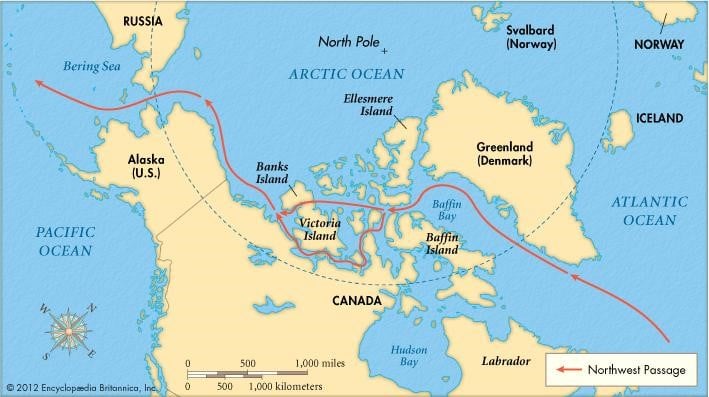
The Canadian government asserts that the Northwest Passage is part of Canada’s internal waters, and subject to the nation’s full sovereignty. In fact, in 2009 the Canadian Parliament renamed the waterways the “Canadian Northwest Passage.” Under Canada’s view, no other nation has the right to navigate in or fly over those waters unless Canada consents.
Canada enjoys sovereignty over the Northwest Passage based on historic title — a status conveyed by Canada’s (and particularly the Canadian Inuit’s) historic usage of those waters. This claim has long been challenged by the United States and certain other nations, which consider the passage an international strait through which they enjoy transit rights.
This dispute arose in the late 1950s and has remained largely frozen since then, with both sides essentially agreeing to disagree. Since there have been so few transits over the past few decades, there has been little to shift the argument one way or another. Where the Chinese may prove useful to Canada is in the positive precedent that their shipping might set.
One of the weaknesses of the Canadian claim is that, under law, Canada must show that its historic