Busca en Nuestros Archivos

Busca en Nuestro Blog

Translate / Traducir

Mostrando entradas con la etiqueta Debt Default. Mostrar todas las entradas

19 octubre, 2013

A Multibillion Bonanza for Wall Street

http://www.globalresearch.ca/the-speculative-endgame-the-government-shutdown-and-debt-default-a-multibillion-bonanza-for-wall-street/5354420

The Speculative Endgame: The Government “Shutdown” and “Debt Default”, 
A Multibillion Bonanza for Wall Street
By Prof Michel Chossudovsky

The “shutdown” of the US government and the financial climax associated with a deadline date, leading to a possible “debt default” of the federal government is a money making undertaking for Wall Street.
A wave of speculative activity is sweeping major markets.
The uncertainty regarding the shutdown and “debt default” constitutes a golden opportunity for “institutional speculators”. Those who have reliable “inside information” regarding the complex outcome of the legislative process are slated to make billions of dollars in windfall gains.
Speculative Bonanza
Several overlapping political and economic agendas are unfolding. In a previous article, we examined the debt default saga in relation to the eventual privatization of important components of the federal State system.
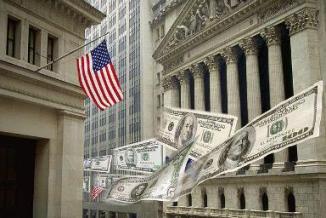
While Wall Street exerts a decisive influence on policy and legislation pertaining to the government shutdown, these same major financial institutions also control the movement of currency markets, commodity and stock markets through large scale operations in derivative trade.
Most of the key actors in the US Congress and the Senate involved in the shutdown debate are controlled by powerful corporate lobby groups acting directly or indirectly on behalf of Wall Street. Major interests on Wall Street are not only in a position to influence the results of the Congressional process, they also have “inside information” or prior knowledge of the chronology and outcome of the government shutdown impasse.
They are slated to make billions of dollars in windfall profits in speculative activities which are “secure” assuming that they are in a position to exert their influence on relevant policy outcomes.
It should be noted, however, that there are important divisions both within the US Congress as well as within the financial establishment. The latter are marked by the confrontation and rivalry of major banking conglomerates.
These divisions will have an impact on speculative movements and counter movements in the stock, money and commodity markets. What we are dealing with is “financial warfare”. The latter is by no means limited to Wall Street, Chinese, Russian and Japanese financial institutions (among others) will also be involved in the speculative endgame.
Speculative movements based on inside information, therefore, could potentially go in different directions. What market outcomes are being sought by rival banking institutions? Having inside information on the actions of major banking competitors is an important element in the waging of major speculative operations.
Derivative Trade
The major instrument of “secure” speculative activity for these financial actors is derivative trade, with carefully formulated bets in the stock markets, major commodities –including gold and oil– as well as foreign exchange markets.
These major actors may know “where the market is going” because they are in a position to influence policies and legislation in the US Congress as well as manipulate market outcomes.
Moreover, Wall Street speculators also influence the broader public’s perception in the media, not to mention the actions of financial brokers of competing or lesser financial institutions which do not have foreknowledge or access to inside information.
These same financial actors are involved in the spread of “financial disinformation”, which often takes the form of media reports which contribute to either misleading the public or building a “consensus” among economists and financial analysts which will push markets in a particular direction.
Pointing to an inevitable decline of the US dollar, the media serves the interests of the institutional speculators in camouflaging what might happen in an environment characterized by financial manipulation and the interplay of speculative activity on a large scale.
Speculative trade routinely involves acts of deception. In recent weeks, the media has been flooded with “predictions” of various catastrophic economic events focusing on the collapse of the dollar, the development of a new reserve currency by the BRICS countries, etc.
At a recent conference hosted by the powerful Institute of International Finance (IIF), a Washington based think tank organization which represents the world’s most powerful banks and financial institutions:
“Three of the world’s most powerful bankers warned of terrible consequences if the United States defaults on its debt, with Deutsche Bank chief executive Anshu Jain claiming default would be “utterly catastrophic.”
This would be a very rapidly spreading, fatal disease, … I have no recommendations for this audience…about putting band aids on a gaping wound,” he said.
“JPMorgan Chase chief executive Jamie Dimon and Baudouin Prot, chairman of BNP Paribas, said a default would have dramatic consequences on the value of U.S. debt and the dollar, and likely would plunge the world into another recession.” (…)
Dimon and other top executives from major U.S. financial firms met with President Barack Obama and with lawmakers last week to urge them to deal with both issues.
On Saturday, Dimon said banks are already spending “huge amounts” of money preparing for the possibility of a default, which he said would threaten the global recovery after the 2007-2009 financial crisis.
Dimon also defended JPMorgan against critics who say the bank has become too big to manage. It has come under scrutiny from numerous regulators and on Friday reported its first quarterly loss since Dimon took over, due to more than $7 billion in legal expenses. (Emily Stephenson and Douwe Miedema, World top bankers warn of dire consequences if U.S. defaults | Reuters, October 12, 2013
What these “authoritative” economic assessments are intended to create is an aura of panic and economic uncertainty, pointing to the possibility of a collapse of the US dollar.
What is portrayed by the Institute of International Finance panelists (who are the leaders of the world’s largest banking conglomerates) is tantamount to an Economics 101 analysis of market adjustment, which casually excludes the known fact that markets are manipulated with the use of sophisticated derivative trading instruments. In a bitter irony, the IIF panelists are themselves involved in routinely twisting market values through derivative trade. Capitalism in the 21st century is no longer based largely on profits resulting from a real economy productive process, windfall financial gains are acquired through large scale speculative operations, without the occurrence of real economy activity. at the touch of a mouse button.
The manipulation of markets is carried out on the orders of major bank executives including the CEOs of JPMorgan Chase, Deutsche Bank and BNP Paribas.
The “too big to fail banks” are portrayed, in the words of JPMorgan Chase’s CEO Jamie Dimon’s, as the “victims” of the debt default crisis, when in fact they are the architects of economic chaos as well as the unspoken recipients of billions of dollars of stolen taxpayers’ money.
These corrupt mega banks are responsible for creating the “gaping wound” referred to by Deutsche Bank’s Anshu Jain in relaiton to the US public debt crisis.
Collapse of the Dollar?
Upward and downward movements of the US dollar in recent years have little do with normal market forces as claimed by the tenets of neoclassical economics.
Both JP Morgan Chase’s CEO Jamie Dimon and Deutsche Bank’s CEO Anshu Jain’s assertions provide a distorted understanding of the functioning of the US dollar market. The speculators want to convince us that the dollar will collapse as part of a normal market mechanism, without acknowledging that the “too big to fail” banks have the ability to trigger a decline in the US dollar which in a sense obviates the functioning of the normal market.
Wall Street has indeed the ability to “short” the greenback with a view to depressing its value. It has also has the ability through derivative trade of pushing the US dollar up. These up and down movements of the greenback are, so to speak, the “cannon feed” of financial warfare. Push the US dollar up and speculate on the upturn, push it down and speculate on the downturn.
It is impossible to assess the future movement of the US dollar by solely focusing on the interplay of “normal market” forces in response to the US public debt crisis.
While an assessment based on “normal market” forces indelibly points to structural weaknesses in the US dollar as a reserve currency, it does not follow that a weakened US dollar will necessarily decline in a forex market which is routinely subject to speculative manipulation.
Moreover, it is worth noting that the national currencies of several heavily indebted developing countries have increased in value in relation to the US dollar, largely as a result of the manipulation of the foreign exchange markets. Why would the national currencies of countries literally crippled by foreign debt go up against the US dollar?
The Institutional Speculator
JPMorgan Chase, Goldman Sachs, Bank America, Citi-Group, Deutsche Bank et al: the strategy of the institutional speculators is to sit on their “inside information” and create uncertainty through heavily biased news reports, which are in turn used by individual stock brokers to advise their individual clients on “secure investments”. And that is how people across America have lost their savings.
It should be emphasized that these major financial actors not only control the media, they also control the debt rating agencies such as Moody’s and Standard and Poor.
According to the mainstay of neoclassical economics, speculative trade reflects the “normal” movement of markets. An absurd proposition.
Since the de facto repeal of the Glass-Steagall Act and the adoption of the Financial Services Modernization Act in 1999, market manipulation tends to completely overshadow the “laws of the market”, leading to a highly unstable multi-trillion dollar derivative debt, which inevitably has a bearing on the current impasse on Capitol Hill. This understanding is now acknowledged by sectors of mainstream financial analysis.
There is no such thing as “normal market movements”. The outcome of the government shutdown on financial markets cannot be narrowly predicted by applying conventional macro-economic analysis, which excludes outright the role of market manipulation and derivative trade.
The outcome of the government shutdown on major markets does not hinge upon “normal market forces” and their impacts on prices, interest rates and exchange rates. What has to be addressed is the complex interplay of “normal market forces” with a gamut of sophisticated instruments of market manipulation. The latter consist of an interplay of large scale speculative operations undertaken by the most powerful and corrupt financial institutions, with the intent to distorting “normal” market forces.
It is worth mentioning that immediately following the adoption of the Financial Services Modernization Act in 1999, the US Congress adopted the Commodity Futures Modernization Act 2000 (CFMA) which essentially “exempted commodity futures trading from regulatory oversight.”
Four major Wall Street financial institutions account for more than 90 percent of the so-called derivative exposure: J.P. Morgan Chase, Citi-Group, Bank America, and Goldman Sachs. These major banks exert a pervasive influence on the conduct of monetary policy, including the debate within the US Congress on the debt ceiling. They are also among the World’s largest speculators.
What is the speculative endgame behind the shutdown and debt default saga?
An aura of uncertainty prevails. People across America are impoverished as a result of the curtailment of “entitlements”, mass protest and civil unrest could erupt. Homeland Security (DHS) is the process of militarizing domestic law enforcement. In a bitter irony, each and all of these economic and social events including political statements and decisions in the US Congress concerning the debt ceiling, the evaluations of the rating agencies, etc. create opportunities for the speculator.
Major speculative operations –feeding on inside information and deception– are likely take place routinely over the next few months as the fiscal and debt default crisis unfolds.
What is diabolical in this process is that major banking conglomerates will not hesitate to destabilize stock, commodity and foreign exchange markets if it serves their interests, namely as a means to appropriate speculative gains resulting from a situation of turmoil and economic crisis, with no concern for the social plight of millions of Americans.
 One solution –which is unlikely to be adopted unless there is a major power shift in American politics– would be to cancel the derivative debt altogether and freeze all derivative transactions on major markets. This would certainly help to tame the speculative onslaught.
The manipulation through derivative trade of the markets for basic food staples is particularly pernicious because it potentially creates hunger. It has a direct bearing on the livelihood of millions of people.
As we recall, “the price of food and other commodities began rising precipitately [in 2006], … Millions were cast below the poverty line and food riots erupted across the developing world, from Haiti to Mozambique.”
According to Indian economist Dr. Jayati Ghosh:
“It is now quite widely acknowledged that financial speculation was the major factor behind the sharp price rise of many primary commodities , including agricultural items over the past year [2011]… Even recent research from the World Bank (Bafis and Haniotis 2010) recognizes the role played by the “financialisation of commodities” in the price surges and declines, and notes that price variability has overwhelmed price trends for important commodities.” (Quoted in Speculation in Agricultural Commodities: Driving up the Price of Food Worldwide and plunging Millions into Hunger By Edward Miller, October 05, 2011)
The artificial hikes in the price of crude oil, which are also the result of market manipulation, have a pervasive impact on costs of production and transportation Worldwide, which in turn contribute to spearheading thousands of small and medium sized enterprises into bankruptcy.
Big Oil including BP as well Goldman Sachs exert a pervasive impact on the oil and energy markets.
The global economic crisis is a carefully engineered.
The end result of financial warfare is the appropriation of money wealth through speculative trade including the confiscation of savings, the outright appropriation of real economy assets as well as the destabilization of the institutions of the Federal State through the adoption of sweeping austerity measures.
The speculative onslaught led by Wall Street is not only impoverishing the American people, the entire World population is affected. 

14 octubre, 2013

Privatization of the Federal State System?

The Shutdown of the U.S. Government and “Debt Default”: A Dress Rehearsal for the Privatization of the Federal State System?
By Prof Michel Chossudovsky
VIDEO: Banks Put Americans on the Hook for Trillions
The “shutdown” of the US government and the financial climax associated with a deadline date, leading to a possible “debt default” of the federal government is a money making undertaking for Wall Street. 
Several overlapping political and economic agendas are unfolding. Is the shutdown –implying the furloughing of tens of thousands of public employees– a  dress rehearsal for the eventual privatization of important components of the federal State system?
A staged default, bankruptcy and privatization is occurring in Detroit (with the active support of the Obama administration), whereby large corporations become the owners of municipal assets and infrastructure.
The important question:  Could a  process of “State bankruptcy” –which is currently afflicting local level governments across the land– realistically occur in the case of the central government of the United States of America? 
This is not a hypothetical question.  A large number of developing countries under the brunt of  IMF “economic medicine” were ordered by their external creditors to dismantle the State apparatus,  fire millions of public sector workers as well as privatize State assets.  The IMF Structural Adjustment Program (SAP)  has also been applied in several European countries.
Will this gamut of deadly macro-economic reforms engineered by Wall Street and the Federal Reserve be conducive to widespread civil disorder across the United States? 
While the declaration of a national emergency or martial law is not envisaged, reports confirm that the Department of Homeland Security (DHS) is currently “engaged in acquiring heavily armored tanks, which have been seen roaming the streets.”  In the words of Ellen Brown, “somebody in government is expecting some serious civil unrest…”
Fiscal Collapse
Flash back to the meltdown of Wall Street in September 2008. In the wake of the economic crisis, a process of fiscal collapse was initiated.
The evolving fiscal crisis had set the stage. It has a direct bearing on the issue of shutdown of the federal government and “debt default”.
The Bush and Obama bank bailouts had led to the appropriation of $1.45 trillion of US  tax revenues. This money was channeled to Wall Street under Bush’s Troubled Assets Relief  Program (TARP) and Obama’s bailout program initiated at the outset of his first term. This money was transferred to the banks.
Meanwhile, “defense expenditure” in support of a war economy had spiraled: 740 billion dollars had been allocated (FY 2010) to fund a vast process of militarization including America`s wars in the Middle East and Central Asia.
“Black Budgets”
Of significance, there were several other unreported shadowy multibillion dollar bailouts which do not appear in government accounts, not to mention the Pentagon’s black budgets which are not included in the official expenditure accounts of the Department of Defense.
According to Aviation Week in a 2009 report:
“the Pentagon’s ‘black’ operations, including the intelligence budgets nested inside it, are roughly equal in magnitude to the entire defense budgets of the UK, France or Japan, and 10 per cent of the total.” (see  Big Increases for Intelligence and Pentagon “Black” Programs in 2010 By Tom Burghardt, May 13, 2009
“War and Wall Street”: Spiraling Public Debt
In the wake of the 2008 financial crisis, a new structure of public indebtedness had been created. Without accounting for the “black budgets” and “shadowy bank bailouts”, reported defense expenditures plus the bank bailouts amounted to a staggering 2.35 trillion dollars. Total revenue in FY 2010 was of the order of $2.38 trillion. 
In other words, these two categories of expenditure, namely War and Wall Street “had eaten up” (together with interest payments on the public debt) the totality of federal government revenues.
The $2.35 trillion included the handouts to the banks plus military expenditure and the funding of the multibillion dollar DoD contracts with Lockheed Martin, Raytheon, Northrop Grumman, British Aerospace, et al.
No Money Left Over From the Public Purse to Fund Regular Government Programs
What this warped budgetary structure implied (in FY 2009 and 2010) was that there was no money (i.e. residual funds) “left over” from the public purse (tax revenues and other sources of federal government revenue) to fund regular government programs.
All other categories of expenditure including medicare, medicaid, social security as well as public investments in infrastructure, etc. had to be financed through debt creation (emission of Treasury bills and government bonds), namely through a dramatic increase in the public debt from $9.9 trillion in FY 2008 to 16.7 trillion (October 2013), a staggering increase of almost 70 percent.
In essence, the federal government has been financing it own indebtedness through generous handouts to Wall Street and the military industrial complex.

FRED Graph
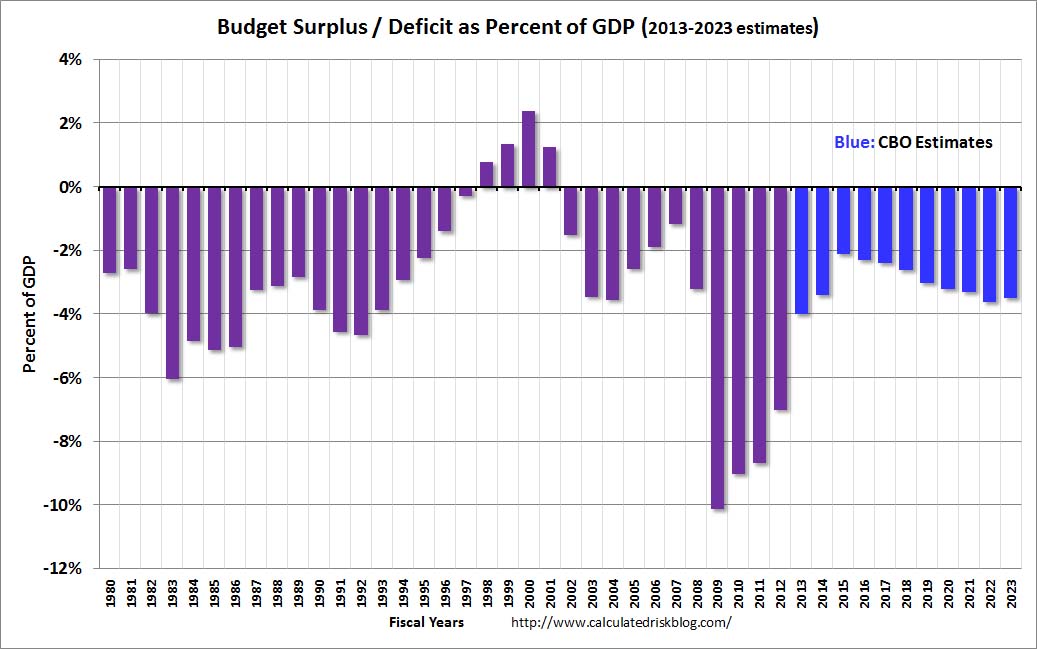
Widening Budget Deficit
These developments are also characterized by a widening budget deficit in the wake of the 2008 financial crash. (See CBO graphs below, which indicate the figures for the budget deficit as well as the forecast for 2012-2022).
The Congress Budget Office (CBO) contends that the “estimates” for 2013-2022 are based on revised historical values of Gross Domestic Product by the Bureau of Economic Analysis (BEA). This is a nonsensical statement.
Yet the Congress Budget Office (CBO) also acknowledges that  “the federal budget deficits [2013-2022] are now expected to shrink dramatically”. These are not our words but those of the CBO.  And these “forecasts” have nothing to do with revised historical values of GDP. The have to do with austerity measures and macro-economic policy.


Budgetary Shift: “Economic Shock Therapy”
In  a matter of three years, according to the CBO “forecast”,  the budget deficit will be reduced from 7 percent of GDP in 2012 to 2 percent in 2015.
A budgetary shift of this nature can only be implemented by “economic shock therapy” leading to socially devastating cuts in public expenditure, which will inevitably result in a wave of civil unrest.
Built into these “forecasts” is the presumption that drastic austerity measures leading to major cuts in government spending will be carried out over a ten year period (2013-2022) thereby reducing the size of the budget deficit as well as its percentage ratio to GDP.  We are not dealing with statistical concepts, the CBO “forecasts” through these 2013-20122 figures a process of fiscal disintegration and impoverishment of the American people.
Medicare, Medicaid, Social Security
The so-called CBO “estimates” for 2013-2022 are based on the assumption that austerity measures (which have not yet been formally adopted) will lead to the downsizing, phasing out and/or privatization of a large number of State programs including medicare, medicaid and social security. How else would it be possible to slash the budget deficit from 7 to 2 percent of GDP in 3 fiscal years?
Medicare, Medicaid and Social Security represented in FY 2012, 45 percent of total government expenditure (See CBO Chart on Federal Government Spending for FY 2012, below).
Meanwhile, legislation has been launched in the House of Representatives to drastically curtail the Food Stamp program over a ten year period (FY 2013-2022)
“The US House of Representatives has passed a bill that would slash food stamp funding by nearly $40 billion over ten years, kicking four million people off the program next year.
While the White House and congressional Democrats have said they will not accept the bill in its present form, its passage sets the baseline for a deal by the Democrats, who also favor significant cuts in food aid to the poorest Americans.
The food stamp bill would cut $39 billion from the Supplemental Nutrition Assistance Program (SNAP) over ten years. It would force adults between 18 and 50 to either work or attend work training to reapply for benefits, and would also institute drug testing for recipients.” See  Slashing Food Stamp Funding: US Congress Moves to cut billions in Food Aid By Andre Damon, September 21, 2013
It is highly unlikely that the budget of the Department of Defense (19 percent) will be used to reduce the budget deficit.

Quantitative Easing: “Keeping the Ship Afloat”

In a bitter irony, while the Wall Street financial institutions were the recipients of the bailouts, they are also the creditors of the federal government, which had been precipitated into a structure of deficit financing controlled by Wall Street. This deficit financing –which was facilitated by Quantitative easing– is distinct from the Keynesian framework. It is controlled by the creditors. It does not create employment, it is not expansionary. It has little bearing on the real economy.
This post 2008 fiscal structure has had a fundamental impact on the process of debt formation. Tax and other federal government revenues had been assigned in 2008-2009 to bailing out the banks while relentlessly funding the war economy including the financing through black budgets of a growing number of Private military and security companies (PMSC). 
The public debt has increased by almost 70 percent in five years, from 9.9 trillion in 2008 to 16.7 trillion in 2013 (October 2013 estimate of the debt ceiling, see graphs above).
The various phases of  Quantitative Easing (QE) throughout the Obama presidency were largely intended by Wall Street to keep the ship afloat, with an increasingly larger share of the debt owned by the Federal Reserve (in the form of  Treasury bills). The Fed has largely been involved in propping up its assets.
Under QE,  tens of billions of dollars are injected into financial markets. Quantitative easing has not resulted in a positive stimulus of the real economy.  “The real goal of the Federal Reserve is to guarantee the continual profitability of Wall Street and the personal incomes of the super-rich.”
The Fed is not a publicly owned central bank; it is a network of 12 private US banks, with the New York Federal Reserve Bank playing a key role. Operating under a semi-secret veil, major Wall Street financial institutions (including the big four) are the “stakeholders” of the Federal Reserve, which ultimately call the shots on Capitol Hill. At the outset of the Obama administration in 2009,  The Federal Reserve Banking system (which is an unaccountable private entity) has been granted increased authority in its management of the US economy, overshadowing the prevailing system of public regulation of the financial system, as well as reinforcing the subordinate role of the US Treasury in relation to Wall Street.
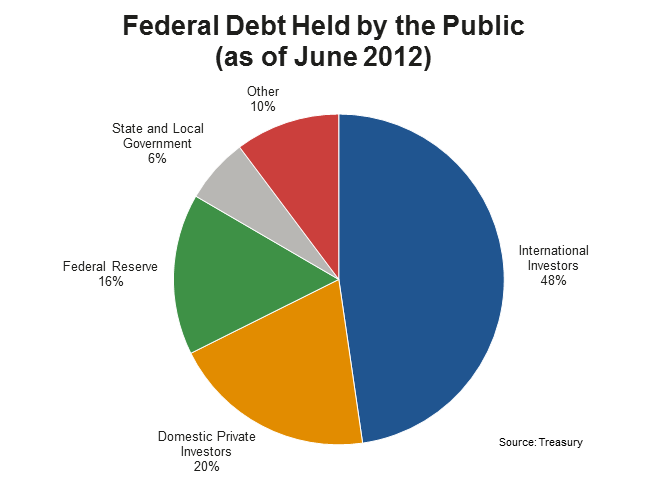
Policies pertaining to the shutdown of the government and the statutory debt ceiling are determined by Wall Street and the Federal Reserve, the US government’s largest creditor. The Federal Reserve banks currently holds $2.1 trillion of US public debt. Japan and China respectively own 1.1 trillion and 1.3 trillion of the US public debt. Based on Jun 2012 figures, The Federal Reserve owns 16 percent of the Federal Debt held by the Public.
The New York Federal Reserve Bank (the largest of the Federal Reserve banks) holds a significant portion of the total holdings of the Federal Reserve system composed of 12 constituent banks.

Source: www.nationalpriorities.org
Were the Federal Reserve to be a publicly owned central bank, quantitative easing would have an entirely different dynamics: the government rather than the Fed (acting on behalf of Wall Street) would be calling the shots. Under a publicly owned central banking arrangement, two trillion dollars worth of public debt could be cancelled, thereby creating conditions for the funding of social programs.
The result of these macroeconomic reforms has been mass unemployment. The American people –including the middle class–  have been impoverished by the Wall Street establishment, which ultimately decides on debt default and the statutory ceiling placed on the public debt.
Under pressure from Wall Street and the Federal Reserve, the choices of the US government are limited to the following options:
State programs can either be downsized, phased out or transferred out of the public purse to the private corporate sector, implying in all cases the layoff of tens of thousands of public employees.
No major reforms of the structure of indebtedness are contemplated by the US Congress, which could meaningfully change the government’s relationship to the Federal Reserve and its Wall Street handlers. The creditors ultimately decide.
What is contemplated are marginal modifications of the status quo including legislation to push the debt limit to December 31st 2014.
This token arrangement would temporarily increase the federal government’s borrowing ability through the issuing of Treasury bills and government bonds by about one trillion dollars. Under this scheme, however, the powers of the Wall Street Banks and the New York Federal Reserve would not only be maintained they would be reinforced.
The ultimate objective is to develop a full-fledged proxy State under the helm of the financial establishment. Both the Executive as well as the US Congress are to remain under the control of Wall Street.
The Privatization of the American State? 
The inevitable scenario established in the wake of the 2008 crisis is fiscal collapse, leading to:
the possible phasing out and/or curtailment of social programs,  the privatization of large sectors of public sector activity.
The fiscal ceiling having now been reached, possibly with a deadline, the government is being pressured by its Wall Street handlers –who control decision-making in the US Congress– to curtail and downsize social programs as well as initiate the transfer of public assets and institutions into the hands of private corporations. There is also a movement to cut as well as privatize Social Security and Medicare.
The privatization of public monuments, museums, national parks, the post office, etc. has been raised in recent media reports as a possible “solution” to the debt crisis. But let us not be misled: the process of acquisition of federal public property including infrastructure and State institutions is likely to go much further.
The public sector is up for grabs. Wall Street will eventually go on a buying spree picking up State owned assets at rock bottom prices.
Ironically, the money transferred by the US government to Wall Street under the bailouts in 2008-2009 can now be used by Wall Street to buy out state property and assets. What this means is that the federal government not only finances its own indebtedness, it is also financing the privatization program (at tax payers expense), leading to the demise of federal government programs.
This process of privatization of the State is nothing new, it has been applied in developing countries under the helm of the IMF whereby state corporations are auctioned off and transferred into the hands of foreign corporations. It has also been applied in Eastern Europe as well more recently in several countries of the European Union
The proceeds of the privatization program are channeled to the State Treasury to meet outstanding debt obligations. In Brazil in the 1990s, important state assets in mining and forestry were purchased by Citi Group, which was Brazil’s largest foreign creditor bank. Ironically, the proceeds of the privatization of the assets purchased by Citi Group were channeled back to Citi Group in the form of debt servicing.
Existing state programs are transferred to private corporations either through outright sale of state assets or through outsourcing of government services to the private sector.
Large numbers of government employees would be laid off as a result of restructuring and privatization.  Government services would be sold to the public at a much higher price.
The Privatization of American Cities
The takeover of State assets in America is well under way largely at the municipal and state level. We recall Orange county which went bankrupt in 1994, Jefferson County, Alabama which filed for Chapter 9 bankruptcy in 2011, and more recently Detroit in 2013. In these and other county/municipal bankruptcies, public assets, lands and infrastructure are sold off to private investors. Across the US, more than 100 municipalities are facing bankruptcy:
All over the United States, politicians are selling off key pieces of infrastructure to foreign investors and big Wall Street banks like Goldman Sachs are helping them do it.  State and local governments across the country that are drowning in debt and that are desperate for cash are increasingly turning to the “privatization” of public assets as the solution to their problems.  Pieces of infrastructure that taxpayers have already paid for such as highways, water treatment plants, libraries, parking meters, airports and power plants are being auctioned off to the highest bidder.  Most of the time what happens is that the state or local government receives a huge lump sum of cash up front for a long-term lease (usually 75 years or longer) and the foreign investors come in and soak as much revenue out of the piece of infrastructure that they possibly can.  The losers in these deals are almost always the taxpayers.  Pieces of America are literally being auctioned off just to help state and local governments minimize their debt problems for a year or two, but the consequences of these deals will be felt for decades. (Michael Snyder, American Dream, July 6, 2011)
The bankruptcies of local level governments immediately backlash on pension funds:
In California, the Orange County Employees Retirement System is estimated to have a 10 billion dollar unfunded pension liability….
How in the world can a single county be facing a 10 billion dollar hole?
The state of Illinois is facing an unfunded pension liability of more than 77 billion dollars.  Considering the fact that the state of Illinois is flat broke and on the verge of default, it is inevitable that a lot of those pension obligations will never be paid.
… Pension consultant Girard Miller told California’s Little Hoover Commission that state and local government bodies in the state of California have $325 billion in combined unfunded pension liabilities.
That comes to about $22,000 for every single working adult in the state of California. (See Vanishing Pensions: All Over America Old Age Pensions Are Being Slashed or Eliminated, Global Research, March 14, 2012)
The privatization of federal State assets on a significant scale as well as the take over and privatization of public services is the next stage of this socially devastating economic restructuring process.
Speculative Onslaught
There is another related agenda, which will be the object of a forthcoming article.
originalThe uncertainty underlying the government shutdown and debt default is the object of a wave of speculative activity on major markets.
Wall Street financial institutions not only exert a decisive influence in the formulation of the Administration’s fiscal and monetary agenda, they also control the movement of currency markets, commodity and stock markets through large scale operations in derivative trade.
Most of the key actors in the US Congress and the Senate involved in the shutdown debate are controlled by powerful corporate lobby groups including, of course, Wall Street. The latter are those which ultimately decide on the outcome. They are not only in a position to influence the results of the Congressional process, they also have foreknowledge of the nature and timing of key decisions and they are in a position to reap multibillion dollar speculative gains in the derivative markets by speculating on policy outcomes of which they have advanced knowledge.
Those who determine the government’s debt policy, namely the Wall Street creditors, also have “inside information” or prior knowledge of the chronology and outcome of the government shutdown impasse. will make billions of dollars in windfall profits
While Wall Street is instrumental in triggering the debt ceiling impasse, major financial institutions will also be placing their bets in large scale speculative transactions.
original
Michel Chossudovsky is an award-winning author, Professor of Economics (emeritus) at the University of Ottawa, Founder and Director of the Centre for Research on Globalization (CRG), Montreal and Editor of the globalresearch.ca website.
He is the author of The Globalization of Poverty and The New World Order (2003) and America’s “War on Terrorism”(2005). His most recent book is entitled Towards a World War III Scenario: The Dangers of Nuclear War (2011). He is also a contributor to the Encyclopaedia Britannica. His writings have been published in more than twenty languages.
He can be reached at crgeditor@yahoo.com
Minor editing, October 13, 2013  

[click images to order books directly from Global Research Publishers]