Busca en Nuestros Archivos

Busca en Nuestro Blog

Translate / Traducir

Mostrando entradas con la etiqueta Sanctions. Mostrar todas las entradas

11 enero, 2019

#AmericasWars, #Coups and #Sanctions in 2019

The New Year Past and Future. Multiple Wars, Coups, Sanctions and Trade Disputes
By Prof. James Petras
Multiple wars, coups, sanctions and trade disputes dominated the US political agenda. War budgets grew, military sales increased and frictions between the US and Saudi Arabia bubbled to the surface . . . and dissipated. Read more...

The Decade-Long U.S. Campaign to Foment Syria’s “Revolution” and Unseat Assad
By Sarah Abed
The fingerprints of U.S. imperialism can be found all over the manufactured insurrection in Syria, in keeping with the ultimate goal of destabilization and eventual “regime change” through fomenting a sectarian civil war. Former NATO commander Wesley Clark has gone on record as stating that Syria was on a list of targeted nations to be toppled by the U.S. as early as 2001. Read more...
02 febrero, 2015

#Sanctions Against #Russia Based on #Falsehoods

Ukrainian Government: 
“No Russian Troops Are Fighting Against Us”. 
Sanctions against Russia based on Falsehoods
By Eric Zuesse

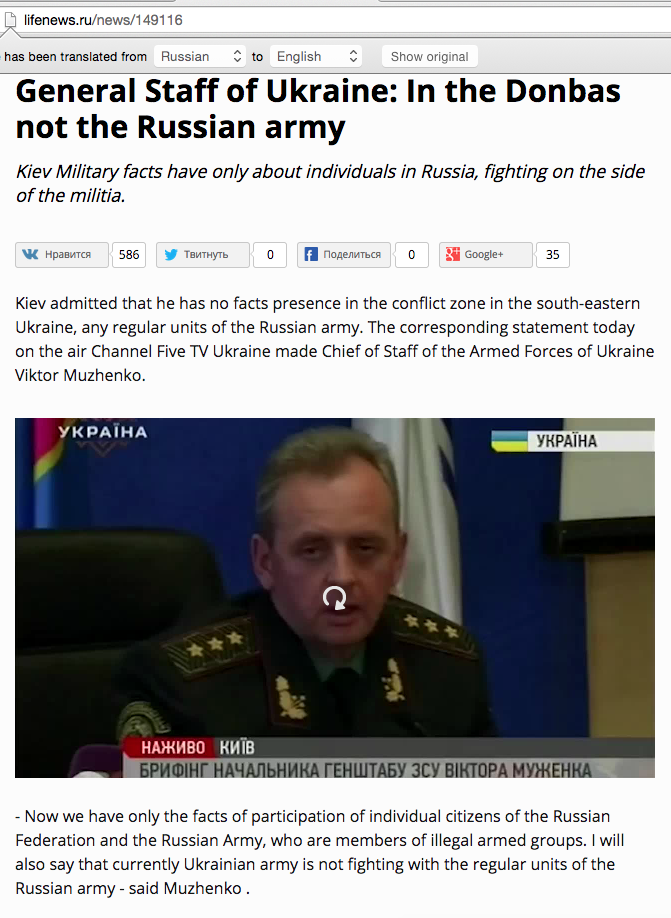
Ukraine’s top general is contradicting allegations by the Obama Administration and by his own Ukrainian Government, by saying that no Russian troops are fighting against the Ukrainian Government’s forces in the formerly Ukrainian, but now separatist, area, where the Ukrainian civil war is being waged.
Here is a screen-print of a google-chrome auto-translation of that statement: 


16 mayo, 2014

Sanctions, Wars, and Assassinations


By John Kozy

“Go, teach Eternal Wisdom how to rule/ Then drop into thyself, and be a fool!”—Pope

The American government likes to call itself “the leader of the free world.” Why anyone believes it is difficult to discern. The people are not obviously freer than people in most other nations. Ask any American what he is free to do that a citizen of The Netherlands cannot and listen for a meaningful reply. America has a large economy when measured by its GDP, but it is, after all, a huge country. Only Russia and Canada are larger but their populations are much smaller. And America is not especially well governed. While a minute number of its citizens are obscenely wealthy; many others barely eke out subsistence livings. The nation as a whole is fairly prosperous while a huge number of its people are impoverished. Its military might is huge; its victories meager. Henry Kissinger has said, “In my life, I have seen four wars begun with great enthusiasm and public support, all of which we did not know how to end and from three of which we withdrew unilaterally.” Wars are not won or lost anymore, they, like old soldiers, just fade away. Umair Haque, Director of Havas Media Labs and ranked as one of the world’s most influential management thinkers by Thinkers50 has written in the Harvard Business Review the following description of today’s America: 

“The US is a rich country that’s beginning to resemble, for the average person, a poor one. Its infrastructure is crumbling. Its educational systems barely educate. Its healthcare is still nearly nonexistent. I can take a high-speed train across Europe in eight hours; I can barely get from DC to Boston in nine. Most troubling of all, it is poisoning its food and water supplies by continuing to pursue dirty energy, while the rest of the rich world is choosing renewable energy. The US has glaring deficits in all these public goods–education, healthcare, transport, energy, infrastructure–not to mention the other oft- unmentioned, but equally important ones: parks, community centers, social services.” 

25 marzo, 2014

Sanctions? How About Sanctions Against the United States?

Andy Piascik

usempire
As the United States imposes sanctions on Russia and moves to do likewise to Venezuela, it’s essential to keep in mind which country it is that’s the most destructive and dangerous in the world today. When such questions have been posed in international polls in recent decades, the answer overwhelmingly is the United States. Not Iran, North Korea, Syria, Cuba, Venezuela, Russia or any of the many other nations the ruling class and corporate media here regularly demonize, but the United States.

People in the global South know this all too well from the long and brutal history of US foreign policy. Because we live in such a closed society, however, where critical analysis of imperialism is by definition excluded from discussions in Washington and the national media, people here must search long and hard for such information. Should information of this sort seep into the mainstream, ruling elites invariably vilify it and those imparting it just as they vilify international figures they regard as enemies.

According to Washington, sanctions are being considered against Venezuela because of repressive measures and violence that is attributed almost exclusively to the government. In reality, counterrevolutionaries are responsible for the majority of those killed including at least one death of a motorcyclist decapitated by wire strung across a street. This tactic was suggested by retired General Angel Vivas, who has become a hero of the counterrevolution for his armed defiance of the government’s attempt to arrest him for the motorcyclist’s death. Simultaneously, the US has imposed sanctions against Russia and is threatening military escalation in response to the incursion into Crimea.