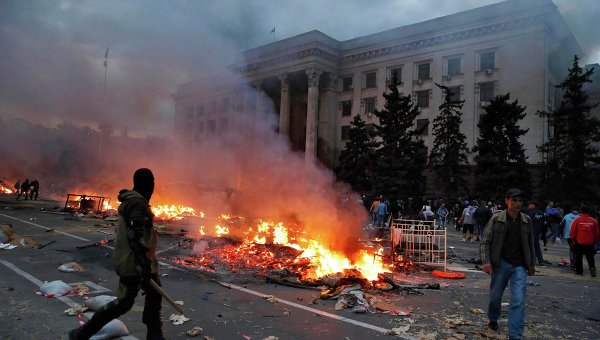
You’d be forgiven for knowing very little about the unrest in Ukraine
– the violence, the rioting on the streets, the armed protesters
storming government buildings amidst plumes of thick black smoke rising
from makeshift barricades. Most of the public have once again
been Beibered by the mainstream media – the arrest of this precocious,
spoilt physical embodiment of crass corporate culture proving newsworthy
enough for an MSNBC host to interrupt an interview with a member of
Congress discussing the true scale of NSA spying.
In this climate of superficial distractions and media inanity, you’d
be equally forgiven for not really knowing why there is political unrest
in Ukraine. Most of the explanations for the violence offered
by the mainstream media present the information in simplistic soundbytes
– talking points without the relevant wider political and historical
context which renders current events coherent.
The following article from The Independent provides us with a brief overview of the media’s presentation of recent events in Ukraine:
In November President Viktor Yanukovych decided to
pull out of a treaty with EU, an agreement many felt would have paved
the way for the Ukraine to join the union. It looked like he was going
to sign the agreement before performing a U-turn, which has made
Ukrainian disappointment all the sharper. However the government would
rather stay friendly with Putin in return for favourable treatment. The
protesters think it would benefit ordinary people far more to be aligned
with the EU and consider Yanukovych a man who only represents the
interests of the richest.
The article goes on to define the demonstrations as ”more than a
pro-EU movement”, one which represents popular resentment towards
perceived government corruption and violent repression
towards peaceful activists.
President Viktor Yanukovych’s government forces are certainly guilty
of using excessive force against the rioters, and accusations of torture
appear to be well-founded and should not be excused. But condemnation
is certainly clouded when you consider the level of violence from the
rioters. By the same token, when mobile phone users near the scene of
the riots received text messages from the state reading, “Dear
subscriber, you are registered as a participant in a mass riot”
it brought to home just how omnipresent - and ominous - surveillance
technology in the 21st century has become.
The problem with the “popular protests against the government and for
integration into the EU” narrative is that it omits crucial information
regarding the role of the West is fomenting and orchestrating
demonstrations such as these; a role which illuminates
broader geopolitical objectives in the region and the extent to which
intelligence agencies and their offshoot organizations meddle in the
affairs of sovereign nations. Understanding the nature of soft power –
the use of coercion and bribery – and the subversion and infiltration of
grassroots political movements by NGOs and other organizations backed
either directly or indirectly by the US government, helps us to
more broadly understand why the unrest in Ukraine is reaching such a
fever pitch.
The seemingly spontaneous 2004 Ukrainian “Orange Revolution”, sparked
by alleged electoral fraud and allegations of voter intimidation, was
led largely by a number of grassroots movements tied to political
activists and student groups. Many of the groups involved, however, were
funded and trained by organizations intimately linked to the US
government. The foreign donors of these groups included the US State
Department, USAID, the National Democratic Institute for
International Affairs, the Open Society Institute and the National
Endowment for Democracy.
The candidate who emerged victorious in the wake of these widespread
orchestrated protests, Viktor Yushchenko, was not only endorsed by the
same institutions which wielded their influence over the protest
movements themselves, he was also supported by the International
Monetary Fund. A central banker by profession, Yushchenko was a
firm advocate of implementing IMF monetary reforms and,
equally crucially, an advocate of NATO membership. Before entering into
Ukrainian politics he had worked at the US State Department,the Reagan
White House, the U.S. Treasury Department, and the Joint Economic
Committee of Congress. In short, it’s safe to say that he was a product
of Washington, an image only exacerbated by his hostility towards
Russia.
It is tempting to automatically assume that the same process is
taking place in Ukraine at the moment. Certainly, intelligence agencies
have historical form when it comes to covert operations and the
manipulation of activists via social media – similar US-backed ”Colour
Revolutions” have taken place in Georgia, Yugoslavia and elsewhere. The
widespread political support for the protesters in Ukraine and the lack
of condemnation for their use of violence would certainly add to the
view that these protests are at least tacitly backed by the West, if not
outright orchestrated. While none of this constitutes “proof”
of outside interference, at the very least it is enough to raise
suspicions. On the other hand, without firm evidence it is perhaps
equally plausible that the support for the protesters is simply a case
of making political capital out of the situation, stoking the flames of
an already lit fire.
As the violence on the streets of Kiev continues, already spreading
away from the capital, the Russian State Duma recently passed a
resolution slamming foreign politicians and other players for
interfering in Ukrainian internal affairs in an attempt to escalate the
conflict. It’s a marked contrast to the rhetoric emerging from
Washington and the EU, both of whom have expressed the possibility of
intervening, with the US adopting a stance which hints at another
planned ”regime change” on Russia’s doorstep.
Perhaps the most damning indictment of the West’s stance over Ukraine
and their support for what they refer to as a “pro-democracy protest
movement” is the profoundly anti-democratic leanings of the violent
protestors at the vanguard of the assault on the Ukrainian authorities.
Anyone familiar with the crisis in Syria and the attempts to topple
President Assad will be all too familiar with the US’s willingness to
get into bed with extremists of the worst possible nature in order to
achieve their objectives.
In Ukraine today it appears that very little has changed. Just as the
Western-backed Syrian rebels with intimate ties to al-Qaeda were
presented in our media as “pro-democracy” organizations, so too are many
of those protesting in Ukraine drawn from far-right and fascistic
groups such as the opposition Svoboda party, whom John McCain was more
than happy to appear on stage with in December 2013 and offer his – and
by extension America’s – support.
Yet it would also be wrong-headed to characterize the protests in
Ukraine as being led by far-right extremists – many protesters are
taking to the streets through genuine and legitimate grievances with the
current government. The danger lies in these moderate protesters
allying themselves with those on the far-right – combined with tacit
support from the US for the likes of the Svoboda party, it could be a
concoction which would set the stage for a dictatorship far more corrupt
and repressive than those currently clinging onto power.
With the geopolitical stakes as high as they are, not least with the
potential for a broader NATO influence in the region, it would be wise
to view the situation in Ukraine through the wider prism of the global
balance of power and all that this entails. Equally, we should be wary
of simplistic media narratives which seek to paint any conflict in black
and white/good vs. evil terms, particularly when the “good guys” are
being backed by the US government and her allies. All too often this
amounts to little more than propaganda designed to rouse support for
opposition movements favourable to “regime change”, and by now it should
be very clear how little this has to do with vague, idealistic notions
of “democracy”, and how much it has to do with regional – and
ultimately global – hegemony.