Sayer Ji
May 20, 2026

Share the X thread on this article here.
Part II: The glyphosate story was one thread. Here is the whole cloth.
In Part I: The Bacterium That Eats Roundup, we sat with a single, almost unbelievable finding: that a soil-and-gut commensal we have known for over a century — Bacillus subtilis — possesses the enzymatic machinery to take glyphosate apart, atom by atom, and return its constituents to the cycles of life. The argument of that essay was that this is not a coincidence. The same organism that lives in our soil, our fermented foods, and our own gut, is the same organism that can dismantle the molecule most responsible for the chemical assault on the holobiont. The microbial answer was already in the room when the question was asked.
What I did not anticipate, in the tine since that piece went out, was how much further the evidence goes. Once you begin pulling the thread, it does not stop at glyphosate. It does not stop at herbicides. It does not stop at pesticides. It does not, astonishingly, even stop at biological molecules at all.
Bacillus subtilis, it turns out, is dismantling the entire petrochemical age.
What follows is a survey of the peer-reviewed literature published mostly within the last five years — drawn from journals including Journal of Hazardous Materials, Environmental Research, Biodegradation, Toxins, and the 2025 review in the Journal of Environmental Management. Taken individually, each finding is remarkable. Taken together, they describe something I think we have not yet had the language for: a single ancient organism functioning as a holobiont-scale immune response to the synthetic chemistry of modernity.
The Synthetics Bs Is Quietly Taking Apart
Let us simply list what this microbe is now documented to degrade. I will keep the catalog tight, because the cumulative weight is the argument.
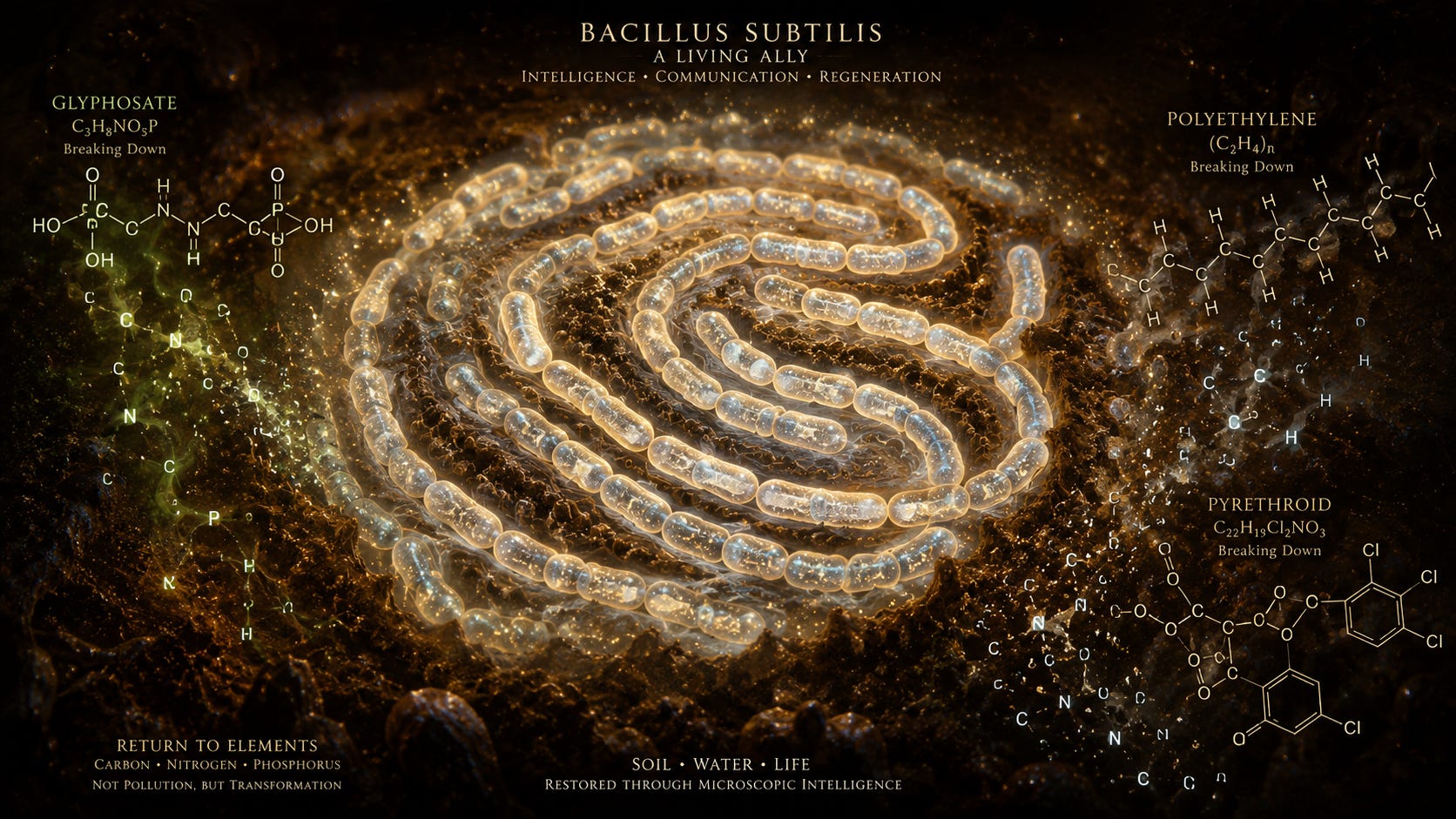
Plastics. B. subtilis strain MZA-75, isolated from soil, degrades polyester polyurethane films.1 More recently, the strain AP-04, isolated from the gut of plastic-fed mealworms (Tenebrio molitor), achieved a 36.55% weight loss in low-density polyethylene films over sixty days — with measurable CO₂ evolution, confirmed by FTIR, SEM, and AFM analyses.2 This is not surface erosion. This is true mineralization. A gut-derived B. subtilis is converting one of the most chemically inert materials humanity has ever manufactured back into carbon dioxide and biomass — the same end products as digesting an apple!
Pyrethroid insecticides. Multiple strains of B. subtilis degrade cypermethrin, β-cypermethrin, cyfluthrin, and cyhalothrin — the synthetic neurotoxins sprayed on virtually every conventional food crop on Earth.3 4 5
Herbicides beyond glyphosate. Strain Y3 degrades pendimethalin, a dinitroaniline herbicide.6 A “promiscuous” nitrilase enzyme from B. subtilis breaks down nitrile-class herbicides while simultaneously promoting plant growth7 — a dual-function detoxifier-and-restorer. The fungicide penthiopyrad is degraded in both laboratory and field conditions.8
Industrial pollutants. B. subtilis ZWB1, in co-culture with B. velezensis, breaks down phenol — one of the foundational toxic intermediates of industrial chemistry.9 The collaboration stabilizes pH and cycles metabolites between the two species, a small ecology of detoxification operating inside a single liter of broth.
Mycotoxins. A dye-decolorizing peroxidase (BsDyP) cloned from B. subtilis SCK6 simultaneously degrades multiple major mycotoxins — the fungal poisons that contaminate grains and feedstock and cause some of the most underrecognized chronic illness in both livestock and humans.10
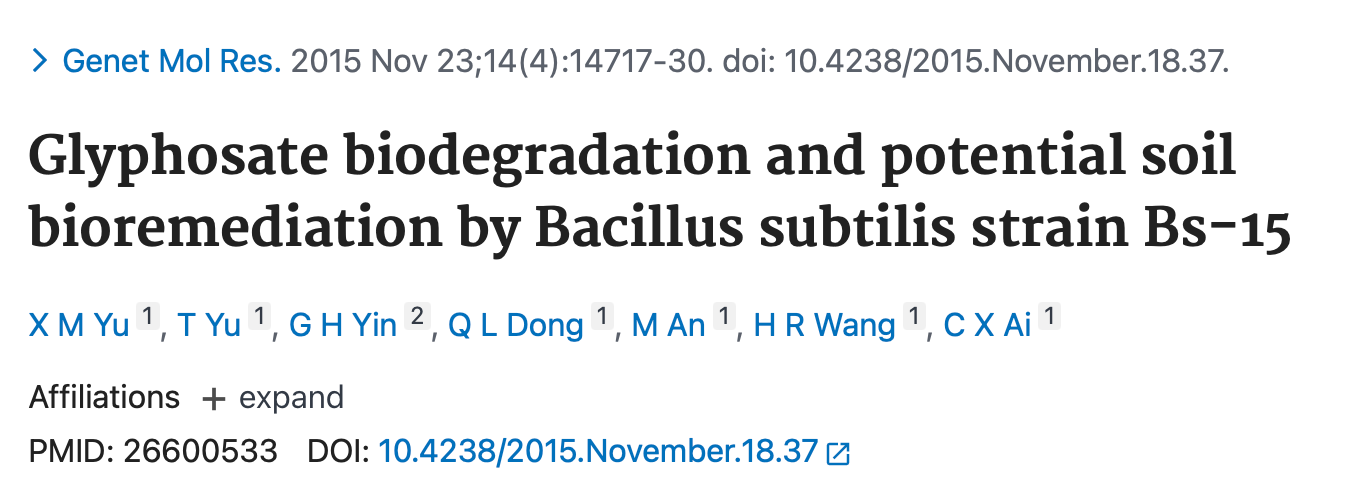
Glyphosate. The molecule we began with. Strain Bs-15 uses it as a carbon and phosphorus source.11
And this is not a fringe collection of papers. The 2025 Journal of Environmental Management review — titled, with refreshing directness, “Bacillus subtilis as a powerful weapon in the removal of environmental pollutants” — synthesizes precisely this catalog and frames it as a coherent body of evidence.12
A single bacterial species, with no genetic modification, no synthetic biology, no human design, is degrading the better part of the chemicals that define industrial civilization.
How are we to think about this?
What the Genome Cannot Do, the Microbe Already Does
The deepest dimension of this finding is one I keep returning to in this lineage of work: the human genome is small, slow, and almost completely silent on the question of how to disassemble synthetic molecules that did not exist when our species evolved. We have roughly 20,000 protein-coding genes. The bacteria in our gut and on our soil collectively encode hundreds of times more enzymatic diversity than that.
Glyphosate did not exist before 1970. Polyethylene did not exist before 1933. Pyrethroids in their modern synthetic form did not exist before the 1970s. Cypermethrin was patented in 1974. Pendimethalin in 1969. None of these molecules has been present on the planet long enough for the human genome to evolve a response. By every standard logic of natural selection, our body should be defenseless against them — and in many measurable ways, it is.
But the bacterial world does not operate on the timescale of mammalian evolution. Bacteria like B. subtilis reproduce in twenty minutes under favorable conditions, exchange genetic material laterally across species lines, and carry a metabolic toolkit refined across roughly three and a half billion years of life on this planet. The enzymes that allow Bs to degrade polyurethane are not new inventions; they are repurposings of ancient lipases and esterases that evolved to process plant cuticles, fatty acids, and other long-chain organic molecules. The carboxylesterases that take pyrethroids apart are the same enzymatic family bacteria have used since the Archean to cleave ester bonds in the natural world.
What is happening, in other words, is not that bacteria are evolving new chemistry to deal with the petrochemical age. They already had the chemistry. The petrochemical age, viewed from the bacterial side, is simply a new menu drawn from molecular shapes ancient enzymes already know how to handle.
This is the deepest meaning of the holobiont frame. The body we call ours, the body that cannot detoxify a polyethylene shopping bag or a cypermethrin residue, is only the mammalian fraction of who we are. The other 99% of cells — the microbial fraction — has been answering questions our genome never had to learn how to ask.
The Bacterium That Talks Before It Detoxifies
There is one finding in this literature that elevates the entire conversation, and I want to give it its own breath here, because I think it changes how we should understand what microbes are.
In Bacillus subtilis, the gene that produces the carboxylesterase responsible for pyrethroid degradation — cesB — is not always on. It is regulated. And the regulator is the colony itself.
The mechanism, worked out at the molecular level by two independent research groups4 5 (with confirmation by DNA pull-down and yeast one-hybrid assays), goes like this: when B. subtilis cells are exposed to pyrethroids, they secrete a small signaling peptide called ComX. When enough cells are present to register the signal collectively — a quorum — a downstream cascade activates the regulator DegU, which then binds directly to the upstream region of the cesB gene and turns on the production of pyrethroid-degrading enzymes.
Read that again slowly. The bacteria do not detoxify individually. They detoxify socially. They sense one another. They confer, in chemical language, on whether a threat has arrived. They commit to the metabolic expense of producing detoxification enzymes only when the colony agrees, through its own communication system, that the response is warranted.
This is not metaphor. This is published, replicated, peer-reviewed microbial coordination. Bacillus subtilis exhibits, at minimum, three properties we typically reserve for higher organisms: a chemical language (ComX and its receptors), a quorum-based decision rule (collective response only above a threshold), and a coordinated metabolic commitment (turning on detoxification genes in concert).
The microbe is not a passive enzyme bag. It is a participating intelligence.
And it is doing this work inside our gut, inside our soil, inside our fermented foods — not because we have asked it to, but because the planet runs on this kind of distributed, communicative, ancient intelligence whether or not we have noticed it.
A Holobiont’s Immune Response to the Petrochemical Age
If we step back, the pattern that emerges from this literature has a shape I do not think we have a clean name for yet. Let me try to describe it.
The petrochemical age has flooded the biosphere with molecules that did not previously exist — herbicides, pesticides, plastics, industrial intermediates, mycotoxins amplified by the monocultures and fungicide-resistant fungi that industrial agriculture itself created. The mammalian body, including the human body, is mostly defenseless against these in the strict genetic sense. Our liver enzymes do their best, but they were calibrated for an earlier chemical universe.
And yet the holobiont — the whole organism that includes our microbial partners — appears to be mounting a coordinated response. Bacillus subtilis is one of the clearest examples, but it is almost certainly not alone. The literature on Bacillus velezensis, Pseudomonas species, Burkholderia, certain Lactobacillus strains, and various soil and gut consortia points the same direction: the microbial world is metabolizing the petrochemical age in real time, often in coordinated multi-species ecologies, often within the same body cavities that house the chronic disease epidemics of late modernity.
If you take the holobiont seriously — and I do — then this is not a curiosity of environmental microbiology. This is an immune response. Not the mammalian immune response of antibodies and T-cells, but the deeper, older, broader immune response of an entire ecosystem of life that has been protecting carbon-based existence on this planet since long before there were antibodies, T-cells, or mammals.
The implication, gently but seriously stated, is this: the human body alone may not be able to clear the residues of the petrochemical age. The holobiont almost certainly can — provided we stop killing it.
What This Asks of Us
The practical question that arises, having seen this, is what we do with it.
The honest, ecological answer has roughly three parts.
Restore the soil. Living, undisturbed, biologically intact soil is where the deepest reservoirs of B. subtilis and its detoxifying cousins exist. Industrial tillage, glyphosate desiccation, synthetic nitrogen, and fungicide regimes systematically destroy the conditions under which these microbes thrive. Regenerative agriculture is not, in this frame, an agricultural fashion. It is the restoration of the planet’s primary detoxification system.
Eat the foods that carry these microbes. Natto, miso, kimchi, raw sauerkraut, traditional cheeses made from raw milk, fermented vegetables of every ancestral tradition — these are not merely “probiotic” in the marketing sense. They are direct transfers of organisms like B. subtilis from a living food matrix into the gut, where the microbes can resume their ancient work of metabolizing what the body cannot.
For those without daily access to these fermented traditions, the clinically validated spore-form strain AB22™ — the same strain at the center of CardioNK™ — offers a direct path to restoring this relationship. CardioNK was built around what I call the Regenerative Natto Complex: nattokinase, 2 billion colony forming units of AB22® Bacillus subtilis, and MK-7, delivered together the way Nature always delivered them — in their evolved synergy, with the parent organism still present. Given what the literature now shows about B. subtilis's broader detoxification capacity, the case for keeping this organism in continuous residence in the gut has never been stronger.

Stop pouring antibiotics, glyphosate, and biocides into the system. Every dose of broad-spectrum antibiotic, every glyphosate-saturated wheat field, every chlorinated municipal water supply, every ultraprocessed food matrix engineered to be biologically sterile, is a direct attack on the holobiont’s detoxification capacity. We are, in the most literal sense, killing the organisms that are trying to clean up after us.
The Bacterium Was Always There
When I wrote Part I of this series, I thought I was writing about glyphosate. I see now that I was only writing about one molecule in a much larger story.
The story, as it appears in the published literature of the last five years, is that a single ancient microbe — present in our soil since before there was a human species, present in our fermented foods since the beginning of culinary civilization, present in our gut whenever we have not driven it out — is quietly mounting a coordinated, socially-regulated, multi-substrate response to nearly every category of synthetic toxin the industrial age has produced.
It is degrading our plastics. It is dismantling our pesticides. It is breaking down our herbicides. It is clearing our mycotoxins. It is decommissioning our industrial intermediates. It is doing this in colonies that talk to one another before they begin the work.
This is not a small finding. This is, I think, evidence of something the holobiont frame has been pointing at for years: that the body we call human is in continuous, ancient, intelligent partnership with a world of organisms whose capabilities exceed our own and whose work on our behalf is largely invisible to us.
The bacterium was always there. The science is finally catching up to what traditional foodways and indigenous agriculture have implicitly known for thousands of years. And the question that remains is not whether the holobiont can heal the damage of modernity.
The question is whether we will let it.
Share the X thread on this article here:

If you want to go deeper on what it looks like to regenerate both — the soil beneath your feet and the ecology within your body, simultaneously — I explored exactly that in the video below.

Sources
Additional Reading
Ji J, et al. Polyester polyurethane degradation by Bacillus sp. YXP1. Environmental Research. 2024;249:118468. PMID: 38354881.
Pérez-García P, et al. Microbial degradation of synthetic plastics: a comprehensive review. Microbiology and Molecular Biology Reviews. 2025;89(4):e0008724. PMID: 40970732.
Probiotic Bacillus subtilis I3 with pesticide-degrading and biocontrol activity in honeybees. Probiotics and Antimicrobial Proteins. 2025;17(1):51–61.
Footnotes
Shah Z, Krumholz L, Aktas DF, Hasan F, Khattak M, Shah AA. Degradation of polyester polyurethane by a newly isolated soil bacterium, Bacillus subtilis strain MZA-75. Biodegradation. 2013;24(6):865–77. PMID: 23536219. ↩
Akash K, Parthasarathi R, Elango R, Bragadeeswaran S. Exploring the plastic-fed Indian mealworm (Tenebrio molitor) gut bacterial strain (Bacillus subtilis AP-04) — A potential driver of polyethylene degradation. Journal of Hazardous Materials. 2025;486:137022. PMID: 39740547. ↩
Zhang M, et al. Degradation of cypermethrin by Bacillus subtilis J6 isolated from broiler chicken cecum: pathway and stress response. Journal of Agricultural and Food Chemistry. 2025;73(33):20685–98. PMID: 40785279. ↩
Zhong G, Lu Q, Pan K, et al. Quorum sensing system effectively enhances DegU-mediated degradation of pyrethroids by Bacillus subtilis. Journal of Hazardous Materials. 2023;455:131586. PMID: 37178530. ↩ ↩2
Xiao Y, Chen S, Gao Y, et al. Synergistic degradation of pyrethroids by the quorum sensing-regulated carboxylesterase of Bacillus subtilis BSF01. Frontiers in Bioengineering and Biotechnology. 2020;8:889. PMID: 32850741. ↩ ↩2
Pang S, Lin Z, Zhang Y, et al. Pendimethalin biodegradation by Bacillus subtilis Y3 isolated from activated sludge. Journal of Environmental Sciences (China). 2016;41:121–27. ↩
Promiscuous nitrilase from Bacillus subtilis with dual herbicide-degrading and plant-growth-promoting activity. Scientific Reports. 2026; in press. doi:10.1038/s41598-026-52818-8. ↩
Penthiopyrad degradation by Bacillus subtilis and Trichoderma harzianum: laboratory and field studies. Molecules. 2020;25(6):1421. ↩
Phenol biodegradation by Bacillus subtilis ZWB1 in co-culture with Bacillus velezensis ZWB2. Environmental Research. 2023;238(Pt 2):117269. ↩
Simultaneous degradation of multiple mycotoxins by a recombinant dye-decolorizing peroxidase (BsDyP) from Bacillus subtilis SCK6. Toxins (Basel). 2021;13(6):429. ↩
Zhan H, Feng Y, Fan X, Chen S. Glyphosate biodegradation by Bacillus subtilis Bs-15 and potential application in bioremediation. Genetics and Molecular Research. 2015;14(4):14717–30. ↩
Bacillus subtilis as a powerful weapon in the removal of environmental pollutants: a comprehensive review. Journal of Environmental Management. 2025;396:127894. ↩
No hay comentarios:
Publicar un comentario