Six years ago this week an
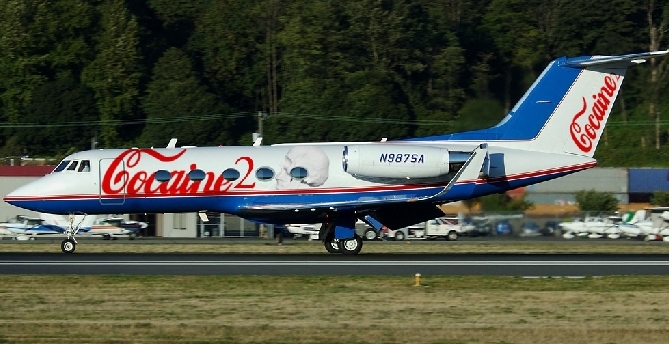
American-registered luxury jet, a Gulfstream II—later dubbed “Cocaine
2”—crashed just before dawn in the middle of the jungle in Mexico’s
Yucatan carrying four tons of cocaine. The event, and its aftermath,
changed forever an official narrative of the war on drugs which has for
years been pushing the notion that there is no significant American
involvement in the global drug trade, and no American Drug Lords.
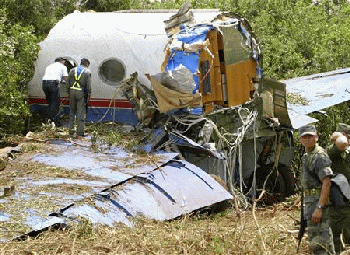
When the Gulfstream's fuselage split into
pieces on impact, spilling cocaine across an area the length of three
football fields, a chain of events was set in motion that would prove
that nothing could be further from the truth.
Several hundred miles away, and more than a
year earlier, in May 2006, the Gulfstream’s ‘sister ship,’ a DC-9 which
became known as “Cocaine1" because it was painted to impersonate an
official US Government plane, had been caught carrying more than 5.5
tons of cocaine.
The two planes shared too many identifying
characteristics, including interlocking owners and a shared base in the
sleepy retirement Mecca of St Petersburg FL on Florida’s Gulf Coast,
to be coincidence.
The twin events represented the biggest
sea change in the global drug trade since the death of Pablo Escobar in
1992, or the assassination of Barry Seal in 1986. Today, despite the
intervening years, new details continue to emerge about the case.
What could YOU buy with $378 billion in laundered drug money?
 Almost every news story that day, September 25, 2007, played bigger than the downed drug plane: The dozen
people who died in a suicide bombing in Baqubaa Iraq. The report that
829,000 Americans were arrested for marijuana possession the previous
year. And the Forbes magazine story announcing that there were so
many billionaires in the world that 82 of them weren't rich enough to
make the Forbes 400 List.
Almost every news story that day, September 25, 2007, played bigger than the downed drug plane: The dozen
people who died in a suicide bombing in Baqubaa Iraq. The report that
829,000 Americans were arrested for marijuana possession the previous
year. And the Forbes magazine story announcing that there were so
many billionaires in the world that 82 of them weren't rich enough to
make the Forbes 400 List.
But none would have the eventual impact
that the story of the Gulfstream crashing in the jungle did. During the
course of the investigation which followed it became clear that the
money used to purchase both planes—the Gulfstream and the DC-9—was
laundered and funnelled through Wachovia Bank, and more importantly,
that it represented just a tiny sliver of the more than $380 billion of
drug money that had been laundered during the past six years through
what was then America’s 4th largest bank.
Wachovia was fined a record $165 million. The sullied bank was forced to sell itself to Wells Fargo Bank in Salt Lake City.
Some observers found it ironic that
America’s first full-service narco-bank was headquartered—not in New
York or San Francisco—but in the conservative bastion of
paleo-Republican Jesse Helms's North Carolina.
The true meaning of "cartel du jour."
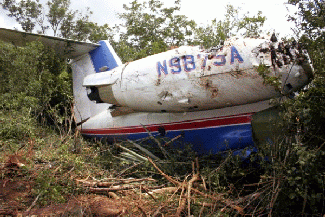
At about three a.m. the normal quiet of
the town of Tixkobob (pop. 17000), located an hour outside of the
Yucatan capital of Merida, was disturbed by the deafening noise of a
low-flying twin-engine jet circling overhead, and the whine and buzzing
of several military helicopters in pursuit.
The noise went on for an incredible two
hours until, out of fuel, the jet crashed three miles outside town on a
plantation, Rancho San Francisco, identified by Mexican journalists as
belonging to an American named Martin Wood.
Although remote, the crash site quickly
drew a crowd. Slightly after dawn a Mexican Army unit from the Tenth
Military Region deployed to the site, secured it, and then guarded it
over the next 36 hours, repelling intrusions from other Mexican law
enforcement agencies, as well as from the DEA, which flew six agents to
the scene from Mexico City to reconnoiter, only to see them turned away
from the site.
The history of the flight.
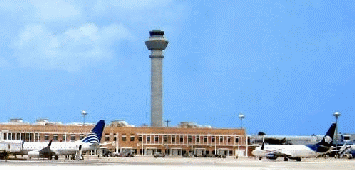
Days earlier, the Gulfstream jet had begun
its journey at Fort Lauderdale’s notorious Executive Airport, flying
southwest across the Gulf of Mexico to Cancun. There the pilot made
arrangements with the airport’s general manager that they would be able
to land without incident at the airport on their return from Colombia
laden with cocaine.
The next day, negotiations being
successfully concluded, the Gulfstream took off for Colombia. Nothing
unusual was noticed. The plane was on a well-worn path. The airport in
Cancun was the busiest drug port in Mexico.
After loading its cargo of cocaine the
following day, the Gulfstream took off from the international airport
just outside Medellin, in Rio Negro Colombia, bound once more for the
exclusive Mexican Caribbean resort of Cancun, in the Mexican state of
Quintana Roo.
Among the mysteries surrounding the
flight, the one which looms largest is this: Why did authorities at the
Cancun airport change their minds, renege on their promise, and refuse
the plane permission to land?
At a press conference a year earlier after
the crash of the DC-9, Mexican Attorney General Daniel Cabeza de Vaca
said officials from Federal security agencies in the Yucatan were known
to be in collusion with drug traffickers. Curiously, with his next
breath he mentioned Kamel Nacif, 69, a Lebanese businessman in Cancun
who was in the news for alleged links to an international network of
pedophiles.
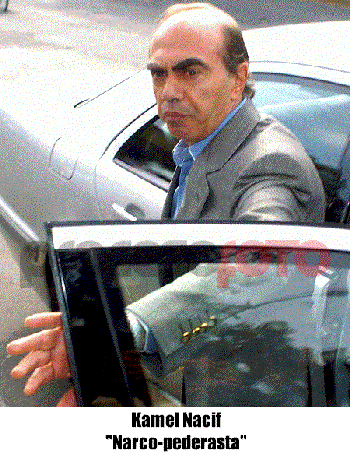
On the off-chance the Mexican Attorney
General was dropping hints, and not just free-associating, I did a quick
search on Nacif, who I was surpised to learn is (or was) the biggest
high-stakes gambler in Las Vegas, a “whale” who won and lost millions
of dollars at a time.
In a Nevada Gaming Commission staff report
questioning the association of Ted Binion, chairman and CEO of the
Horseshoe Casino, with what the report called “certain individuals,” the
report cited Kamel Nacif by name, chiding Binion for putting up $2
million to bail Nacif out of jail.
Nacif, the Commission staff reported, was associated with “narcotics, firearms sales, and money laundering.”
Unsung heroes of the drug trade: The Americans
Today
there is new information about many aspects of the case. As per usual
when it comes to stories about drug trafficking, the really interesting
bits concern aspects of the case that received something less than the
full attention of the mainstream media.
An example is the matter of the Americn ownership of the downed plane.
Soon after the crash it was learned that
the now-mangled drug plane had been used for at least a decade by the
CIA, flying "extraordinary renditions “to the US base in Guantanamo
which housed prisoners suspected of being Al Qaeda, as well as the DEA,
ferrying extradited drug traffickers from Colombia to the USA.
During that time the plane was “parked” or
“sheepdipped” in the hands of a motley crew of politically
well-connected ‘straw’ owners.
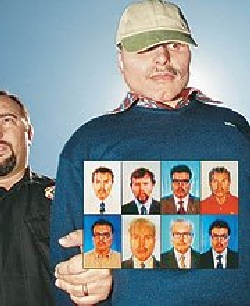
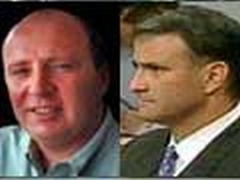
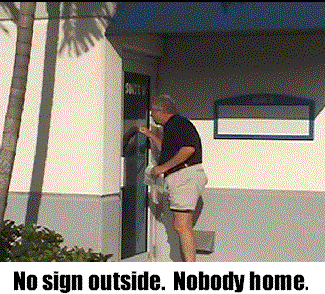
With that in mind, I paid a visit (along
with a pilot friend pictured, above) to the address, 4811 Lyons
Technology Parkway #8 in Coconut Beach FL. that “Donna Blue Aircraft
Inc” listed on FAA documents as well as with the Florida Dept. of
Corporations.
What I found was an empty office suite with a blank sign out front, and no visible sign of any entity called Donna Blue Aircraft, Inc.
 What there was, however, oddly enough, were a half-dozen unmarked police cars parked directly in front of the empty suite.
Today documents
from the FAA cast new suspicion on the story told by two Brazilian
businessmen in Boca Raton who had—just weeks earlier—purchased the
Gulfstream II, according to the FAA, through a dummy company they owned
called Donna Blue Aircraft (DBA,"doing business as," get it?).
Joao Malago and Eduardo Dias Guimaraes
both stated repeatedly that they were no longer responsible for the
plane when it went down, having sold it to two pilots from Fort
Lauderdale, the week before it scattered cocaine litter across the
jungle floor.
They may not have been telling the truth.
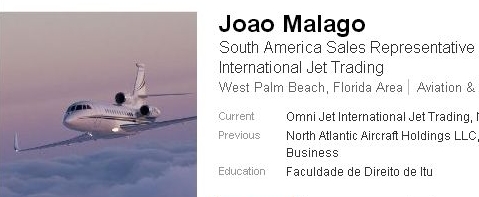
Two very very lucky Brazilians
"We are not the owners of the plane," said Guimaraes, reached in Goiania in central Brazil.
He deferred most questions to his partner,
Malago, who said from Sao Paulo that Donna Blue purchased the aircraft
in July from a company that had owned it for 10 years. Then they quickly flipped it, reselling it to two Florida pilots who they said paid for it in full.
Malago,
who said he'd been a pilot for 25 years and had bought and sold planes
throughout Latin America, said he learned of the crash only after after
receiving a phone call from an insurance company, had been unable to
reach the new owner by phone and feared he was dead.
He stated that he knew nothing of the
plane's history or what use it had been put to previously. "Generally,
(when you buy a plane) you don't know the history of the plane," he
said.
That was a red flag. Anyone with even
limited knowledge of general aviation knows this statement to be untrue.
Scrutinizing an airplane’s logbooks,which contain its flight
and repair history, is one of the first things checked out by potential
buyers.
Raising further suspicion was the
company's website, which seemed a clumsy and half-hearted attempt to
construct a plausible “legend,” or cover, for what was clearly a dummy
front company. The company’s bogus
phone number (415.555-5555) contributed to the effect. And when the site
featured a quote from a supposedly satisfied Donna Blue Aircraft
customer, it gave his name as “John Doe.”
The FAA "weighs in"
On the FAA website,
I discovered, on the final Deregistered Aircraft document for the
crashed Gulfstream N987SA when its registration was canceled five months later, Donna Blue Aircraft was still named as the plane’s owner.
So I contacted an FAA spokesman at the Agency's home office in Oklahoma, and followed up with an email.
“As you know,” my note began, “when a
plane is sold, the owner is required to report the sale to the FAA. Yet
when it was deregistered in February, 2008, five months after crashing,
the FAA still listed the plane's owner as Donna Blue Aircraft.
“The Brazilian owners of Donna Blue Aircraft said they'd sold the plane a week before its last flight South for $2 million to two pilots from Fort Lauderdale, Clyde O'Connor and Greg Smith. Smith wrote them a check for $2 million to purchase the plane, the Brazilians claimed.
“Yet within the aviation community in Fort
Lauderdale Greg Smith is known to be so penurious that charter flight
operators make sure to give him extra cash to take when he flies a
charter for them, because he never has any money, and if the plane needs
to refuel, they're stuck.

“Moreover, no documentation was ever provided by the Brazilians to prove that the plane actually did change hands.
If a plane crashes after being sold to a
new owner, but while the transfer of registration is still in progress,
when the FAA delists the plane months later shouldn’t the new owner be
listed as the owner of record on the plane’s FAA decertification?”
“Thanks for any guidance you can offer.”
The note I got back was terse, and perhaps more notable for what it does not say than what it does.
“N987SA is de-registered. The aircraft
registration prior to de-registration was with Donna Blue Aircraft,
Inc. I checked with the FAA Aircraft Registry; there has been no
additional action."
The FAA wasn't throwing the two
Brazilians under the bus, exactly. But they were clearly creating a bit
of daylight between them.
A Chupeta connection?
 On the Colombian side of the equation, there are indications that the nationality of the two Brazilian owners of the Gulfstream offer a clue to clearing up a few unanswered questions.
It may be that airport officials had a
change of heart when they learned the plane had been tracked across the
Caribbean from the US radar tracking station at Swan Island off
Honduras, and was now being pursued by an Embracer jet from the Mexican
Air Force, as has been widely reported.
In the drug trade, it is important to recall, the
title “cartel du jour” is a designation which changes rapidly and
without notice. Just ask the kingpins from the Medellin, or the Cali,
cartels.
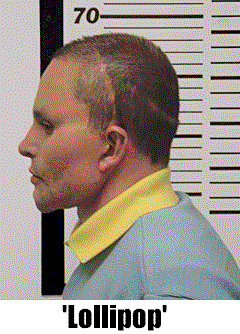
It turns out that when the drug traffickers on the Gulfstream lost their "get out of jail free" card, a drug kingpin who the DEA has called the biggest drug trafficker since Pablo Escobar had just been captured.
On August 7, just over a month earlier, a joint operation between forces including Brazil, the US, Argentina, Spain and Uruguay took down a drug kingpin who was recently
profiled here. Before being caught, Juan Carlos Ramirez Abadia, known
as “Lollipop” (El Chupeta), had been successfully holed up for more than
five years in Sao Paulo Brazil.
Three weeks after his arrest, two Brazilians bought the Gulfstream.