Busca en Nuestros Archivos

Busca en Nuestro Blog

Translate / Traducir

Mostrando entradas con la etiqueta Pearl Harbor. Mostrar todas las entradas

10 diciembre, 2020

How to #GetSaved from #COVID19 Under #NuclearBombs

By Jacob G. Hornberger, December 09 2020

Given the outrage over what the court historians and the U.S. mainstream press have long maintained was an unprovoked attack by Japan on the United States, why have these same court historians and mainstream media outlets given a pass to the U.S. government for initiating an unprovoked attack on Cuba at the Bay of Pigs in 1961?
By Diana Johnstone, December 09 2020

In the current atmosphere of confusion and distrust, the glee with which economists Klaus Schwab and Thierry Malleret greet the pandemic as harbinger of their proposed socioeconomic upheaval suggests that if Covid-19 hadn’t come along by accident, they would have created it (had they been able).

05 noviembre, 2018

#Japan #1941: #Aggressor, or #Victim?

tomatobubble,com

The Setting:
Globalist agents FDR and Churchill want desperately to drag the United States into World War II. Knowing that American entry into the war would endanger Germany's war efforts, Hitler ignores repeated U.S. provocations of Germany. To further discourage U.S. entry into the war, Germany, Italy, and Japan sign on to a mutual defense pact in September of 1940- The TriPartite Pact. War against one means war with all three.
  

Japanese poster celebrates the TriPartite Pact.

Ironically, the TriPartite Pact will have the unintended effect of facilitating FDR's treasonous scheme to embroil the U.S. into the conflict. As a "backdoor" to the European conflict (which Germany was winning) FDR and Churchill intensify their instigation of Japan. When the aggressive moves become

31 octubre, 2017

How The #Spanish #American #War Changed The #World

Teddy Roosevelt's mythical horseback charge up San Juan Hill 
catapulted him to national prominence.
tomatobubble,com

High School history fables taught us that the Spanish-American War of 1898 was a meaningless war instigated by the Yellow Journalist William Randolph Hearst. Here's a typical history-book sample of the retarded drivel that is still being spoon-fed to captive audiences of dumbed down students:

"It is arguable that the Spanish-American War was perhaps the most pointless war in the history of the United States. Although it was not known at the time, the war was not truly fought for territory, for markets, for principle, or even for honor. Rather, it began because William Randolph Hearst, editor of the popular New York Journal sought sensational material to print."

Certainly, Hearst and his Jewish rival at the New York World, Joseph Pulitzer, helped to poison the public mind towards Spain. But this idiotic and incomplete analysis ignores the "big picture" of the Globalist hand which moves the chess pieces. The Spanish-American War was neither "pointless", nor insignificant. To the contrary, without the precedent-setting features, tactical acquisitions, and adverse side-effects of this unjust war, and the prolonged US-Philippines War which grew out of it, World War I, the Bolshevik Revolution, World War II and all the other horror stories of the past 100 + years would not have been possible.

Intrigued? Keep reading.

1- As outrageous and essential as their propaganda was, the belief that a newspaper circulation rivalry between Hearst and Pulitzer caused the war, as the first cartoon above suggests, is just as moronic.
2- The shocking claim of Spaniards strip-searching American women was false.

As the turn of the century approached, America was strong, independent, and what the Globalists would call "isolationist" - a stupid propaganda term used to mock the desire to maintain peaceful commerce and neutral relations with foreign countries. The very thought of picking a fight overseas was as foreign to the American psyche as homosexual "marriage" or government housing.

The Globo-Zionist crime gang was not nearly as entrenched among the American elite as it is today, but the pernicious influence of the New World Order was growing. Money Masters such as Jacob

27 abril, 2017

#Japan #1941: #Aggressor, or #Victim?

tomatobubble,com

The Setting:
Globalist agents FDR and Churchill want desperately to drag the United States into World War II. Knowing that American entry into the war would endanger Germany's war efforts, Hitler ignores repeated U.S. provocations of Germany. To further discourage U.S. entry into the war, Germany, Italy, and Japan sign on to a mutual defense pact in September of 1940- The TriPartite Pact. War against one means war with all three.

Japanese poster celebrates the TriPartite Pact.

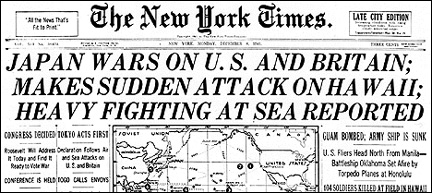
Ironically, the TriPartite Pact will have the unintended effect of facilitating FDR's treasonous scheme to embroil the U.S. into the conflict. As a "backdoor" to the European conflict (which Germany was winning) FDR and Churchill intensify their instigation of Japan. When the aggressive moves become too much for Japan to bear (oil embargo, closure of Panama Canal to Japanese shipping, U.S. battleships cruising through Japanese waters etc.) Japan decides the make the first move, by attacking Pearl Harbor (the U.S. naval base in the territory of Hawaii) on December 7, 1941 ....exactly as FDR had intended!

In the ensuing days, war declarations between the TriPartite allies, and the US/UK alliance were exchanged.

 
https://hankmemoir.files.wordpress.com/2009/12/times-front-page.jpghttps://sites.google.com/a/bsd7.org/america-combo/_/rsrc/1429735646178/workshops/-a-day-of-infamy-analyzing-fdr-s-speech/fdr0906b1.jpg
 
The diabolical FDR, acting "surprised", delivers his "Day of Infamy" speech to a confused and

04 diciembre, 2016

#PearlHarbor #Facts and #Proof

Posted on  by Carl Herman
By guest author, diogenes (bio below).
Robert B. Stinnett, Day of Deceit:  The Truth about FDR and Pearl Harbor (New York, Free Press, 2000)
Stinnett conclusively demonstrates with vast and incontrovertible documentary evidence that in order to precipitate an unwilling American public into supporting intervention in the Second World War, President Roosevelt oversaw the contrivance and deployment of a closely-guarded secret plot to goad the Japanese into attacking Pearl Harbor. The plan was set in motion in October 1940, and its development closely monitored through decoded intercepts of Japanese diplomatic and military radio communications. Knowledge of the plan was limited to 13 Roosevelt administration members and chief military officers, and 21 members of Naval Intelligence and related operations. Once it produced the intended result and the attack impended, the Pacific fleet’s modern naval vessels were sent to sea from Pearl Harbor, leaving seven antiquated World War One battleships as decoys. Meanwhile, the Japanese fleet was tracked with radio intercepts from its formation off the Kuril Islands on November 16, and its sailing for Hawaii on November 26; its course was cleared of all shipping with a Vacant Sea order on the 22nd; and Pearl Harbor naval patrols were ordered out of the area on the 25th. Intelligence of the impending attack was withheld from the officers (Admiral Kimmel and General Short) charged with defending Pearl Harbor, who were kept uninformed of the plan and intelligence of the impending attack, and scape-goated afterward. A coverup of the entire operation was maintained through eight official and Congressional investigations between 1941 and 1946, and down to Strom Thurmond’s inquiry in 1995. Stinnett’s forty-seven pages of Appendices (p. 261-308) present photographic reproductions of essential documents obtained from Federal archives through the Freedom of Information Act, as well as numerous other documents reproduced in the body of the text, and 65 pages (p. 309-374) of closely detailed and referenced notes, all of which copiously and conclusively document Stinnett’s factual assertions, arguments and conclusions.  His voluminous research files and notes are deposited at the Hoover Institute library at Stanford.
It is notable that Lt. Commander McCollum’s “eight-action memo” for inciting war with the Japanese

20 diciembre, 2014

How The #Spanish #American #War Changed The #World


Teddy Roosevelt's mythical horseback charge up San Juan Hill 
catapulted him to national prominence.
tomatobubble,com

High School history fables taught us that the Spanish-American War of 1898 was a meaningless war instigated by the Yellow Journalist William Randolph Hearst. Here's a typical history-book sample of the retarded drivel that is still being spoon-fed to captive audiences of dumbed down students:

"It is arguable that the Spanish-American War was perhaps the most pointless war in the history of the United States. Although it was not known at the time, the war was not truly fought for territory, for markets, for principle, or even for honor. Rather, it began because William Randolph Hearst, editor of the popular New York Journal sought sensational material to print."

Certainly, Hearst and his Jewish rival at the New York World, Joseph Pulitzer, helped to poison the public mind towards Spain. But this idiotic and incomplete analysis ignores the "big picture" of the Globalist hand which moves the chess pieces. The Spanish-American War was neither "pointless", nor insignificant. To the contrary, without the precedent-setting features, tactical acquisitions, and adverse side-effects of this unjust war, and the prolonged US-Philippines War which grew out of it, World War I, the Bolshevik Revolution, World War II and all the other horror stories of the past 100 + years would not have been possible.

Intrigued? Keep reading.

1- As outrageous and essential as their propaganda was, the belief that a newspaper circulation rivalry between Hearst and Pulitzer caused the war, as the first cartoon above suggests, is just as moronic.
2- The shocking claim of Spaniards strip-searching American women was false.

As the turn of the century approached, America was strong, independent, and what the Globalists would call "isolationist" - a stupid propaganda term used to mock the desire to maintain peaceful commerce and neutral relations with foreign countries. The very thought of picking a fight overseas was as foreign to the American psyche as homosexual "marriage" or government housing.

The Globo-Zionist crime gang was not nearly as entrenched among the American elite as it is today, but the pernicious influence of the New World Order was growing. Money Masters such as Jacob Schiff, John Rockefeller, JP Morgan and others were already on board with the Globalist movement; as were media moguls like Adolph Ochs(NY Times), and the aforementioned Hearst and Pulitzer. America's potential as a global 'hit-man' for the NWO was not lost upon these One Worlders, particularly in regard to establishing a menacing naval presence from which the emerging U.S. bully could influence the affairs of Asia. Thus was born the idea for the first "Asian pivot" - the theft of the Spanish colonies of Guam and the Philippines.

The "problem" of overcoming American "isolationism" posed a challenge for the Globalists. Americans wanted as much to do with the affairs of Asia as they did of Mars or Venus. Besides, Spain wasn't about to give away territories which it had benevolently ruled for more than three centuries. Concurrent with the desire to take Guam and the Philippines was a movement to annex Hawaii and make it an American territory. But in 1897, the annexation movement stalled due to the strong opposition of native Hawaiians and the inability of supporters to win a 2/3 majority in the U.S. Senate. What's a Globalist to do?

19 agosto, 2014

Pretexts for Imperial War

Provocations as Pretexts for Imperial War: From Pearl Harbor to 9/11
By Prof. James Petras
Provocations as Pretexts for Imperial War: From Pearl Harbor to 9/11
Article first published by GR in August 2008
Wars in an imperialist democracy cannot simply be dictated by executive fiat, they require the consent of highly motivated masses who will make the human and material sacrifices. Imperialist leaders have to create a visible and highly charged emotional sense of injustice and righteousness to secure national cohesion and overcome the natural opposition to early death, destruction and disruption of civilian life and to the brutal regimentation that goes with submission to absolutist rule by the military.

The need to invent a cause is especially the case with imperialist countries because their national territory is not under threat. There is no visible occupation army oppressing the mass of the people in their everyday life. The ‘enemy’ does not disrupt everyday normal life – as forced conscription would and does. Under normal peaceful time, who would be willing to sacrifice their constitutional rights and their participation in civil society to subject themselves to martial rule that precludes the exercise of all their civil freedoms?

The task of imperial rulers is to fabricate a world in which the enemy to be attacked (an emerging imperial power like Japan) is portrayed as an ‘invader’ or an ‘aggressor’ in the case of revolutionary movements (Korean and Indo-Chinese communists) engaged in a civil war against an imperial client ruler or a ‘terrorist conspiracy’ linked to an anti-imperialist, anti-colonial Islamic movements and secular states. Imperialist-democracies in the past did not need to consult or secure mass support for their expansionist wars; they relied on volunteer armies, mercenaries and colonial subjects led and directed by colonial officers. Only with the confluence of imperialism, electoral politics and total war did the need arise to secure not only consent, but also enthusiasm, to facilitate mass recruitment and obligatory conscription.

Since all US imperial wars are fought ‘overseas’ – far from any immediate threats, attacks or invasions – -US imperial rulers have the special task of making the ‘causus bellicus’ immediate, ‘dramatic’ and self-righteously ‘defensive’.

To this end US Presidents have created circumstances, fabricated incidents and acted in complicity with their enemies, to incite the bellicose temperament of the masses in favor of war.

The pretext for wars are acts of provocation which set in motion a series of counter-moves by the enemy, which are then used to justify an imperial mass military mobilization leading to and legitimizing war.

State ‘provocations’ require uniform mass media complicity in the lead-up to open warfare: Namely the portrayal of the imperial country as a victim of its own over-trusting innocence and good intentions. All four major US imperial wars over the past 67 years resorted to a provocation, a pretext, and systematic, high intensity mass media propaganda to mobilize the masses for war. An army of academics, journalists, mass media pundits and experts ‘soften up’ the public in preparation for war through demonological writing and commentary: Each and every aspect of the forthcoming military target is described as totally evil – hence ‘totalitarian’ – in which even the most benign policy is linked to demonic ends of the regime.