Busca en Nuestros Archivos

Busca en Nuestro Blog

Translate / Traducir

Mostrando entradas con la etiqueta Yolanda. Mostrar todas las entradas

01 diciembre, 2013

Paul Walker

http://the-tap.blogspot.com/2013/12/suspicious-car-crash-kills-paul-walker.html

Suspicious car crash kills Paul Walker, 
founder of Reach Out Worldwide 
currently helping Filipino tsunami victims

Sheriff deputies work near the wreckage of a Porsche sports car that crashed into a light pole on Hercules Street near Kelly Johnson Parkway in Valencia on Saturday, Nov. 30, 2013. A publicist for actor Paul Walker says the star of the “Fast & Furious” movie series has died in a car crash north of Los Angeles. He was 40. Ame Van Iden says Walker died Saturday afternoon. No further details were released. AP Photo/The Santa Clarita Valley Signal, Dan Watson

American actor Paul Walker of “The Fast and the Furious” film series died in a car accident on Sunday at the age of 40.
Reports said it was after he attended a charity event for the victims of super typhoon “Yolanda” (international name Haiyan) in the Philippines.
Paul Walker. AP FILE PHOTO

“It is with a truly heavy heart that we must confirm that Paul Walker passed away today in a tragic car accident while attending a charity event for his organization Reach Out Worldwide,” Walker’s representatives posted online, using the actor’s official Twitter and Facebook account.
“He was a passenger in a friend’s car, in which both lost their lives.”
Ame Van Iden, the actor’s publicist, said the accident happened Saturday afternoon (US time) in Los Angeles.
The Los Angeles County Sheriff’s department said the crash happened in community of Valencia. The Santa Clarita Signal reported a red Porsche crashed into a light pole and tree and burst into flames.
TMZ, the first entertainment website to break the news, said Walker was in a Porsche when its unidentified driver supposedly lost control and crashed into a tree.
The same article said Walker was in Los Angeles for “a car show to support the Philippines typhoon relief effort.”
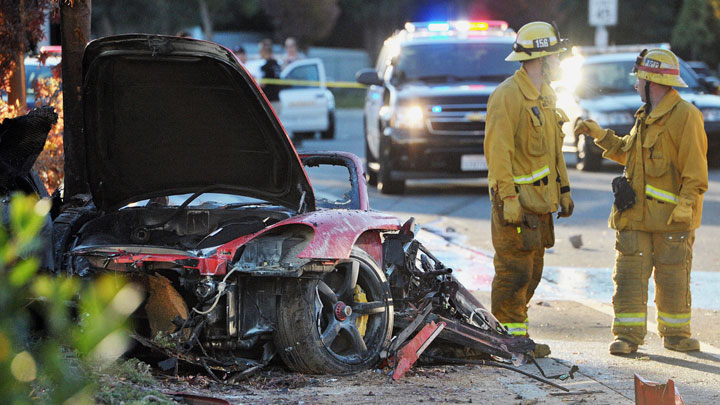
Sheriff’s deputies work near the wreckage of a Porsche that crashed into a light pole on Hercules Street near Kelly Johnson Parkway in Valencia, Calif., on Saturday, Nov. 30, 2013. A publicist for actor Paul Walker says the star of the “Fast & Furious” movie series died in the crash north of Los Angeles. AP

The actor, together with his co-stars, earlier urged people to help the Philippines in the aftermath of what is now considered among the world’s strongest typhoons that left more than 5,000 people dead in the country.
Walker is the founder of Reach Out Worldwide, a humanitarian aid organization formed in 2010 to help victims of the Haiti earthquake. The organization has already sent medical teams to areas affected by the super typhoon “Yolanda.”
Until now, fans refuse to believe news of the actor’s death, thinking it is another hoax.
But Walker’s representatives said on Facebook, “We appreciate your patience as we too are stunned and saddened beyond belief by this news. Thank you for keeping his family and friends in your prayers during this very difficult time. We will do our best to keep you apprised on where to send condolences.” Walker was working on the latest “Fast & Furious” movie at the time of his death. He also starred in the suspense drama, “Hours,” a movie that is set for release this month.

17 noviembre, 2013

#Philippines Typhoon not Result of #GlobalWarming

Climate Change: The Philippines Haiyan Typhoon is not the Result of Global Warming
By Prof Michel Chossudovsky
climatechange2
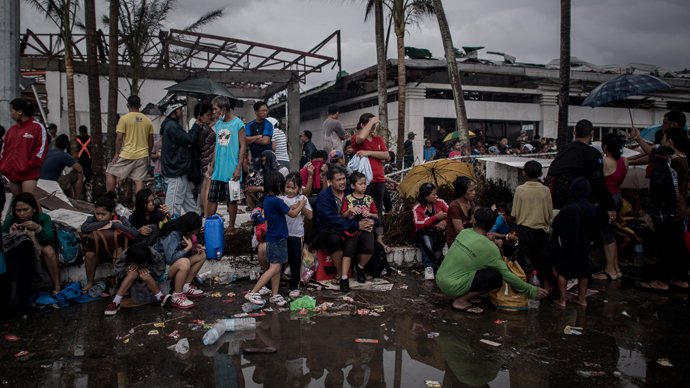
Haiyan (Yolanda), the strongest tropical typhoon ever recorded has occurred in the Philippines with devastating consequences for an entire nation, resulting in more than 10,000 deaths. An estimated 615,000 people have been displaced. Up to 4.3 million people have been affected, according to government sources.
The tragedy in the Philippines has become a talking point at the Warsaw international venue on Climate Change under UN auspices. The plight of  typhoon Haiyan has casually been assigned without evidence to the impacts of global warming. 

While there is no scientific evidence that Super typhoon Haiyan (Yolanda) was the consequence of global warming,  the opening statements at the Warsaw Summit have hinted in no uncertain terms to a verified causal relationship. U.N. Framework Convention on Climate Change Executive director Christiana Figueres, stated (without evidence) that the typhoon was part of the “sobering reality” of global warming. (quoted in Did Climate Change Cause Supertyphoon Haiyan? | TIME.com, November 11, 2013).
In turn, Philippines Representative to the UN Climate Change Venue Mr. Yeb Sano in  his address to the opening session stated:
“Typhoons such as Yolanda (Haiyan) and its impacts represent a sobering reminder to the international community that we cannot afford to procrastinate on climate action. Warsaw must deliver on enhancing ambition and should muster the political will to address climate change.” (UN News Center, November 11, 2013)
In a bitter irony, the tragedy in the Philippines has contributed to reinforcing a consensus which indirectly feeds the pockets of corporations lobbying for a new deal on carbon trade. Cap and Trade is a multibillion dollar bonanza which is supported by the global warming consensus.  According to UNFCC head Figueres:
“We must clarify finance that enables the entire world to move towards low-carbon development,… We must launch the construction of a mechanism that helps vulnerable populations to respond to the unanticipated effects of climate change.”
Known and  documented, cap-and-trade markets are manipulated. What is at stake is the trade in carbon derivatives which is controlled by powerful financial institutions including JP Morgan Chase. (See Copenhagen’s Hidden Agenda: The Multibillion Trade in Carbon Derivatives, Global Research, December 8, 2009). In 2008, Simon Linnett, Executive Vice-Chairman of Rothschild’s acknowledged the nature of this multibillion dollar business:
As a banker, I also welcome the fact that the ‘cap-and-trade’ system is becoming the dominant methodology for CO2 control. Unlike taxation, or plain regulation, cap-and-trade offers the greatest scope for private sector involvement and innovation.” (Telegraph, January 31, 2008)
Cap and trade packaged into derivative products feeds on the global warming consensus. Without it, this multibillion dollar trade would fall flat.
The humanitarian crisis in the Philippines bears no relationship to global warming. The social impacts of typhoon Haiyan are aggravated due to the lack of infrastructure and social services, not to mention the absence of a coherent housing policy. Those most affected by the typhoon are living in poverty in make-shift homes.
A reduction of CO2 emissions as suggested Mr. Yeb Sano in  his address to the opening session of the Warsaw Climate summit will not resolve the plight of an impoverished population.
In the Philippines, the social impacts of natural disasters are invariably exacerbated by a macro-economic policy framework imposed by Manila’s external creditors.
What is at stake is the deadly thrust of neoliberal economic reforms. For more than 25 years, since the demise of the Marcos dictatorship, the IMF’s “economic medicine” under the helm of the Washington Consensus has prevailed, largely serving the interests of financial institutions and corporations in mining and agribusiness.
The government of Benigno Aquino has embarked upon a renewed wave of austerity measures which involves sweeping privatization and the curtailment of social programs. In turn, a large chunk of the State budget has been redirected to the Military which is collaborating with the Pentagon under Obama’s “Asia Pivot”. This program –which serves the interests of Washington at the expense of the Philippines population–  also includes  a 1.7 billion dollars purchase of  advanced weapons systems.